|
 |
 |
 |
 |
 |
 |
 |
 |
 |

| . |  |
. |
Revamped Alliance Not To Change Japan's Pacifism: Senior MPs
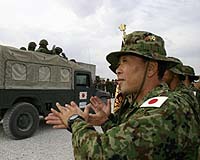
A revamped US-Japan alliance would not violate the nation's pacifist constitution, senior lawmakers from Japan's ruling party said Sunday "It will never happen that Japan's Self Defense Force would be involved in the US military strategy," said Hidenao Nakagawa, a parliament member and policy chief of the ruling Liberal Democratic Party (LDP). "We are determined to keep to our constitution's pacifism" when the alliance between Japan and the United States is strengthened, Nakagawa said in a televized interview. "But it is necessary to respond to new kinds of threats such as terrorism," Nakagawa added. Involvement of Japanese troops in US military deployments abroad which have little to do with Japan's national defense, "should never be permitted under the constitution," said Yoshihisa Inoue, policy chief of the LDP's junior coalition partner, New Komeito. The comments came eight days after the two governments adopted an interim report designed to cut US forces in the Japanese island of Okinawa, deploy a powerful missile defense radar in Japan and bind their militaries more closely together. Prime Minister Junichiro Koizumi also proposed to give Japan's military a firm legal basis by revising the pacifist post-war constitution. Japanese opposition parties and local officials have criticized the new military agreement as lifting limits on the country's military support for the United States. The agreement, which "authorizes Japan's support and commitment for military action by the United States, is extremely dangerous," Seiji Mataichi, secretary-general of the Social Democratic Party of Japan, has said. Under a 1960 Japan-US Security Treaty, Japan's support for the US military is limited to activities contributing to peace and stability in the "Far East." Japan's 1947 constitution, written after the country's World War II defeat, says "the Japanese people forever renounce war as a sovereign right of the nation and the threat or use of force as a means of settling international disputes." As a result, Japanese troops have been limited to a non-combat, logistical role in international peacekeeping operations. But Koizumi broke with tradition by deploying about 600 troops on a reconstruction and humanitarian mission in southern Iraq since late 2003. To avoid violating the pacifist constitution, the government says the troops operate in a "non-combat zone" within Iraq. Under the new accord with the US, Washington will move 7,000 marines from Okinawa to Guam and relocate US bases in Japan. Tokyo is to expand the roles and missions of its military both in home defense and in international missions with the United States. The accord comes amid tensions with North Korea over its nuclear weapons programs and growing concern over China's military buildup, which the Pentagon has said threatens the regional military balance. All rights reserved. � 2005 Agence France-Presse. Sections of the information displayed on this page (dispatches, photographs, logos) are protected by intellectual property rights owned by Agence France-Presse. As a consequence, you may not copy, reproduce, modify, transmit, publish, display or in any way commercially exploit any of the content of this section without the prior written consent of Agence France-Presse. Related Links SpaceWar Search SpaceWar Subscribe To SpaceWar Express  Walker's World: Japan's Strategic Fears
 Washington (UPI) Oct 26, 2005
There is a tangible mood of pessimism in Japan about next month's scheduled visit to Tokyo by Russian President Vladimir Putin, his first for five years. Japanese hopes are fading over a compromise on Russia's hold on the Kuril Islands and of a direct pipeline to Siberian oil. |
|
|
| The content herein, unless otherwise known to be public domain, are Copyright 1995-2016 - Space Media Network. All websites are published in Australia and are solely subject to Australian law and governed by Fair Use principals for news reporting and research purposes. AFP, UPI and IANS news wire stories are copyright Agence France-Presse, United Press International and Indo-Asia News Service. ESA news reports are copyright European Space Agency. All NASA sourced material is public domain. Additional copyrights may apply in whole or part to other bona fide parties. Advertising does not imply endorsement, agreement or approval of any opinions, statements or information provided by Space Media Network on any Web page published or hosted by Space Media Network. Privacy Statement All images and articles appearing on Space Media Network have been edited or digitally altered in some way. Any requests to remove copyright material will be acted upon in a timely and appropriate manner. Any attempt to extort money from Space Media Network will be ignored and reported to Australian Law Enforcement Agencies as a potential case of financial fraud involving the use of a telephonic carriage device or postal service. |