
 |
 |
 |
 |
 |
 |
 |
 |
 |
 |

| . |  |
. |

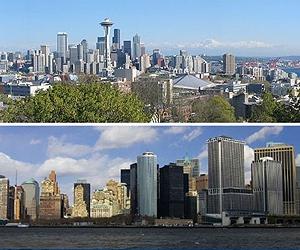
Washington DC (SPX) Nov 18, 2010 You would never confuse Seattle, Washington, with New York City. One is home to about 600,000 people, the other has a population of 8.2 million. One ardently protects the wild salmon thrashing through its rivers, the other likes its salmon smoked and served with cream cheese on a bagel. But these cities share an important feature: They're both leaders in addressing the issue of climate change, and both rely on space-based data to help them make their plans. Even before they formally turned their attention to the climate problem, both cities were ahead of the game when it came to mitigation - that is, minimizing emissions of greenhouse gases in an attempt to slow down the advance of global warming. Seattle draws more than 90 percent of its electricity from hydroelectric sources, which emit no greenhouse gases. New York has a very low carbon footprint thanks to its high-density living and famous public-transit system. In fact, on a per capita basis, New York's greenhouse-gas emission is roughly half that of green-energy Seattle. But both cities perceived room for improvement. Seattle set a goal to slice 7 percent off its 1990 level of emissions by 2012, 30 percent by 2024, and a whopping 80 percent by 2050. New York targeted a 30 percent reduction from 2005 levels by 2030 for the whole city and by 2017 for the municipal government. Both cities report being on target to meet their goals.
Getting started "Eighty-five percent of the buildings that exist today will be here in 2030," said Adam Freed, Deputy Director of the Mayor's Office of Long-Term Planning and Sustainability, "so we enacted landmark legislation last year that requires ongoing energy efficiency upgrades and improvements in existing buildings - all buildings that are over 50,000 square feet in the city. We think it's the most comprehensive, far-reaching green-building legislation in the country." Cars and other modes of transportation are the largest source of Seattle's greenhouse gas emissions and the second-largest source in New York. So both cities are aiming for cleaner and fewer cars, and more walking and bicycling. But while mitigation may buy time and prevent the worst climate-change scenarios, most scientists who have studied the subject agree that the climate is already changing and further change is inevitably on its way. New York included plans for adapting to those changes as part of the comprehensive effort it announced on Earth Day, 2007. Seattle at large began looking at adaptation only within the last year or so, but its water utility, Seattle Public Utilities, is an old hand at it. The agency has been working with the University of Washington's Climate Impact Group since 2002 to get a handle on what's in store for the region and how best to live with it.
Been there, done that "Summer droughts, winter floods. Even in the case of sea-level rise," she said, "we (already) experience extreme high tides. It means we have developed strategies to adapt to those things." Sea-level rise is perhaps the biggest wild card in the climate-change deck. Satellite data show that global sea level has risen nearly seven inches in the last century, and both coastal cities are concerned about the ocean next door. The New York City Panel on Climate Change projects a rise along the New York City coastline of anywhere between 12 and 55 inches by 2080, with the global-warming effect exacerbated by the sinking of the tectonic plate on which the city sits. Sometimes you just can't catch a break. Seattle needs to rebuild the gribble-plagued seawall that holds its waterfront soil in place, an expensive undertaking. (Gribbles are small seagoing, wood-boring crustaceans, not the furry creatures that infested the Starship Enterprise. Those were tribbles.) With the rise of the sea, the city will have to decide whether to rebuild the wall higher, and if so, by how much. "Right now the range (of projected sea-level rise) is between six and 50 inches," Simmons said at the presentation. "Settling on a point in that range is very hard."
Champagne results on a beer budget "It's making tweaks and doing common-sense, in many cases low-technology retrofits." For example, when the time comes to repave a road, it can be crowned differently or raised a couple of inches to get it out of the flood zone, he said. "I was surprised at how much folks were already doing," Freed added, "not under a climate change or adaptation umbrella, but to increase their own efficiency. The telecommunication industry has been switching from copper wires to fiber optics, not because it's less susceptible to water or static and other challenges from heat, but because it has a bigger bandwidth. But in doing so, they've actually made their system more resilient." Simmons said she has observed the same principle at work in many Seattle programs. In some cases, operational changes are taking the place of expensive new construction. Seattle Public Utilities found enough flexibility in its system to allow it to sidestep the need to build expensive new water-storage facilities to make up for the expected loss of snowpack. "We said let's look at what would happen if we were to refill one of our reservoirs to a higher level. And then, on another one of our reservoirs, we did the opposite (allowing the water to drop below traditional levels)," said Paul Fleming, manager of the utility's Climate and Sustainability Group. "We are essentially creating new storage, but we're not doing it by building something new, but rather by changing our assumptions. "That's an area where the Climate Impacts Group has helped us," Fleming added. "They provided us with the kind of data that we can use to assess the effectiveness of those strategies."
Down-to-Earth space science New York also saw the importance of grounding its actions in the best available science. Mayor Bloomberg convened the New York City Panel on Climate Change, co-chaired by NASA's Cynthia Rosenzweig and City University of New York's William Solecki, to determine how New York's climate is likely to change through the century. The panel's findings formed the basis for strategies to increase the city's resilience. "We could not have done that work without the (panel's) projections," Freed said. "They're very, very helpful to get buy-in and to ensure that we're all planning for the same scenarios." "Cities are on the front lines for both mitigating and adapting to climate change," Rosenzweig said. "I think this is an exciting demonstration of NASA science being applied in an actual urban area."
Share This Article With Planet Earth
Related Links Office of Sustainability and Environment - Seattle Earth Observation News - Suppiliers, Technology and Application

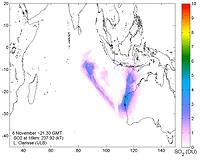 Satellites Tracking Mt Merapi Volcanic Ash Clouds
Paris, France (ESA) Nov 16, 2010 Since its latest series of deadly eruptions, Java's Mt Merapi has been spewing volcanic ash clouds into the air. Satellite data are crucial for assessing the eruption's danger to air traffic and public safety. Mt Merapi began erupting on 26 October and has killed more than 200 people. Numerous international flights in and out of the Indonesia area have been cancelled due to ash clouds. ... read more |
|
|
| The content herein, unless otherwise known to be public domain, are Copyright 1995-2010 - SpaceDaily. AFP and UPI Wire Stories are copyright Agence France-Presse and United Press International. ESA Portal Reports are copyright European Space Agency. All NASA sourced material is public domain. Additional copyrights may apply in whole or part to other bona fide parties. Advertising does not imply endorsement,agreement or approval of any opinions, statements or information provided by SpaceDaily on any Web page published or hosted by SpaceDaily. Privacy Statement |

 del.icio.us
 Digg
Digg Reddit
 YahooMyWeb
 Google
 Facebook







