|
 |
 |
 |
 |
 |
 |
 |
 |
 |

| . |  |
. |
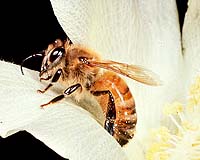
Honeybees Defy Dino-Killing Nuclear Winter
New Orleans LA (SPX) Nov 08, 2004 The humble tropical honeybee may challenge the idea that a post-asteroid impact "nuclear winter" was a big player in the decimation of dinosaurs 65 million years ago. Somehow the tropical honeybee, Cretotrigona prisca, survived the end-Cretaceous extinction event, despite what many researchers believe was a years-long period of darkness and frigid temperatures caused by sunlight-blocking dust and smoke from the asteroid impact at Chicxulub. The survival of C. prisca is problematic and telling, asserts paleontology graduate student Jacqueline M. Kozisek of the University of New Orleans. Late Cretaceous tropical honeybees preserved in amber are almost identical to their modern relatives, she says. If no modern tropical honeybee could have survived years in the dark and cold without the flowering plants they lived off of, Kozisek reasoned, something must be amiss with the nuclear winter theory. "It couldn't have been that huge," says Kozisek of the Chicxulub-related temperature drops asserted by other researchers. Kozisek will present her work on Monday, 8 Nov., at the Geological Society of America annual meeting in Denver. Modern tropical honeybees have an optimal temperature range of 88 to 93 degrees F (31-34�C) in order to maintain vital metabolic activities, according to entomological research, says Kozisek. That's also the range that's best for their food source: nectar-rich flowering plants. Based on what is known about the Cretaceous climate and modern tropical honeybees, Kozisek estimates that any post-impact winter event could not have dropped temperatures more than 4 to 13 degrees F (2-7�C) without wiping out the bees. Current nuclear winter theories from the Chicxulub impact estimate drops of 13 to 22 degrees F (7-12�C) � too cold for tropical honeybees. "I'm not trying to say an asteroid impact didn't happen," says Kozisek. "I'm just trying to narrow down the effects." To do this, Kozisek took a novel approach for a paleontologist � instead of looking at what died out, she dug through the literature to find out what survived the massive extinction event. "I made a list of all survivors and picked those with strict survival requirements," said Kozisek. She determined that those survival requirements were by calling on studies of the closest modern analogues - which wasn't always easy for some species, she pointed out. There was, for instance, a very early primate that crawled out of the Cretaceous alive, but there is really no comparable small primate around today with which to reliably compare, she said. On the other hand, a good number of tropical honeybees haven't changed a lot in 65 million years and a great deal is known about modern tropical honey bees' tolerances to heat and cold. What's more, amber-preserved specimens of the oldest tropical honey bee, Cretotrigona prisca, are almost indistinguishable from � and are probably the ancestors of � some modern tropical honeybees like Dactylurina, according to other studies cited by Kozisek. Survival and Its Implications: Tropical Honeybees (Hymenoptera: Apidae: Meliponini) and the Cretaceous-Tertiary Boundary Monday, 8 November, 10:30-10:45 a.m., CCC 605 Abstract may be viewed at: http://gsa.confex.com/gsa/2004AM/finalprogram/abstract_80171.htm . Related Links Geological Society of America University of New Orleans SpaceDaily Search SpaceDaily Subscribe To SpaceDaily Express  Counting On Toes
 Moffett Field CA (SPX) Nov 08, 2004
Our four-legged, five-toed ancestors conquered the land earlier and more independently than expected, say paleontologists studying newfound 345 to 359-million-year-old tracks at an eroding beach in eastern Canada. |
|
|

| The content herein, unless otherwise known to be public domain, are Copyright 1995-2006 - SpaceDaily.AFP and UPI Wire Stories are copyright Agence France-Presse and United Press International. ESA PortalReports are copyright European Space Agency. All NASA sourced material is public domain. Additionalcopyrights may apply in whole or part to other bona fide parties. Advertising does not imply endorsement,agreement or approval of any opinions, statements or information provided by SpaceDaily on any Web page published or hosted by SpaceDaily. Privacy Statement |