|
 |
 |
 |
 |
 |
 |
 |

| . |  |
. |

|
|
. |

 by Staff Writers Beirut, Lebanon (UPI) Jun 20, 2011
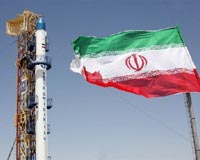
The real importance of Iran's recent launch of its Rasad-1 satellite, the second it's put into orbit in two years, is the Safir booster rocket used to loft the 34-pound, data-gathering craft into space. That technology produces intercontinental ballistic missiles. Iran's state television reported that the June 16 launch thrust Rasad, which means "Observation" in Farsi, went into orbit 163 miles above the Earth. The satellite had been scheduled for launch in August 2010 and there was no explanation for the delay at a time when U.N. experts are reported to have concluded Iran has accelerated its efforts to develop long-range missiles. These include the Shehab-3b and Sejjil-2 intermediate-range ballistic missiles capable to hitting the Persian Gulf Arab states and Israel, by passing tough sanctions imposed by the U.N. Security Council in June 2010 over Iran's contentious nuclear program. Tehran is reported to have increased the military budget by more than 40 percent, from $7 billion to $10 billion a year, apparently to fund the construction of more ballistic missiles. This was possible because of rising oil prices. Rasad-1 was built at the Malek Ashtar University, founded and run by the Islamic Revolutionary Guards Corps, the elite military organization that's in charge of Iran's ballistic missile program and the strategic missile command. This underlines the military aspect of the Rasad launch and indeed Iran's entire space program, which is seen by the West and by Israel as an integral part of the drive to develop a long-range ballistic missile capability. According to Western specialists, the multistage Safir-2 used in the Rasad launch is much smaller than a weapon capable of carrying conventional or nuclear warheads. But the 72-foot, 26-ton Safir is a version of the Shehab-3 intermediate-range missile that currently forms the backbone of Iran's operational missile force. The Rasad launch presumably took place at the Semnan launch site in the Great Salt Desert south of Tehran. It was there on Feb. 3, 2009, Iran sent aloft its first indigenously launched satellite, a research and communications craft called Omid-1 atop a Safir rocket. The Islamic Republic thus joined the fewer than a dozen other countries capable of launching satellites into space. "Tehran now has established its status as having the most advanced space, missile and nuclear programs in the Muslim Middle East, confirming its technical superiority over its Arab rivals," Jane's Intelligence Digest reported at the time. The successful launch "confirms that the Iranians have overcome the technological obstacles to launching a multistage missile, a process than can increase flight range considerably," Jane's said. In 2010, Iran announced plans to start sending research animals into space in 2011, initially using modified Shehab ballistic missiles as the booster rockets. On Feb. 3 that year, Tehran announced it sent a rocket carrying a mouse, two turtles and a dozen worms into space aboard a 10-foot Kavoshgar-3 research rocket. At that time, Iranian President Mahmoud Ahmadinejad, who has made the space program one of his government's priorities, unveiled a capsule for a monkey, along with four prototype Iranian-built satellites Tehran plan to launch before March 2012. Hamid Fazeli, director of Iran's Space Organization, which oversaw the Rasad launch, said a 625-pound capsule carrying a monkey would be launched aboard a Kavoshgar-5 rocket between July 23 and Aug. 23 this year to an altitude of 74 miles. Communications Minister Reza Taqipour says these launches will be followed by orbital missions as a prelude to an Islamic manned space program, by around 2021. Many of the technological building blocks involved in the booster rockets like the Safir-2 are the same as those needed to develop long-range ballistic missiles. This was the pattern of early U.S. and Russian development in the 1950s and 1960s of the Atlas, Titan and R-7 ballistic missiles. One U.S. analysis of the recent advances in Iran's missile technology said a successful Safir-2 mission "could raise concerns in the U.S. Congress among Republicans who claim U.S. President Barack Obama acted wrongly by reducing Missile Defense Agency facilities in Poland and the Czech Republic against Iranian Safir-type missiles that could eventually have the capability to strike the United States directly." In 2010, Iran unveiled plans for a four-engine, liquid-fuel Simorgh rocket to carry a 220-pound satellite into orbit at an altitude of 310 miles.
|
. |
|
| The content herein, unless otherwise known to be public domain, are Copyright 1995-2011 - Space Media Network. AFP and UPI Wire Stories are copyright Agence France-Presse and United Press International. ESA Portal Reports are copyright European Space Agency. All NASA sourced material is public domain. Additional copyrights may apply in whole or part to other bona fide parties. Advertising does not imply endorsement,agreement or approval of any opinions, statements or information provided by Space Media Network on any Web page published or hosted by Space Media Network. Privacy Statement |

 del.icio.us
 Digg
Digg Reddit
 Google