
require_once("mobile_device_detect.php"); mobile_device_detect(true,false,true,true,true,true,true,"../m/reports/Kim_Jong-Un_says_N_Korea_has_miniaturised_nuclear_warheads_999.html",false); ?> include"/home2/www/vhosts/spacewar.com/swxphp/swxphp-start.php" ?>
Kim Jong-Un says N. Korea has miniaturised nuclear warheads![]() S. Korea imposes fresh sanctions on North Seoul (AFP) March 8, 2016 - South Korea on Tuesday unveiled a series of fresh unilateral sanctions against North Korea, which include asking citizens to boycott North Korean restaurants abroad. The new measures imposed over the North's recent nuclear test and long-range rocket launch also blacklist scores of North Korean individuals and entities and bans any vessels previously docked in North Korean ports from South Korean waters. They follow tough sanctions adopted by the UN Security Council last week and -- though largely symbolic given the lack of North-South economic ties -- are likely to prompt an angry response from Pyongyang. Seoul took the unprecedented step last month of closing operations at the jointly-run Kaesong industrial complex and Tuesday's measures were aimed at "further toughening" sanctions against the North, the government said. Designed to block foreign cash flows to the regime in Pyongyang, the government announcement included a request for South Koreans to stay away from North Korean businesses abroad. "Since North Korean facilities such as overseas restaurants are one of North Korea's channels for foreign currency, we ask the public to refrain from using these facilities," said Lee Suk-Joon, head of the Office for Government Policy Coordination. The South Korean government estimates that Pyongyang rakes in around $10 million every year from some 130 restaurants in 12 countries. "A decrease in the use of North Korean restaurants will have an effect of blocking its foreign cash flow for the most part," the government said in a separate statement. Lee said the government suspected most of the foreign currency was "ultimately being used for weapons of mass destruction" through various channels. Seoul also blacklisted 40 individuals and 30 groups involved with North Korea's nuclear and missile programmes -- including two individuals and six groups from a third country -- banning them from doing any business with South Koreans. The move to ban foreign vessels that have previously docked in the North would appear to spell the end of an ambitious trilateral infrastructure project aimed at transporting Russian coal to South Korean ports through the North's port city of Rajin and Russia's border town of Khasan. The so-called Rajin-Khasan project was viewed as an integral part of South Korean President Park Geun-Hye's vision of uniting the railways of South and North Korea to connect them to Europe. "It is difficult to continue our cooperation under the current circumstances," said Kim Hong-Kyun, Special Representative for Korean Peninsula Peace and Security Affairs. The project could resume if there was "progress in North Korea's denuclearisation," Kim said, adding that South Korea had warned Russia of its intentions in advance. The new measures add to a number of existing sanctions South Korea imposed in 2010 after blaming North Korea for the sinking of one of its naval corvettes.
|
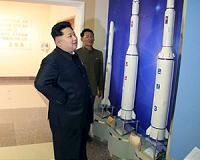
North Korean leader Kim Jong-Un says his scientists have successfully miniaturised thermo-nuclear warheads to place on a ballistic missile and create a "true" deterrent, state media said Wednesday.
While Pyongyang has talked of success in mastering miniaturisation before, this is the first time Kim has so explicitly claimed a breakthrough that experts see as a game-changing step for the North's nuclear capabilities.
Kim also stressed that the warheads were "thermo-nuclear" devices, echoing the North's claim that the fourth nuclear test it conducted in January was of a more powerful hydrogen bomb.
"The nuclear warheads have been standardised to be fit for ballistic missiles by miniaturising them," Kim noted during a meeting with nuclear technicians, the North's official KCNA news agency said.
"This can be called a true nuclear deterrent," Kim was quoted as saying.
His comments came a day after the North's powerful National Defence Commission threatened pre-emptive nuclear attacks on South Korea and the US mainland, as Seoul and Washington kicked off large-scale joint military exercises.
Kim echoed the threat, warning that North Korea would "never hesitate to make a pre-emptive nuclear strike" in the event of any effort by the US and its allies to undermine its national sovereignty as a nuclear state.
Military tensions have surged on the divided Korean peninsula since the North's nuclear test in January and a long-range rocket launch last month.
The UN Security Council responded by imposing tough new sanctions last week, which Pyongyang has condemned and labelled as part of a US-led conspiracy to bring down Kim's regime by force.
- 'More powerful' deterrent -
"The stronger our nuclear strike capability gets, the more powerful our deterrent to aggression and nuclear war grows," Kim said.
Experts have been divided on just how far North Korea may have gone in its ability to miniaturise nuclear warheads, although several top US and South Korean military officials have briefed on its likely success.
The issue is key as, while North Korea is known to have a small stockpile of nuclear weapons, its ability to deliver them accurately to a chosen target has been in doubt.
Kim's confirmation still leaves a question mark over the North's ballistic missile capabilities, with many experts believing it is years from developing a working inter-continental ballistic missile (ICBM) that could strike the continental United States.
It is also unclear whether any miniaturised device the North has designed would be robust enough to survive the shock, vibration and temperature change associated with ballistic flight.
North Korea's claim to have successfully tested an H-bomb in January was greeted with scepticism at the time as the estimated yield was seen as far too low for a full-fledged thermo-nuclear device.
However, numerous weapons experts have suggested it may have been a "boosted" fission device, which makes more efficient use of nuclear material and can be made smaller without sacrificing yield.

| . |
|
|
Tweet |