|
 |
 |
 |
 |
 |
 |
 |
 |
 |

| . |  |
. |
Marine Corps Lavs And Tanks To Get Advanced Night Vision Tech
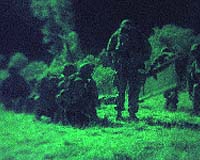
McKinney TX (SPX) Feb 10, 2006 Raytheon will improve the Marine Corps' ability to fight 24/7 in all weather conditions by equipping nearly 900 vehicles with detection and targeting systems based on advanced infrared technology. The company recently received $96 million to produce, install and support 416 Improved Thermal Sight Systems (ITSS) for the Corps' Light Armored Vehicles (LAV 25s) and $25 million in Firepower Enhancement Program (FEP) funds to outfit another 150 of their 403 M1A1 tanks with equivalent night vision systems. ITSS and FEP are new, compact sighting systems that boost warfighters' ability to see the battlefield in the day, at night and in adverse conditions such as sand storms, rain, smoke and dust. LAV and tank gunners use the systems to target and shoot enemy platforms at safe distances. Both systems also support long-range reconnaissance missions, including precise location of distant targets. Each ITSS contains a high-performance 2nd generation forward looking infrared imaging system, a laser rangefinder, an embedded fire control computer and a "far target" location system. These elements form an integrated mission solution that Marines use to execute fire control missions. "ITSS and FEP are powerful mission solutions," said Glynn Raymer, vice president of Raytheon Combat Systems. "Using ITSS and FEP, Marines and other troops will have no doubt about their ability to see the battlefield, 24/7." Raytheon anticipates that ITSS and FEP contract options, in tandem with sales of ITSS to allied forces, could result in additional new orders valued at $200 million during the next few years. Related Links Raytheon Company  Quick Kill System Could Protect Against Rocket Propelled Grenades
 McKinney TX (SPX) Feb 08, 2006
Raytheon Company's new Quick Kill System is the first active protection system (APS) to destroy a rocket propelled grenade (RPG) at close range, using a precision launched warhead with a focused blast. The successful test occurred at a New Mexico Institute of Mining and Technology test center Feb. 7, 2006. |
|
|

| The content herein, unless otherwise known to be public domain, are Copyright 1995-2006 - SpaceDaily.AFP and UPI Wire Stories are copyright Agence France-Presse and United Press International. ESA PortalReports are copyright European Space Agency. All NASA sourced material is public domain. Additionalcopyrights may apply in whole or part to other bona fide parties. Advertising does not imply endorsement,agreement or approval of any opinions, statements or information provided by SpaceDaily on any Web page published or hosted by SpaceDaily. Privacy Statement |