|
 |
 |
 |
 |
 |
 |
 |
 |
 |

| . |  |
. |
ROBE Upgrade Sets KC-135 On Forefront Of Battle Communications
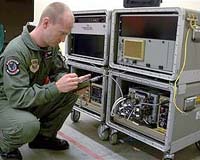
Fairchild Air Force Base WA (SPX) Jan 21, 2006 A KC-135 Stratotanker here was fitted with upgraded communications equipment recently which will revolutionize battle space and the way the United States and its allies fight wars. After 18 months on the drawing board, the Roll-On Beyond Line-of-Sight Enhancement Spiral 2 program, ROBE, has been fitted to the first KC-135 and will undergo testing at Eglin Air Force Base, Fla. This system will allow allied forces in the battle zones near-real-time communications with any headquarters across the globe. This will give commanders a better picture of the battlespace and could potentially lead to more timely decisions and more effective operations. The system was originally envisioned by Gen. John P. Jumper, former chief of staff of the Air Force, who felt that tankers orbiting and refueling over hot zones could be used for other purposes, said Catherine Meyn, ROBE program manager. The research resulted in ROBE. "The equipment will allow information to reach forward to units on the front lines while they will also be able to reach information back to the decision makers at headquarters,� Ms. Meyn said. Although ROBE has been fitted on KC-135s since October 2002, Spiral 2, the most recent generation of ROBE, incorporates the latest technologies allied military services will use to streamline battle space communications. The Spiral 2 upgrade includes enhancements in data forwarding and satellite communications technology, among other things. "The basis of this new system is that satellite communication technologies are cheaper and more available than ever and the use of satellites has increased,� said Tech. Sgt. Greg Meuser, of the 92nd Aircraft Maintenance Squadron. "We're starting to see the limits of the amount of data transfer satellites are able to handle all at one time.� To combat this and keep communications flowing in near real-time, ROBE Spiral 2 is able to take information from many different sources, combine them into one stream and upload to the satellites eliminating line-of-sight limitations. "Line-of-sight communications are good up to 300 nautical miles, depending on terrain,� said Tech. Sgt. Alecia Judd, NCO in charge of tactics with the 92nd Operations Support Squadron. "Because of that, every 300 nautical miles, we've had to have either an AWACS or ground station to forward the data onto the next one, until it reached its final destination.� ROBE Spiral 2 will take the military out of that era and plant them in a new one where a KC-135 can forward all of that information onto satellites and minimize the need for the other units. "Since tankers are usually in an orbit pattern over hot zones, they are a perfect aircraft to carry the equipment,� Sergeant Judd said. Units on the ground can use the orbiting tankers to pass on important information to aircraft in the air. "The system is like our nation's highways. Before ROBE, communications ran on many different state highways -- what we've come up with is an interstate for communications,� Sergeant Meuser said. ROBE provides a similar "roadmap� function by providing the best route information can travel on. It does this by being connected into a network of nodes; a node could be an aircraft, satellite or a headquarters. Each node knows where it is in the network, and can send information and data to the next one more quickly than if the information had to be forwarded from one relay station to the next. All of this happens while minimally affecting the aircrew. ROBE is a box of equipment Airmen hand-carry onto the aircraft. Once loaded, the kit can be hooked up to equipment preinstalled on the aircraft. This allows the Air Force to enhance aircraft with the technology, but only install the critical components when needed. Sergeant Meuser said that once the boom operator loads the software, the system is pretty much self sufficient. Even if it needs restarting operators on the ground can control it. "The whole purpose of the system is to interfere as little as possible with the aircrew so that the mission can continue. At the same time you want to focus the capabilities of ROBE to enhance communications as much as possible in-theatre,� Ms. Meyn said. With previous versions of ROBE, because of the limitations of the satellite antenna, whenever the aircraft would bank through a turn it would lose connection to the satellite, Sergeant Judd said. With Spiral 2, they are installing more antennas which should drastically improve the aircraft's ability to stay connected. According to the Northrop Grumman Web site, 40 Air Force KC-135 aircraft have been enhanced to carry the ROBE equipment, and there are 20 ROBE kits available for use. The Fairchild tanker is the first and only aircraft at this point to have ROBE Spiral 2 installed. Related Links Northrop Grumman  Outside View: A Bad New Map
 Washington (UPI) Jan 20, 2006
Among the critics and reinterpreters of Fourth Generation war, the bad is most powerfully represented by Thomas Barnett's two books "The Pentagon's New Map" and "Blueprint for Action." What Barnett advocates is bad in two senses: first, that it won't work, and second, that if it did work the result would be evil. |
|
|

| The content herein, unless otherwise known to be public domain, are Copyright 1995-2006 - SpaceDaily.AFP and UPI Wire Stories are copyright Agence France-Presse and United Press International. ESA PortalReports are copyright European Space Agency. All NASA sourced material is public domain. Additionalcopyrights may apply in whole or part to other bona fide parties. Advertising does not imply endorsement,agreement or approval of any opinions, statements or information provided by SpaceDaily on any Web page published or hosted by SpaceDaily. Privacy Statement |