The early warning system of Russia's Space Troops is to get a new addition this year. A radar station, Voronezh-M, is being completed and tested under real conditions in the Leningrad Region. Stations of this type feature improved characteristics while taking less time and resources to deploy, maintain and run. The new radar will close the gap in radar coverage created seven years ago by the phasing out of the Russian station near Skrunda in Latvia.
By the end of the year we plan to put the station on trial combat duty, and in 2007 on full combat duty. A network of such stations will be deployed both at existing sites and in new areas threatened by missiles. The first step will be to replace old stations outside Russia – one in Azerbaijan, two stations in Ukraine, and stations in Kazakhstan and Belarus. Strategic priority will be given to the southern border. Such a network will spell the end of the problems related to perimeter coverage created by the break-up of the Soviet Union's Space Troops.
This year, the first of the ten-year federal space program, Russia has increased its space budget by as much as one-third compared with 2005. Funds are also allocated through two other channels — the state armaments program for 2007-2015 (defense and security) and the special federal programs "Global Navigation System" and "Development of Russian Space Centers in 2006-2015". Despite this, Russia, the one-time leader in space exploration (next year will mark the 50th anniversary of the first artificial satellite launched by the Soviet Union), ranks sixth in space spending, lagging not only behind the United States, but also China and India.
In the second half of the 1990s, Russia's military space potential dropped to its lowest level ever in most respects, and some systems were near the point of no return. In 2001, the orbiting GLONASS (Global Navigation Satellite System) time-coordinate positioning constellation, for example, was down to eight satellites from 24 in 1995. Overall, it has been trimmed down from 186 to the present 94-97.
In the five years of their existence, the Space Troops' main achievements have been averting a potential crisis in military space and space missile defenses, stopping the quantitative and qualitative degradation of the orbital constellation and its ground infrastructure, and creating the preconditions for its revival so that it can fulfill its tasks effectively.
Beginning next year, the Space Troops will start launching mainly new types of military spacecraft under test and deployment programs drawn up for orbital constellations. By 2009-2010, this switch will be effected in all key areas of the military space program. The number of space missile systems used will be reduced. At the same time highly toxic components of rocket fuel will be phased out to be replaced by environmentally clean booster vehicles.
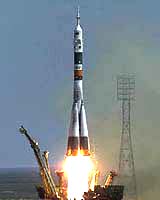
The medium-class Soyuz-2 rocket, being developed as a complete upgrade of the currently used environmentally safe rockets of the Soyuz series, is sure to become the most sought-after booster to launch military-purpose spacecraft for the next decade. One of the launching priorities is to set up an Angara system at the Plesetsk space center, built around a unified series of environmentally clean rockets, including those of the heavy class. The first test launchings of the Angara are scheduled for 2010-2011.
Further efforts to develop GLONASS will continue, as decreed by the president and specified in a government decision. This year, the plan is to launch three GLONASS-M spacecraft with a guaranteed 7-year orbital life, and six more in 2007. Starting in 2008, a new generation of GLONASS-K spacecraft with an orbital life of 10 to 12 years will be made available. These plans, if realized, will bring the orbital GLONASS constellation to its full strength of 24 spacecraft, with four of them having an orbital life of 10 to 12 years.
(First of two parts)