|
 |
 |
 |
 |
 |
 |
 |
 |
 |

| . |  |
. |
EU 3 Want Iran Hauled Before UNSC
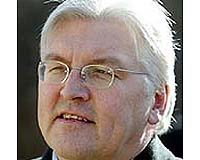
UPI Germany Correspondent Kehl Am Rhein, Germany (UPI) Jan 12, 2006 The European Union-3 said Thursday talks with Iran had reached a dead end, and added it wanted to refer the row over the country's controversial nuclear program to the U.N. Security Council for possible sanctions. "We believe the time has now come for the Security Council to get involved," German Foreign Minister Frank-Walter Steinmeier said after meeting his British and French counterparts, Jack Straw and Philippe Douste-Blazy and EU foreign policy chief Javier Solana in Berlin. Steinmeier said Iran had repeatedly breached regulations set forth by the Vienna-based International Atomic Energy Agency. "We will therefore call for an extraordinary IAEA board meeting for it to take the necessary action to that end." The board meeting of the IAEA is set to make a final decision on the UNSC referral, the ministers said. All four politicians explained their frustration over Iran's recent decision to break the IAEA seals at Natanz, a modern site in Northern Iran where uranium enrichment takes place. Steinmeier called the measure a "unilateral rejection" of 21/2 years of negotiations with the EU. Straw added the EU-3 had done everything in its power to keep the diplomatic approach alive. "We have tried to reach out to Iran, but it seems it has turned its back on diplomacy," Straw said. He added U.S. Secretary of State Condoleezza Rice had told him the United States was ready to make a few concessions of its own: He stated Washington would not vote against accession talks of Iran with the World Trade Organization, and was willing to loosen its embargo. Straw said the EU-3 mentioned those concessions, however without success. Solana said the EU respected Iran's right to a nuclear program but added the body had lost in its real goals because of several broken agreements. He added the position of the EU-3 received overwhelming backing from all EU member states. Iran can, under its international obligations, enrich uranium, but the international community fears the Islamic Republic is hiding a nuclear weapon project under the disguise of a civil energy program. It has to be seen how Teheran will react to the decision of the EU-3. On Wednesday, Iranian President Mahmoud Ahmadinejad criticized such a move. "Unfortunately, a group of bullies allows itself to deprive nations of their legal and natural rights," he said. "I tell those superpowers that with strength and prudence, Iran will pave the way to achieve peaceful nuclear energy." Large parts of Iran's population might back Ahmadinejad for not simply conceding to the West, Roman Siebertz, an Iran expert at Bonn University, said Thursday. "Iran in the past decades has always felt itself to be at the mercy of Western foreign policy," he told German news channel Phoenix. "I suspect parts of the population will support Ahmadinejad's approach." The Iranian President, in office since last year, has been a target of international condemnation for his blatant anti-Semitic remarks. Ahmadinejad called for Israel to be "wiped off the map" and, on repeated occasions, has denied the Holocaust. "Ahmadinejad knows confrontation and he is ready to face it," Siebertz said. Observers say there is o doubt the IAEA will refer Iran to the Security Council and propose sanctions. Such sanctions could hit Iranian oil exports, a large source of income for the Islamic Republic. Solana said any sort sanctions were not directed against the Iranian people. "We have no problem with the people in Iran...It's a great country, a country we respect." The key to impose pressure is held by Russia and China, two permanent UNSC members with veto powers who have previously resisted the attempts. Both countries have close economic ties with Iran, with Moscow being a key partner of Teheran's energy portfolio. A $1 billion nuclear plant is built in Iran with Russian help, and China needs Iranian oil to fuel its fast-growing economy. Russia had previously tried to be an honest broker in the row and offered that Iran undertake uranium enrichment on Russian soil to ease fears Iran could use the process to secretly and illegally build a nuclear bomb, but the talks failed last week. While an easy resolution of the conflict seems virtually impossible as of now, the door to reasonable talks was not completely shut, Steinmeier said. "We are still open to solve the problem diplomatically, multilaterally and peacefully." The EU-3 holds another meeting on the row with Iran next week in London that will include Russia, China and the United States.
related report
Iran shrugs off referral to UN on nuclear row "We should not be worried," said Abdolreza Rahmani Fazli, the deputy to Ali Larijani who is Iran's chief official for the nuclear file told state television. "It is not what we want, but if that's the case... our officials must plan their policy... to put on a strong show of diplomacy and make our case" in the Security Council, he said. Iran provoked a storm of international criticism when it broke the seals at three nuclear plants in order to resume research on uranium enrichment earlier in the week. But Britain, France and Germany stepped up pressure on Thursday, calling for an emergency meeting of the UN nuclear watchdog to refer the dossier to the UN Security Council. And in Washington, US Secretary of State Condoleezza Rice said the Security Council should "call for the Iranian regime to step away from its nuclear weapons ambitions." Western suspicions that Iran is secretly trying to develop nuclear weapons have been strongly denied by Tehran, which says its programme is for peaceful purposes. Iran's chief negotiator, in an interview with CNN television broadcast late Thursday, said: "We have already declared that our intention is to do nuclear research, it has nothing to do with enrichment." Ali Larijani said that, based on articles of the International Atomic Energy Agency charter and Non-Proliferation Treaty "all countries can conduct nuclear research, and indeed other countries must help them with this research," he said according to a dubbed translation. He added: "We cannot deprive our nations' scientists of the research." Enriched uranium can be used as fuel for nuclear power stations, but in its highly enriched form makes the explosive core for atomic weapons. UN chief Kofi Annan spoke with Larijani, UN spokesman Stephane Dujarric said, but he gave no details of what was said during the 40-minute telephone conversation. Even before the European meeting in Berlin, Iranian Foreign Minister Manouchehr Mottaki, cited by the student Isna agency, said the decision of Iran to "master nuclear technology is irreversible". Iranian President Mahmoud Ahmadinejad said earlier that Iran would press on with its nuclear programme to avoid dependency on leading nuclear energy powers who use it as "an economic and political weapon". "Today, those who have the highest level of nuclear energy, have the nuclear fuel in their claws and are using it as an economic and political weapon," national television quoted him as saying in a speech in the southern Hormuzgan province. He continued that "in these circumstances we must master the fuel cycle and the peaceful nuclear technology". Supreme leader Ayatollah Ali Khamenei had set the tone earlier in the week. "The ones who are invoking sanctions, have sanctioned Iran whenever they could... but these sanctions have resulted in Iranian youth's self reliance, therefore such sanctions have no effect," the powerful leader said.
related report
Politics & Policies: Iran - What if? By Claude Salhani, UPI International Editor The European Union-3 -- Britain, France and Germany -- who have been engaged with Iran in trying to find a peaceful solution to the crisis have all voiced disappointment with Tehran's decision. They are meeting Thursday in Berlin to decide whether to refer the problem to the U.N. Security Council. But time is running out. The threshold will soon be crossed when the Iranian facilities become "hot," meaning an attack on the sites would endanger the environment, most likely causing the deaths of tens of thousands of civilians in Iran. Can you say Chernobyl? So what if Israel and/or the United States did actually venture into unchartered waters and decided to carry out military strikes on Iran's nuclear facilities? What are the likely consequences? First, given the complexity of such an undertaking -- given that, according to Iranian dissident sources, there are anywhere between 200 and 300 possible sites -- the scope of the military operation would have to be formidable. It would require top-notch intelligence to identify and strike only at relevant sites. Assuming that 200 sites are targeted, such a military operation would require at least 600 airplanes, again assuming that only three planes were assigned to hit each facility. The attack planes would have to include bombers, escort fighters, refueling planes and command-and-control aircrafts. If the United States were to participate in the raid, it certainly has all the hardware needed, such as the Stealth B1 bomber, carrier-based attack aircrafts in the Mediterranean and the nearby Gulf, as well as Cruise missiles. However, if Israel were to go at alone, it would have to commit almost its entire air force. Israel, says its Chief of General Staff Lt.-Gen. Dan Halutz, can destroy Iran's nuclear program, though he stressed, "It is not only Israel's problem." Israel certainly has the hardware, too. Among its main strike force, Israel possesses at least 33 F-15A/B, 17 15C/D, 25 F-15I Fighter-Bombers, 94 F-16As/B Fighter-Bombers, 75 F-16C/D Fighter-Bombers, 102 F-16I Fighter-Bombers and 5-A-4N Skyhawk attack planes, as well as two C-130H Hercules ELINT (electronic intelligence gathering), four KC-130H Hercules tankers and three Boeing 707-320 tankers. Given the sheer number of aircraft in the skies, encounters with Iranian air force should be expected. Even if the Iranian air force is not up to par, seeing it lacks new combat aircraft, spare parts, training, etc. it is bound to hit something, maybe at least one or two aircrafts. Now imagine the fate reserved for a captured Israeli or U.S. airman downed during a raid on Iran. Can you say Somalia? With the Iranian Revolutionary Guard defending the installations, as is reported, Iran's nuclear facilities should have impressive anti-aircraft weaponry as protection, including ground-to-air missiles. Now consider the collateral damage when carrying out an attack on this scale. Again, we are talking about hitting anywhere from 200 to 300 targets, some of which are reported to be in or near civilian agglomerations. There are bound to be a few stray hits despite the best intelligence in the world. Can you say Belgrade, where that same intelligence directed a hit on the Chinese Embassy? Or Iraq, where false intelligence led to numerous civilians becoming "collateral damage." Now picture this: Al Jazeera and other Arabic television channels showing house after house destroyed by American and/or Israeli air raids; images of mutilated bodies, women, children, as is bound to be the case, all in living color to be viewed by several millions of Arab and Muslim around the world. Think they hate us now? Think how much more will they hate us then? But so far we have only examined the immediate action-reaction of such an operation. What about the longer-term consequences? First, any attack on Iranian soil will ignite Iranian national pride and unite all Iranians around the government, strengthening the ayatollahs' hold on power. In other words, it would be strongly counterproductive. Second, it would not necessarily terminate Iran's nuclear project. Iran could just as easily regroup and rebuild. Tehran has scattered the project to enough different locations that some of it is bound to survive the initial raids, as will their scientists who will resume their plans with renewed vigor. Third, the effect on the price of oil on world markets is bound to reach new heights as Iran's production would be undoubtedly disrupted, either voluntarily -- (an Iranian boycott) or involuntarily (accidental hit on refineries, oil installations, etc.) And last, but by no means least, the other factor to consider is the fate of the 150,000 or so American service personnel currently deployed in neighboring Iraq where they would be prone to attacks from pro-Iranian militias seeking avenge for the raids. Either way, it's not a pretty picture.
Source: United Press International Related Links SpaceWar Search SpaceWar Subscribe To SpaceWar Express  Iran Nukes Represent The Utmost Political Risk For This Year
 Washington (UPI) Jan 10, 2006
At the risk of escalating the crisis into a major conflagration with the Western powers Iran has removed U.N. seals on its uranium enrichment equipment, announcing it will resume nuclear research Tuesday. Meanwhile a Washington lobby group calling for regime change in Tehran divulged that Iran now has 5,000 centrifuge machines for installation at the Natanz nuclear facility. |
|
|
| The content herein, unless otherwise known to be public domain, are Copyright 1995-2016 - Space Media Network. All websites are published in Australia and are solely subject to Australian law and governed by Fair Use principals for news reporting and research purposes. AFP, UPI and IANS news wire stories are copyright Agence France-Presse, United Press International and Indo-Asia News Service. ESA news reports are copyright European Space Agency. All NASA sourced material is public domain. Additional copyrights may apply in whole or part to other bona fide parties. Advertising does not imply endorsement, agreement or approval of any opinions, statements or information provided by Space Media Network on any Web page published or hosted by Space Media Network. Privacy Statement All images and articles appearing on Space Media Network have been edited or digitally altered in some way. Any requests to remove copyright material will be acted upon in a timely and appropriate manner. Any attempt to extort money from Space Media Network will be ignored and reported to Australian Law Enforcement Agencies as a potential case of financial fraud involving the use of a telephonic carriage device or postal service. |