|
 |
 |
 |
 |
 |
 |
 |
 |
 |

| . |  |
. |
The Year In Iraq
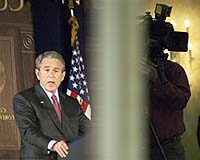
UPI Senior News Analyst Washington (UPI) Jan 05, 2006 It was a year when the United States achieved all of its political goals in Iraq and made major progress in developing the new Iraqi military forces. Yet as the year ended, America's future prospects there were more clouded and problematic than ever. It was the year when Iraq took giant steps towards its future political structure, yet the year ended with more uncertainty than ever over what that structure would eventually deliver. The Iraqi people overwhelming approved their new draft constitution in October. Then on Dec. 15 they held parliamentary elections with an impressively high turn out. But the outcome of those elections was to leave Iraq more fractured and unpredictable than ever before. The "5-5-5" main Shiite political coalition won an overwhelming majority of the votes among the nation's estimated 15 million Shiites, a 60 percent majority of the total population. The Kurdish areas in the north and the large central provinces of the Sunni Arab heartland where the insurgency has been raging most seriously also voted according to ethnic blocs. The elections therefore left the Shiites and Kurds more firmly in control than ever with the Sunnis feeling more estranged from the U.S.-backed political forces in the saddle in Baghdad. The clear implication of this was that the Sunni insurgency would continue to rage in 2007 as fiercely as before. It was a year when even with more than 150,000 U.S. troops in Iraq and aggressive search and destroy missions being mounted continuously in western Iraq and up the Euphrates valley, the insurgency resolutely refused to go away. It peaked over the summer months and continued to flare at grim levels through October and November. There was something of a lull during the parliamentary election campaign but the year ended with clear signs that the insurgents were trying to raise their levels of violence again. The Bush administration spent most of the year trying to avoid acknowledging the significance of benchmark statistics in Iraq and claiming they were misleading when it had to acknowledge them at all. The reason was not hard to see: The figures were sobering. The conflict was nowhere near on the Vietnam scale, but there were no signs that U.S. strategy on the insurgency was having much effect in reducing it. For four months, from August through November, the Department of Defense was reduced to claiming that 3,000 insurgents -- no more and no less -- per month were being killed or captured. There was no independent evidence anywhere to corroborate this suspiciously round and tidy figure. Nor did the insurgency show any sign of losing cohesion and its ability to continually inflict high levels of casualties At the same time, most U.S. military analysts with access to intelligence estimated the number of active insurgents at remaining stable around 20,000 with another 200,000 estimated strong sympathizers and active helpers within the Sunni community of five million people. Analyst Michael Eisenstadt of the Washington Institute for Near East Policy warned that the insurgency therefore still had the potential to metastasize and become far more serious from within the Sunni community alone. During the year, U.S. military deaths in Iraq passed the 2,000 mark and are now over 2,170. Almost 2,000 of those deaths have occurred since President George W. Bush declared "Mission Accomplished' in Iraq on the decks of the 80,000 ton nuclear aircraft carrier USS Abraham Lincoln on May 1, 2003. And more than half of U.S. combat fatalities per month for at least half the past year have been caused by improvised explosive devices, or IEDs. It was also the year when the number of U.S. troops wounded in Iraq passed 16,000, of whom more than 7,000 were injured so seriously that they could not be returned to active duty. It was a year when it became clear that there were no magic fixes in Iraq. None of the successful constitutional milestones and elections, nor the beginning of the trial of Saddam Hussein appeared to affect the insurgency in any significant way. President Bush late in the year publicly acknowledged that about 30,000 Iraqi civilians had been killed so far in the conflict. The independent Iraq Body Count came to roughly the same conclusion. As of Dec. 30, it put its estimate of Iraqis killed since the start of operation to topple Saddam Hussein in March 2003 as between 27,636 and 31,160. By the end of the year, Iraqi oil production and electricity generation were both clearly on the rise but both still had to reach and maintain even the same anemic levels they were at under Saddam before the U.S. invasion of Iraq on March 19, 2003. But at the end of the year, the really big question marks in Iraq were not about the Sunnis and their insurgency; they were about the Shiite majority and where they would go. The year ended with reports from Western political organizations operating throughout Shiite southern Iraq and from the British military forces trying to maintain security there that local Shiite militias, especially Moqtada al-Sadr's Mahdi Army were rapidly organizing and consolidating their forces throughout the region. At the same time, the Iraqi Interior Ministry was consolidated under Shiite control with more than 100,000 troops at its disposal. And there were widespread credible reports that the new security forces, especially the police, were already heavily infiltrated and in many regions effectively controlled by sectarian paramilitary and militia groups, especially in the Shiite and Kurdish regions. It was, therefore a year when the Shiites of southern Iraq and their supporters in neighboring Iran seemed to be the real beneficiaries from the continuing conflict between the Sunni insurgents and the U.S. armed forces and their Iraqi allies. Question marks remained over the operational effectiveness, reliability and even ultimate loyalty of the large new Iraqi security forces too. Critics in Congress charged in the summer that after more than two years of effort, only one to three Iraqi police and army battalions out of more than 120 were judged able to operate on their own without U.S. support. The situation is said to have improved significantly since then, but hard figures on the growth of Iraqi operational performance reliability are still hard to come by. It was also a year when the American public and politicians on Capitol Hill grew increasingly uneasy or angry over Iraq. Rep. John Murtha, D-Penn, broke the long bipartisan consensus of support or silence in Congress by going publicly with a fierce criticism of the administration's record in Iraq. But with the exception of Sen. Russell Feingold, D-Wis., almost no members of his own party, especially would-be presidential contenders, cared to join him. It was a year when lots of reports circulated in Congress and the Washington media that there would be very significant U.S. troop cuts in Iraq in 2006 with increased responsibilities being handed over to Iraqi forces. But all this just appeared to be smoke without fire. The year ended with up to 15,000 more U.S. troops in Iraq than had been there at the beginning of it, and at a time when the Bush administration appeared to be contemplating the possibility of military action against neighboring Iran over its nuclear programs. It was certainly not the best of years in Iraq but it wasn't the worst of them either. It was a year of drift, a year of more of the same. It was a year without any truly good security breakthroughs but without any more hideous shocks there either -- 2004 had contained enough of those. It was a year of preparation for 2006: But whether that would prove to be good thing or a very bad one remained to be seen.
Source: United Press International Related Links SpaceWar Search SpaceWar Subscribe To SpaceWar Express  Unmanned Aerial Vehicles Protect Marines On The Roads Across Iraq
 Camp Taqaddum, Iraq (AFNS) Dec 23, 2005
Predicting the future is one power that will never be attainable, but if it was possible it could save the lives of many service members in a combat zone. With the skills of the Marines of Intelligence Shop, 2nd Marine Logistics Group (Forward) and the help of modern technology, stopping events before they occur is getting closer and closer.
|
|
| |||||||||
| The content herein, unless otherwise known to be public domain, are Copyright 1995-2016 - Space Media Network. All websites are published in Australia and are solely subject to Australian law and governed by Fair Use principals for news reporting and research purposes. AFP, UPI and IANS news wire stories are copyright Agence France-Presse, United Press International and Indo-Asia News Service. ESA news reports are copyright European Space Agency. All NASA sourced material is public domain. Additional copyrights may apply in whole or part to other bona fide parties. Advertising does not imply endorsement, agreement or approval of any opinions, statements or information provided by Space Media Network on any Web page published or hosted by Space Media Network. Privacy Statement All images and articles appearing on Space Media Network have been edited or digitally altered in some way. Any requests to remove copyright material will be acted upon in a timely and appropriate manner. Any attempt to extort money from Space Media Network will be ignored and reported to Australian Law Enforcement Agencies as a potential case of financial fraud involving the use of a telephonic carriage device or postal service. |