
 |
 |
 |
 |
 |
 |
 |
 |
 |
 |

| . |  |
. |
|
Successful Workaround in Deep Space by Simon Mansfield 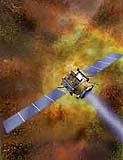 Pasadena - January 14, 2000 - Mission controllers at JPL regained control of the Deep Space One (DS1) spacecraft after successfully implementing a new method of controlling the spacecraft's attitude.
During a session with the Deep Space Network on Friday the DS1 team was able to download a large block of science data previously acquired last year of Mars. Dr Marc Rayman deputy mission manager for DS1 told SpaceWar that the workaround to manage spacecraft attitude would be repeated next week during the mission's weekly DSN session allocated for the extended mission. Since December 15, the DS1 team has been implementing an innovative method that salvages the extended mission's science component and ensures DS1 will be able to perform a flyby of comet Borrelly in September 2001. The problems for DS1 began November 11 when the spacecraft's star tracker stopped functioning. The star tracker helps determine the spacecraft's orientation, and although not one of the 12 technologies tested during DS1's primary mission, it is a new and sophisticated device said Rayman. "The star tracker is not part of the navigation system but rather the attitude control system. Among its many responsibilities, the attitude control system determines how the spacecraft is oriented when firing the engines or pointing the science camera," Rayman added. Since the breakdown of the star tracker, the spacecraft has been in a safe mode using its Sun sensor to point its main antenna and solar arrays at the Sun and rotating once per hour. Deep Space One has been one of NASA's most successful faster, cheaper better missions and was used to validate 12 new technologies that will have wide spread application in future FBC missions.
DEEP SPACE ONE
|
|
|
| The content herein, unless otherwise known to be public domain, are Copyright 1995-2016 - Space Media Network. All websites are published in Australia and are solely subject to Australian law and governed by Fair Use principals for news reporting and research purposes. AFP, UPI and IANS news wire stories are copyright Agence France-Presse, United Press International and Indo-Asia News Service. ESA news reports are copyright European Space Agency. All NASA sourced material is public domain. Additional copyrights may apply in whole or part to other bona fide parties. Advertising does not imply endorsement, agreement or approval of any opinions, statements or information provided by Space Media Network on any Web page published or hosted by Space Media Network. Privacy Statement All images and articles appearing on Space Media Network have been edited or digitally altered in some way. Any requests to remove copyright material will be acted upon in a timely and appropriate manner. Any attempt to extort money from Space Media Network will be ignored and reported to Australian Law Enforcement Agencies as a potential case of financial fraud involving the use of a telephonic carriage device or postal service. |
 Pasadena - December 24, 1999 - The Deep Space 1 spacecraft executed a highly successful and innovative set of maneuvers on Wednesday, December 15 in the first test of new ways of controlling the spacecraft now that the star tracker is not working and is unlikely to resume operation.