|
 |
 |
 |
 |
 |
 |
 |
 |
 |

| . |  |
. |
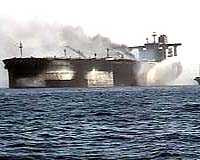
Tanker Traffic On The High Seas Problematic
Washington (UPI) June 3, 2005 Ships and pipelines transport more than 35 million barrels of oil daily and much of the traffic passes through narrow and hazardous straits. Pirates and terrorists are known to target many of these choke points and just one incident can upset the balance of global oil trade. Small incidents -- hitting shipping routes, travel times and delivery schedules -- can cause a catastrophic domino effect. The Panama Canal and trans-Panama pipeline, which connect the Pacific Ocean with the Caribbean and Atlantic Ocean, have a daily oil flow of 400,000 barrels. The canal's capacity is restricted due to its inability to handle two-way traffic, but a project is under way to expand the route. The Suez Canal and Sumed pipeline, which connect the Red Sea and the Gulf of Suez with the Mediterranean, have an estimated daily capacity of 3.8 million barrels. The Sumed transports some 2.5 million barrels daily, most of which comes from Saudi Arabia and is primarily destined for Europe and the United States. An incident on any of these major routes or others could seriously disturb oil trade. Security remains a concern of companies conducting business around the globe. South Korea asks IMO to increase security in Malacca Strait South Korea called on the International Maritime Organization to increase oil tanker security for vessels passing through the Malacca Strait in Southeast Asia. Known as the world's busiest shipping lanes, the narrow strait bordered by Malaysia, Singapore and Indonesia, has seen the world's worst attacks by pirates and terrorists, said South Korean President Roh Moo-hyun. Approximately 50,000 ships pass through the straits annually and it carries a third of the world's traded goods and half of its oil supplies. IMO reports say any serious disruption to the flow of maritime traffic through this channel could pose widespread harm, presenting ships with a detour more than 600 miles. Freight rates could also increase.
Power shortages an ongoing problem in China The province has nine contingency measures to deal with shortages as they arise, which are equipped to deal with outages ranging from 1 million kilowatts to 9 million kilowatts, according to a statement released Thursday by the province's Economic and Trade Commission and its Electric Power Bureau. The province faces the most-severe power shortages in its history, with an estimated maximum shortage of around 8 million kilowatts in the coming months, the statement said. Small-scale steel mills will be required to cease operations when there are severe shortages. Energy-consuming industries such as cement production and electroplating will be temporarily stopped from operating or be forced to reduce production during the July to August period, the statement added. Local governments, official buildings, hotels, large retail facilities and entertainment venues will also feel the effects of the new plan. "We will continue to experience electricity shortages this year and we will try our best to make sure most citizens have a supply of electricity," said Jin Deshui, vice-governor of Zhejiang province. Local weather forecasters say Zhejiang will experience a hot summer this year. Power shortages have become a major issue in many parts of China since 2003. More than 18 out of 31 province-level regions on the Chinese mainland suffered from power shortages in 2003 alone. That number rose to 24 last year. Chinese LNG demand increases, supply may suffer Although China's current liquefied natural gas usage accounts for 3 percent of overall domestic consumption, it expects that number to increase significantly. Chinese experts project LNG demand to soar to an annual rate of 10 percent in the next several years. The Chinese government looks to raise its LNG consumption to 6 percent and 11 percent in 2010 and in 2020, respectively, said Niger Baker, a senior vice president of BP China. Although it has an abundance of natural gas resources, China's four natural gas production regions are not symmetrically distributed. Gas-related materials illustrate that the total fixed reserves is 340 billion cubic yards but with only 210 billion that can be exploited. For the long run, China is apparently short for supply. Major U.S. oil company says renewable energy unfavorable ExxonMobil has decided not to invest in solar and wind energy despite the growing popularity of renewable sources of energy. Although it was considering renewable energy as a viable option, the world's largest publicly traded oil company said opportunities are feasible only with Uncle Sam's help. ExxonMobil estimates demand from solar and wind energy sources will increase at a 10 percent annual rate over the next 25 years, but only on the back of government subsidies and tax breaks to inspire investment in cleaner, more environment-friendly energy sources. "It's an uneconomic niche and our business is not built around the expectation of a bunch of subsidies to make a profit," said Scott Nauman, manager of the economics and energy division of ExxonMobil. "We want a business that is robust on its own merits." Japan to pursue petrochemical venture in Iran via Thai partners Japanese trading house Itochu Corp. plans to partner with two firms from Thailand for petrochemical operations in Iran. Itochu, Siam Cement Public Co. and Thailand's state-owned PTT Public Co. will sign agreements to establish an investment company, which in turn will take a 60 percent stake in another new firm in Iran. Itochu's stakes in the petrochemical venture via the investment company will be 12 percent. Adding polyethylene production in southern Iran will begin in 2008. Closing oil prices, June 3, 3 p.m. London Brent crude oil: $52.77 West Texas intermediate crude oil: $53.98 All rights reserved. Copyright 2005 by United Press International. Sections of the information displayed on this page (dispatches, photographs, logos) are protected by intellectual property rights owned by United Press International. As a consequence, you may not copy, reproduce, modify, transmit, publish, display or in any way commercially exploit any of the content of this section without the prior written consent of by United Press International. Related Links SpaceWar Search SpaceWar Subscribe To SpaceWar Express  Green Diesel: New Process Makes Liquid Transportation Fuel From Plants
 Madison WI (SPX) Jun 03, 2005
University of Wisconsin-Madison College of Engineering researchers have discovered a new way to make a diesel-like liquid fuel from carbohydrates commonly found in plants. |
|
|
| The content herein, unless otherwise known to be public domain, are Copyright 1995-2016 - Space Media Network. All websites are published in Australia and are solely subject to Australian law and governed by Fair Use principals for news reporting and research purposes. AFP, UPI and IANS news wire stories are copyright Agence France-Presse, United Press International and Indo-Asia News Service. ESA news reports are copyright European Space Agency. All NASA sourced material is public domain. Additional copyrights may apply in whole or part to other bona fide parties. Advertising does not imply endorsement, agreement or approval of any opinions, statements or information provided by Space Media Network on any Web page published or hosted by Space Media Network. Privacy Statement All images and articles appearing on Space Media Network have been edited or digitally altered in some way. Any requests to remove copyright material will be acted upon in a timely and appropriate manner. Any attempt to extort money from Space Media Network will be ignored and reported to Australian Law Enforcement Agencies as a potential case of financial fraud involving the use of a telephonic carriage device or postal service. |