
 |
 |
 |
 |
 |
 |
 |
 |
 |
 |

| . |  |
. |
|
New Gyroscope-on-a-Chip Will Aid Station Keeping 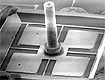 El Segundo - August 16, 1999 - Hughes Space and Communications has licensed a high-performance, all-silicon microgyroscope designed for use in space from JPL that will make it possible for a wider range of spacecraft to have continuous use of a balancing mechanism that operates in a similar fashion to our own inner ear.
Jointly developed by JPL and Hughes, this new gyroscope is lighter, cheaper, higher-performing and less complex than its conventional counterparts, while uniquely designed for continuous space operation. Its dimensions are 4 by 4 millimeters (0.16 by 0.16 inches), smaller than a shirt button, and its weight is less than one gram (just under 0.03 ounces). "Now the remarkable, inherent sense of stability enjoyed by humans on Earth by virtue of gravity and the inner ear will be afforded to all spacecraft in zero gravity," said HSC President and CEO Tig H. Krekel. Spacecraft require gyroscopes to maintain orientation in flight. Gyroscopes determine changes in angular direction, traditionally by virtue of a rapidly spinning, heavy mass. Spinning mass gyroscopes, originally the gyroscopes of choice for space applications, require lubrication and eventually wear out. By contrast, the newly developed JPL/Hughes microgyro does not have any specific life-limiting features; the resulting long life of more than 15 years is a significant plus for space applications. Other gyroscopes designed for use in space use solid-state technology -- that is, without any moving parts -- and provide the required long lifetime, but these instruments are very expensive, power-hungry and bulky, weighing up to 20 pounds or more. Current gyroscopes-on-a-chip, only useful for some terrestrial applications, can measure rotation at just over the speed of the minute hand on a watch, but no slower, whereas the newly licensed microgyro can measure rotation 30 times slower than the hour hand. In the world of gyroscopes for space, measurement of extremely slow rotation is highly desirable -- the slower the better -- because the slowest of rotations can take a spacecraft significantly off target over an extended period. Unlike its microgyro counterparts, the JPL/Hughes instrument features superior performance in both space and terrestrial environments, making it a versatile, dual-use technology. Like its current microgyro counterparts, the JPL/Hughes version relies on measurement of vibrations. "The heart of the instrument is a cloverleaf design that is tied down and vibrates at a very high speed," said JPL's Dr. Tony Tang, engineering lead for the development of the instrument. "We look for changes in the vibration of a light piece of micro-machined silicon that has no moving parts." The exclusive use of silicon helps to reduce costs, since this durable material is now routinely used for computer chips and it is thus more easily fabricated than other materials. The new microgyroscope, including its control electronics, was created out of a technology cooperation agreement between HSC and JPL beginning in 1997. Hughes recently acquired exclusive rights from the California Institute of Technology to develop the microgyro for commercial space applications. Caltech has the right to elect title to inventions developed at JPL under its contract with NASA to manage JPL.
|
|
|
| The content herein, unless otherwise known to be public domain, are Copyright 1995-2016 - Space Media Network. All websites are published in Australia and are solely subject to Australian law and governed by Fair Use principals for news reporting and research purposes. AFP, UPI and IANS news wire stories are copyright Agence France-Presse, United Press International and Indo-Asia News Service. ESA news reports are copyright European Space Agency. All NASA sourced material is public domain. Additional copyrights may apply in whole or part to other bona fide parties. Advertising does not imply endorsement, agreement or approval of any opinions, statements or information provided by Space Media Network on any Web page published or hosted by Space Media Network. Privacy Statement All images and articles appearing on Space Media Network have been edited or digitally altered in some way. Any requests to remove copyright material will be acted upon in a timely and appropriate manner. Any attempt to extort money from Space Media Network will be ignored and reported to Australian Law Enforcement Agencies as a potential case of financial fraud involving the use of a telephonic carriage device or postal service. |