|
 |
 |
 |
 |
 |
 |
 |
 |
 |

| . |  |
. |
Outside View: After The Iraq Vote
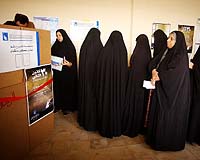
Outside View Contributor Washington (UPI) Oct 18, 2005 The referendum on Iraq's constitution is only the beginning of a political process to resolve the issues dividing Iraqis along ethnic and sectarian lines. Iraq's factions must now turn their attention to the election to take place on Dec. 15. There is little time to thoroughly explain and debate issues, and this election is likely to be one where most Iraqis vote along ethnic and sectarian lines, with only a small fraction voting for secular and national parties. The new government cannot formally take office until Jan. 1, and could take weeks -- or months -- longer to organize. New ministers must then come in, and only then will the key issues that were the focus of the constitution become the subject of real-world political battles. Much will depend on how many of the Sunnis who voted against the constitution will now attempt to participate in the political process. Polls in June 2005 showed deep divisions among Sunnis as to whether boycotting the Jan. 30 elections was a bad idea. For example, 83 percent in Baghdad thought it was a bad idea, but only 40 percent in Ramadi. In the months that followed, however, more and more Sunnis favored participation in the constitutional referendum. A poll in September 2005 showed that 84 percent of all Iraqis in the Baghdad area favored registering and voting while only 7 percent opposed it. The percentages were: 75 percent pro- and 5 percent anti- in the Mosul area, 78 percent pro- and 7 percent anti- in the Tikrit/Baquba area. These percentages were not radically different in the Kurdish area: 79 percent pro- and 6 percent anti-, and the Shiite areas in the south: 87 percent pro- and 2 percent anti-. The turnout was good, particularly given the fact that serious problems existed indistributing ballots and/or knowing which voters should go to which polling places -- especially in the less secure Sunni areas. The turnout was 63 percent to 64 percent of registered voters versus 58 percent in the January election. This reflected a major increase in Sunni voters, since Shiite turnout in the south was lower than in January. The Sunni vote did not reflect a solid bloc, in part due to deep internal divisions in the Sunni community. One Sunni party, the Iraqi Islamic Bloc, did support the constitution after obtaining some changes to the test, and agreement that it could be amended by the new parliament. Some strongly opposed it, and hard-line insurgents opposed registering and voting. The results of the vote are still unclear, but reflect the predictable favorable outcome in Shiite and Kurdish areas. However, this does not mean agreement on how the constitution is to be completed, interpreted, and enforced. The Kurds want Kirkuk, oil areas, and secure revenues. The Shiites still have to work out the power balance between factions, the role of figures like al-Sadr, and issues such as the role of religion versus secular practices. The Sunni vote was strongly "anti-" in purely Sunni areas, with "no" votes ranging around 85 percent to 95 percent. (97 percent in al Anbar). It may have been more favorable in mixed areas. However, problems existed in the Sunni turnout in many areas, including Mosul and Nineveh province, because of insurgent threats -- which may explain why 78 percent of the voters supported the constitution. Similarly, 70 percent were favorable in Diyala. It should be noted that an agreement was reached before the referendum that the new parliament would have the right to amend the constitution. Moreover, many provisions are vague or partially contradictory, and 50 out of 130 clauses were not completed before the referendum. These key issues are: -- Defining federalism, the relative power of the federal regions versus the national government, and demarcating any ethnic and sectarian zones with "fracture" lines in areas like Kirkuk, Basra and Mosul. -- Allocating oil revenues for existing and future fields, and deciding on the future of oil development. -- Deciding who has the power to tax. -- Defining the power of the national government relative to provincial and local government. -- Deciding on the role of religion in the state. -- Deciding on the relative balance of religious and secular law and the power of national versus local courts and law enforcement. -- Deciding who really has power over the police, whether the security forces will become national, and whether the prohibition of militias will actually be enforced. -- Interpreting the meaning of the human rights provisions of the constitution. Some further compromises may be possible before the election, but it seems unlikely that most of these key issues can really be resolved before mid-2006. Throughout this period, insurgents will continue to try to block the political process and cause a civil war. Sunnis will have to decide whether and how to participate in the political process, and pre-referendum polls showed sharp divisions over whether to participate by town and governorate. The Shiite majority will have to resolve its own issues about the relative role of religion in the state, and Shiite militias. The Kurds will have to settle their future role in government, and deal with issues like the future of Kirkuk. Inevitably, there will be debates about who controls the military, security forces, and police, and the role of the Coalition. (Anthony H. Cordesman holds the Arleigh A. Burke Chair in Strategy at the Center for Strategic and International Studies, a Washington think tank.) (United Press International's "Outside View" commentaries are written by outside contributors who specialize in a variety of important issues. The views expressed do not necessarily reflect those of United Press International. In the interests of creating an open forum, original submissions are invited.) All rights reserved. � 2005 United Press International. Sections of the information displayed on this page (dispatches, photographs, logos) are protected by intellectual property rights owned by United Press International.. As a consequence, you may not copy, reproduce, modify, transmit, publish, display or in any way commercially exploit any of the content of this section without the prior written consent of United Press International. Related Links SpaceWar Search SpaceWar Subscribe To SpaceWar Express  Outside View: Another Scapegoat?
 New York (UPI) Oct 17, 2005
The increasing number of clashes between U.S. and Syrian forces raises serious questions about the Bush administration's intentions and the wisdom of its actions. It appears this escalation on the American side is dictated not entirely by the urgency over the infiltration of foreign insurgents from Syria into Iraq.
|
|
| |||||||||
| The content herein, unless otherwise known to be public domain, are Copyright 1995-2016 - Space Media Network. All websites are published in Australia and are solely subject to Australian law and governed by Fair Use principals for news reporting and research purposes. AFP, UPI and IANS news wire stories are copyright Agence France-Presse, United Press International and Indo-Asia News Service. ESA news reports are copyright European Space Agency. All NASA sourced material is public domain. Additional copyrights may apply in whole or part to other bona fide parties. Advertising does not imply endorsement, agreement or approval of any opinions, statements or information provided by Space Media Network on any Web page published or hosted by Space Media Network. Privacy Statement All images and articles appearing on Space Media Network have been edited or digitally altered in some way. Any requests to remove copyright material will be acted upon in a timely and appropriate manner. Any attempt to extort money from Space Media Network will be ignored and reported to Australian Law Enforcement Agencies as a potential case of financial fraud involving the use of a telephonic carriage device or postal service. |