|
 |
 |
 |
 |
 |
 |
 |
 |
 |

| . |  |
. |
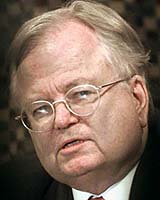
Former US Envoy Optimistic On Iraq
UPI Editor Washington (UPI) Dec 12, 2005 The biggest problem facing Iraq is neither the insurgency nor the economy but whether its political system can produce a viable government, former Presidential envoy to Iraq, Ambassador Robert Blackwill, said Monday. "I am optimistic, on the basis of the current political, military and economic developments," Blackwill told a meeting of the Council on Foreign Relations in Washington on the eve of this week's planned parliamentary elections in Iraq. "But the new government in Iraq cannot succeed without substantial American involvement," he added. On the basis of his most recent visit to Baghdad last month, Blackwill estimated that the new 275-seat parliament would be very different from the old. He saw a decline in the number of seats for the Shia Alliance from 140 in the last parliament to 100-125 in the new. He saw the Kurdish seats fall from the current 75 seats to a range between 55 and 65 seats, and former premier Iyad Allawi's group roughly maintaining their current total of 40 seats. The big change, he believed, would come with a surge in the number of Sunni seats from the current 16 to a range of 40 to 50 seats, reflecting the new determination of many Sunni groups and religious leaders to advocate a strong Sunni turnout at the polls. Blackwill, a veteran diplomat and official in the National Security Council in the 1989-1993 George H.W. Bush administration and deputy head of the NSC in the current Bush administration, is now retired and in private practice as a consultant, but retains close ties to Iraqi political leaders and to the White House. Blackwill saw the most likely next Iraqi prime minister as the current vice-president and former Finance Minister Adel Abdul Mahdi, whom he described as "a believer in reaching out to the Sunni." "I knew him well as finance minister," Blackwill said. "He's French-educated, with two economics degrees from French universities. He's quiet, reserved, no flamboyance. Tortured inside Saddam Hussein's prisons, he is seen inside Iraq as one of the most competent of the ministers in the interim government, but his political skills have yet to be tested." Blackwill expected Mahdi to govern on the basis of a coalition that included the Kurds, Allawi's group and some Sunni, and with the important backing of the Shia religious leader Ayatollah Sistani. Above all, Blackwill saw no immediate prospect of a new Iraqi government demanding an early withdrawal of U.S. and coalition troops. "No leading Iraqi politician has called for a timeline of U.S. withdrawal, and Allawi makes a strong case against setting one," Blackwill said. "The Iraqi political elite, with some Sunni exceptions, is not pre-occupied with how we got here, but where we go now -- and they broadly agree that they need U.S. and British forces until they can take on the insurgents alone. "The argument in the United States now is not about an exit strategy but about setting timelines for withdrawal, and in Iraq it is hard to find anyone -- except the insurgents -- who supports that," he added. Speaking to a packed Washington audience of officials, diplomats, media and Council members, Blackwill's optimistic presentation was respectfully and even warmly received by an audience filled with people who knew him well as a diplomatic or academic colleague. This could be a significant sign that the gloomy view of the United States' role in Iraq that pervades the Democratic Party, much of the media and the U.S. opinion polls was no longer shared by a Washington elite that pays close attention to the political developments in Iraq. Blackwill took a series of questions about reducing or removing the U.S. military presence, but reminded his audience that "This war is not going to be lost in Washington because this president (Bush) will not change his mind." He rejected any suggestion that U.S troops should be withdrawn to let the Iraqis "face the abyss" of civil war and be thus driven to reach an accommodation among themselves. "Hedging our bets against the possibility of Iraqi failure will help bring about that failure," Blackwill said. Blackwill also dismissed recent calls for a substantial revision of the new Iraqi constitution, made most recently by Kanan Makiya, the Iraqi human rights advocate and author of one of the best-regarded books on Saddam Hussein's Iraq, "The Republic of Fear." Writing in the New York Times Sunday, Makiya warned that the constitution so weakened the central Iraqi state that the country was likely to fall apart, arguing that "profound tensions and contradictions have been enshrined in the constitution of the new Iraq, and they threaten the very existence of the state." "No, the constitution is not the most important challenge," Blackwill insisted. "If we have a moderate government in Baghdad that is only mildly Islamist, or if we have the reverse, an immoderate government that is very strongly Islamist, then either way it will not matter much what the constitution says. How the Sunnis are treated in their daily lives will be more important. The quality of governance, the delivery of services, will be more important." Blackwill, who also noted that he could not say that torture should "never" be used, also suggested that the issue of torture and ill-treatment was less prominent in Iraq than it was in Washington. "I was in Baghdad at the time of Abu Ghraib (the prison where U.S. troops were photographed ill-treating prisoners) and the Shia were not in mourning over Abu Ghraib," he said. "Be careful of long-distance high-mindedness."
Source: United Press International Related Links SpaceWar Search SpaceWar Subscribe To SpaceWar Express  Outside View: Looking At Iraq's Insurgency
 Washington (UPI) Dec 12, 2005
Iraq is a war where the course of the insurgency remains uncertain. The frequency and intensity of attacks has continued to fluctuate, with no evidence the insurgency is getting significantly better or worse. U.S. and Iraqi officials continue to make claims that the offensives in the west have had a major impact on the insurgency, but the data on attack numbers and casualties do not reflect any clear trends. |
|
|
| The content herein, unless otherwise known to be public domain, are Copyright 1995-2016 - Space Media Network. All websites are published in Australia and are solely subject to Australian law and governed by Fair Use principals for news reporting and research purposes. AFP, UPI and IANS news wire stories are copyright Agence France-Presse, United Press International and Indo-Asia News Service. ESA news reports are copyright European Space Agency. All NASA sourced material is public domain. Additional copyrights may apply in whole or part to other bona fide parties. Advertising does not imply endorsement, agreement or approval of any opinions, statements or information provided by Space Media Network on any Web page published or hosted by Space Media Network. Privacy Statement All images and articles appearing on Space Media Network have been edited or digitally altered in some way. Any requests to remove copyright material will be acted upon in a timely and appropriate manner. Any attempt to extort money from Space Media Network will be ignored and reported to Australian Law Enforcement Agencies as a potential case of financial fraud involving the use of a telephonic carriage device or postal service. |