Soldiers in urban battle zones could receive more timely and complete information about enemy forces from low-flying unmanned aerial vehicles (UAV) with technologies being developed by Northrop Grumman under a U.S. Department of Defense contract.
This work could lead to an autonomous system that coordinates the delivery of data from UAVs and other military reconnaissance assets and intelligence sources.
For example, a soldier with a handheld computer would request information about suspected enemy positions, and the system would prioritize the requests and direct individual UAVs to obtain the information and deliver it. These technologies could someday be adapted for other military applications and missions.
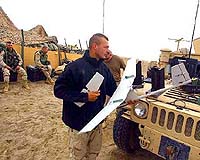
Currently, soldiers engaged in urban warfare have no direct access to reconnaissance and surveillance data, nor can they control the high-altitude aircraft and satellites that collect it.
In addition, those platforms cannot provide information with the detail and timeliness required in a rapidly changing urban combat zone.
HURT technology would allow the warfighter to directly request information critical to individual needs. Northrop Grumman begins work this month on an $11.6 million contract awarded by the Defense Advanced Research Projects Agency (DARPA) to lead the so-called "HURT" program. HURT stands for heterogeneous urban RSTA (reconnaissance, surveillance and target acquisition) team.
"A HURT system would give the warfighter the ability to ask for reconnaissance imagery unobtainable by high-altitude or fixed sensors," said H.R. Keshavan, Northrop Grumman's HURT program manager.
"Low-flying UAVs could see around or even inside buildings to provide more up-to-date information."
During the program's first phase, Northrop Grumman's Integrated Systems sector will serve as prime contractor to demonstrate that "coordinated autonomy" can be achieved.
For example, the HURT system must be able to simultaneously order the UAVs to conduct wide-area surveillance while dispatching an individual vehicle to a location requested by a soldier for a close-up look.
Northrop Grumman also will conduct two engineering flight tests during the first phase to demonstrate further capabilities.
While these flights will utilize small UAV systems, the technologies developed under HURT could eventually be used with larger unmanned systems such as Northrop Grumman's RQ-4 Global Hawk, RQ-8 Fire Scout vertical takeoff and landing tactical UAV and X-47B Joint Unmanned Combat Air Systems (J-UCAS).
Key members of the HURT development team include Honeywell Laboratories, SRI International, Teknowledge Corporation and AeroVironment as well as researchers from NASA, the U.S. Army and academic institutions.