|
 |
 |
 |
 |
 |
 |
 |
 |
 |

| . |  |
. |
Battle Lab Tests Future Battlefield Communications
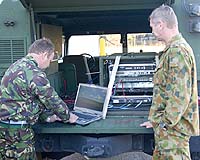
Fort Gordon GA (SPX) Dec 13, 2005 A satellite-based communications systems for combat vehicles is now being evaluated by the Battle Command Battle Lab. Lighter, smaller, mobile and more efficient are the waves of future battlefield communications, said Col. Charles Dunn, deputy director of Battle Command Battle Lab. He can speak with certainty because the technology of tomorrow's battlefield is the province of the Battle Lab activities. Currently the lab is closing out an evaluation on one of several satellite-based Mounted Battle Command on-the-move systems that will provide broadband communications to a battlefield commander using lighter, smaller, and less expensive vehicle-mounted technologies. "But the electronics are more technically complex because the miniaturized components must be crafted to withstand the severities of a harsh combat environment," said Dunn. "Right now we are investigating the possibilities of placing small satellite antennas on military vehicles, particularly command and control vehicles." The task he describes is to link several of these vehicles using satellites, so that distance and physical obstacles are no longer issues between two points. In this environment, commanders will be able to create multiple communication links between the commander, subordinate commanders and staff elements anywhere in the theatre of operations. Recent lessons learned in the Global War on Terrorism heightened the significance of the Battle Lab's work. "This is important because we learned during Operation Iraqi Freedom that modern battlefield movements quickly outpace the reach of current communications capabilities, Dunn said "This posed a significant command and control challenge between units that were up in front and those that were in the rear, as well as units that were to the left and the right in a vastly dispersed battlespace" Dunn said. Added to this in this desert environment, there were either terrain obstacles or immense distance that precluded line-of-sight communication. "What we learned is that to compensate for that inability you have to be able to hit a satellite so that it can relay your signal to a distant location," said Dunn. "Of course satellite communications has limitations like rain, foliage, urban buildup as well as the normal laws of physics that must be addressed." These are areas of concern for Battle Command Battle Lab G, one of three labs chartered by Training and Doctrine Command as a Battle Command Battle Lab. Together with Fort Huachuca, Ariz., and Fort Leavenworth, Kan., it is chartered with the responsibility of enhancing battle command capabilities. Within the Battle Command Battle Lab G there are five different major divisions. One of these divisions provides modeling and simulation capabilities. This allows the lab to experiment, test and analyze communications traffic at a reduced cost to the Army. Additional capabilities of the organization include spectrum analysis, software programming, and code and model validation and verification. Introduction of new technology may result in a reduction in manpower but a corresponding increased dependency on automation. This fact leads to the second division of Battle Command Battle Lab G. The futures experimentation division evolves out of the fact that reliance on automation may require changes in organizations, doctrine, and procedures. "For example, how are the ways that I can interact with you 20 to 30 miles away," Dunn said. "Before I may have sent a courier or I may have picked up a telephone after we dropped cable and established relay stations from sender to receiver. Today, given continuous clandestine enemy activities, suicide bombers and those kinds of things, a physical cable creates a target; the enemy is just going to cut the line to disrupt our communications. Also, to guard it, you must have force protection which requires you to take soldiers from the fight to guard the cable. "However, today, signal units can establish radio communications in the form of WiFi, WiMax, laser, satellite, and normal line-of-sight signal waves. These technologies affect the manning of organizations to include required skill sets. "While improvements and enhancements to systems often result in increased capabilities, there is always a need for new procedures to accommodate the new technologies," said Dunn. These are the kinds of issues considered by the future experimentation division. Another mission area of the battle lab is the Network Operations Security Center for the Battle Lab Collaboration and Simulation Environment. The Training and Doctrine Command owned center is a distributive, closed, secured network that includes all of the Training and Doctrine Command battle labs onto a single network. Battle Command Battle Lab G administers and coordinates use of the network. This network allows for the conduct of force-on-force simulations across a distributed environment. Four or five major simulation exercises are conducted each year over the network. Also operating out of Battle Command Battle Lab G is a group orchestrating information assurance and network security. These individuals travel throughout the country to insure that every point that connects to the classified Battle Lab Collaboration and Simulation Environment network - the equipment and personnel - are well versed in the security of the network. The final division addresses live experimentation. This group evaluates commercially available technology for possible insertion into the force to satisfy an operational needs statement. "The technology is proven and in the market. We test comparable products of multiple vendors so that we can provide the acquisition community the data needed to compare a technology or a vendor so that an informed decision can be made," said Dunn. "The team acquires prototypes and sample hardware such as new antennae and modem systems from industry partners. They are evaluated to determine whether the specifications described in advertisements can really be met by the hardware when placed in an operational environment." Two exchange officers lead the technical evaluations of the battle command on-the-move project. Maj. Scott Youngson, British Royal Corps of Signals, said it has been interesting to work with the latest technology. "It is not something that I have had a chance to do in the United Kingdom." "Australia is in the process of refining its program of command on-the-move with the use of satellites on-the-move systems,� said Maj. Clay Campbell, Royal Australian Signals Corps. �One of the good things about this is that these are prototype systems and the experiments that we are doing allow us to provide feedback to the vendors who have been extremely receptive to making changes to software and subtle changes to hardware to improve the performance." On a day-to-day basis the officers design the test regimes that will examine the performance of the components and the complete systems under a number of different operational scenarios. "Essentially, we pump data into the systems and then measure the throughput," Campbell said. "This includes static and mobile testing with and without cryptographic equipment, with and without protocol accelerator; a whole matrix of solutions so that we can ultimately examine different systems side by side under the same circumstances in the hope that it becomes apparent which is the most effective tool." Testing the system on a Humvee in urban and rural areas where the signal could be blocked by buildings or trees is valuable, he said. By testing new systems and modifications to encryption and existing systems, the battle lab will provide the acquisition community information that will help them make decisions about the future technology to be delivered. Related Links Battle Command Battle Lab SpaceWar Search SpaceWar Subscribe To SpaceWar Express  SAIC Announces Team To Compete For Joint Warfighting Center Program
 Suffolk VA (SPX) Dec 09, 2005
Science Applications International Corporation (SAIC) today announced it plans to compete for the U.S. Joint Forces Command's (USJFCOM) Joint Warfighting Center (JWFC) Support Team (JST) procurement.
|
|
| |||||||||
| The content herein, unless otherwise known to be public domain, are Copyright 1995-2016 - Space Media Network. All websites are published in Australia and are solely subject to Australian law and governed by Fair Use principals for news reporting and research purposes. AFP, UPI and IANS news wire stories are copyright Agence France-Presse, United Press International and Indo-Asia News Service. ESA news reports are copyright European Space Agency. All NASA sourced material is public domain. Additional copyrights may apply in whole or part to other bona fide parties. Advertising does not imply endorsement, agreement or approval of any opinions, statements or information provided by Space Media Network on any Web page published or hosted by Space Media Network. Privacy Statement All images and articles appearing on Space Media Network have been edited or digitally altered in some way. Any requests to remove copyright material will be acted upon in a timely and appropriate manner. Any attempt to extort money from Space Media Network will be ignored and reported to Australian Law Enforcement Agencies as a potential case of financial fraud involving the use of a telephonic carriage device or postal service. |