by Frank Sietzen "SpaceCast News Service"
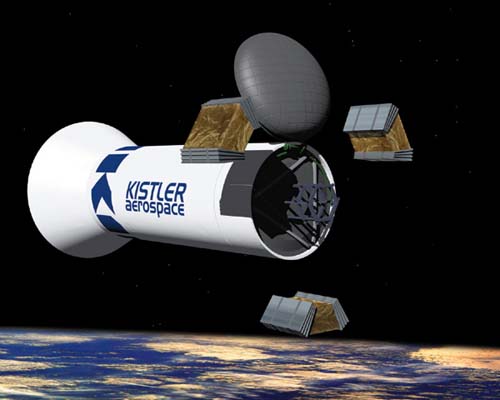
 Washington DC - October 21, 1997 - Motorola's announcement last week that it is planning a vast space satellite constellation as well as replacement launches for other satellite programs could prove the critical ticket for one- or more- of the batch of struggling small companies proposing various designs of reusable space vehicles. While most of the attention last week focused on the effect the Request For Proposals (RFP) for launch services released by the firm will have on the existing U.S. and international fleet of expendable rockets, industry sources tell SpaceCast Kistler Aerospace and Pioneer Rocketplane Inc. have quietly moved into the fray, offering their budding - and unbuilt - new launchers as candidates.
For Kistler, the Motorola proposal comes at a strategically important time
in the firms's evolution. Plans recently completed between Kistler and the
Department of Energy will enable the firm to begin suborbital test flights
of its two-stage K-1 reusable space booster next summer from the
little-used Nevada Nuclear Test Site. Those tests are planned to end with a
first-ever orbital flight and landing of an all-privately financed space
vehicle by the end of 1998. Kistler has funded the development of the K-1
entirely from venture capital sources as well as owner Walter Kistler's own
deep pockets. Launching Motorola satellites, an entirely commercial space
venture with no U.S. government participation, would make for a spectacular
first customer for the fledgling project.
For Pioneer Rocketplane, the RFP will give the firm more marketing muscle
to show potential investors. The company proposes the development of a
small winged rocketplane that will be refueled from an airborne tanker
plane before soaring into orbit. But the project remains behind Kistler in
amassing capital. A robust commercial space launch market will surely help
the firm's plans take shape. And Pioneer can point to one major difference
between it and its competitors: only Pioneer's reusable launcher will carry
a human pilot.













 Washington DC - October 21, 1997 - Motorola's announcement last week that it is planning a vast space satellite constellation as well as replacement launches for other satellite programs could prove the critical ticket for one- or more- of the batch of struggling small companies proposing various designs of reusable space vehicles. While most of the attention last week focused on the effect the Request For Proposals (RFP) for launch services released by the firm will have on the existing U.S. and international fleet of expendable rockets, industry sources tell SpaceCast Kistler Aerospace and Pioneer Rocketplane Inc. have quietly moved into the fray, offering their budding - and unbuilt - new launchers as candidates.