|
 |
 |
 |
 |
 |
 |
 |
 |
 |

| . |  |
. |
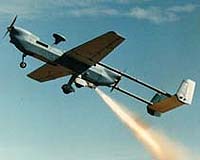
Northrop Grumman Demonstrates Hunter 2 Unmanned System For Army
Northrop Grumman recently demonstrated, through a series of ground and flight tests here, the capabilities of its new Hunter II unmanned system, the company's proposed system solution for the U.S. Army's Extended Range/Multi-Purpose (ER/MP) program. The company completed the test series, which included more than 50 hours of flight time over 14 separate flights, on February 16 as part of the program's Systems Capabilities Demonstration (SCD) phase. "Our Hunter II demonstrator air vehicles successfully completed a series of prescribed ground and flight mission scenarios for the ER/MP program including auto landing and take-off capabilities under both day and night conditions," said Bill McCall, Northrop Grumman's ER/MP program director. "We also demonstrated how easy it is to assemble, disassemble and perform maintenance tasks on the air vehicle, which will simplify logistic support for the Hunter II system." Over a six-day flight period that included a discretionary day, Northrop Grumman demonstrated Hunter II's capabilities to take off and land autonomously; fly at the required speeds and altitudes; perform relay missions (using a second Hunter II demonstrator air vehicle); and deliver high-quality data and video imagery through its communications system. All the SCD missions were performed carrying a mission-ready sensor payload. The company also demonstrated air vehicle performance ranges in excess of 300 km and endurance in excess of 12 hours. As part of the discretionary day, the company conducted several demonstrations to highlight Hunter II's complete system capability. These demonstrations included:
"The Hunter II system builds on the battle-proven Hunter systems and infrastructure to provide a low-risk, easy-to-use, easy-to-maintain system that allows soldier-operators to focus on performing the mission, not flying the air vehicle," said McCall. "It includes an advanced communications architecture that supports the Army's transition from dedicated, centralized operations to a distributed command, control, communications and computer integration (C4I) network. It also offers significant life-cycle cost savings by taking advantage of existing Army doctrine, organization, training, material, logistics, personnel and facilities." Related Links SpaceWar Search SpaceWar Subscribe To SpaceWar Express  SAIC Demos Live-Fire Capability From Vigilante UAV
 Mclean VA (SPX) Mar 07, 2005
Science Applications International Corporation (SAIC) has announced the successful live-fire of four 2.75" unguided rockets from its Vigilante VTOL UAV (Vertical Takeoff and Landing Unmanned Aerial Vehicle) system during flight testing conducted at the U.S. Army's Yuma Proving Ground. |
|
|
| The content herein, unless otherwise known to be public domain, are Copyright 1995-2016 - Space Media Network. All websites are published in Australia and are solely subject to Australian law and governed by Fair Use principals for news reporting and research purposes. AFP, UPI and IANS news wire stories are copyright Agence France-Presse, United Press International and Indo-Asia News Service. ESA news reports are copyright European Space Agency. All NASA sourced material is public domain. Additional copyrights may apply in whole or part to other bona fide parties. Advertising does not imply endorsement, agreement or approval of any opinions, statements or information provided by Space Media Network on any Web page published or hosted by Space Media Network. Privacy Statement All images and articles appearing on Space Media Network have been edited or digitally altered in some way. Any requests to remove copyright material will be acted upon in a timely and appropriate manner. Any attempt to extort money from Space Media Network will be ignored and reported to Australian Law Enforcement Agencies as a potential case of financial fraud involving the use of a telephonic carriage device or postal service. |