|
 |
 |
 |
 |
 |
 |
 |
 |
 |

| . |  |
. |
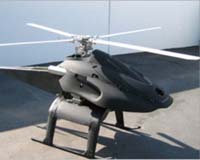
Second Boeing X50A Dragonfly Canard Rotor And Wing Prototypes Completes Hover Flight
Boeing's second canard rotor/wing (CRW) technology demonstrator � the X-50A Dragonfly unmanned air vehicle � has successfully completed a four-minute hover flight at the U.S. Army's Yuma Proving Ground in southwest Arizona. The aircraft reached an altitude of about 20 feet above ground. "Our first flight test objectives were met today," said Clark Mitchell, Boeing Phantom Works program manager for the CRW prototype. "This is a significant achievement toward validating the new stopped-rotor technology." Under joint development by Boeing Phantom Works and the Defense Advanced Research Projects Agency (DARPA), the CRW is a revolutionary aircraft that combines the speed and range of fixed-wing flight with the flexibility of rotary-wing flight. It also incorporates tip jet propulsion and stopped rotor technologies. "The most significant objective met was verification that software compensation effectively reduces the rotor control issue we were having, or cross coupling," he said. The phenomenon of cross coupling was a finding in the mishap investigation of Ship 1 in 2004 that led to wind tunnel tests for Ship 2 at the Boeing helicopter facility in Philadelphia earlier this year. Ship 2 then completed ground checkout testing at the Boeing facility in Mesa, Ariz., where it was configured for flight. After a flight readiness review, the vehicle was shipped to Yuma where it completed a preparatory "pop up" flight Nov. 4. The flight lasted only about 30 seconds during which the aircraft stabilized briefly at 16 feet above the ground and then landed. Success with the initial flight led to the hover flight Dec. 2. Mitchell said that flight tests are expected to continue into early next year. The flight-test schedule calls for 11 flights. Under the remote control of a pilot in a ground station cockpit, the X-50A Dragonfly will gradually perform more extensive hover flights, then forward-moving rotary wing flights. The test program will culminate with the first ever "conversion" from rotary wing flight to fixed-wing flight and back again to rotary wing flight for landing. The conversion requires the main rotor to stop turning in flight, and lock in place to become a fixed wing for high speed flight. Ship 1, the first Dragonfly prototype vehicle, was involved in a flight mishap on March 23, 2004, that led to a joint investigation by Boeing and DARPA. The findings identified cross coupling of the rotor controls as the main cause of the mishap. Since then, improvements have been incorporated into Ship 2 that address design issues related to findings. These include changes such as new rotor torsion springs for increased control power, new flight control software and a flight data recorder. Related Links Boeing Phantom Works DARPA SpaceWar Search SpaceWar Subscribe To SpaceWar Express  Fire Scout UAV Moving Closer To Production
 San Diego CA (SPX) Dec 06, 2005
Northrop Grumman has successfully conducted a critical design review of its MQ-8B Fire Scout unmanned aerial vehicle (UAV) for the U.S. Navy. The review moves the program closer to full-scale production and delivery of the vertical takeoff and landing UAV to the Navy.
|
|
| |||||||||
| The content herein, unless otherwise known to be public domain, are Copyright 1995-2016 - Space Media Network. All websites are published in Australia and are solely subject to Australian law and governed by Fair Use principals for news reporting and research purposes. AFP, UPI and IANS news wire stories are copyright Agence France-Presse, United Press International and Indo-Asia News Service. ESA news reports are copyright European Space Agency. All NASA sourced material is public domain. Additional copyrights may apply in whole or part to other bona fide parties. Advertising does not imply endorsement, agreement or approval of any opinions, statements or information provided by Space Media Network on any Web page published or hosted by Space Media Network. Privacy Statement All images and articles appearing on Space Media Network have been edited or digitally altered in some way. Any requests to remove copyright material will be acted upon in a timely and appropriate manner. Any attempt to extort money from Space Media Network will be ignored and reported to Australian Law Enforcement Agencies as a potential case of financial fraud involving the use of a telephonic carriage device or postal service. |