|
 |
 |
 |
 |
 |
 |
 |
 |
 |

| . |  |
. |
Analysis: Bolton Challenges U.N. Proposals
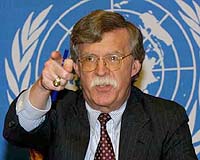
UPI Chief International Correspondent Washington (UPI) Sep 02, 2005 The Bush administration is engaged in its worst arm-wrestling contest with the United Nations since the confrontation leading up to the Iraq war. That is the assessment of observers as John Bolton, Washington's newly appointed diplomatic demolition expert at the United Nations, attempts to redefine a key document prepared for discussion and eventual ratification at the world body's 60th anniversary summit attended by over 100 world leaders on Sept 14. The document renews the organization's commitment to a minutely detailed laundry list of objectives known as the Millennium Development Goals established at the September 2000 U.N. Millennium Summit and including new global standards for security, environmental protection, human rights, poverty reduction, combating HIV/AIDS, peacekeeping and reforming the Security Council. Last week, with less than 20 days to go to the summit, Bolton sent the 193 foreign ambassadors to the United Nations a barrage of some 750 amendments to the text requiring a daunting almost line-by-line revision. Washington is being criticized for demanding too much too late on draft proposals that have been under consideration by the U.N. member states since April 19. The U.S. response is that it began proposing changes in June, apparently without much success. But the spokesman for the Russian mission to the U.N., Sergei Trebelkov, told United Press International Friday, "American diplomacy was not very active in this regard, but with the arrival of Ambassador Bolton it became more active, actually more aggressive -- I mean in a positive sense, of course." President Bush bypassed the Senate, where Bolton's nomination has been blocked for months, and gave the conservative diplomat noted for what many consider his train wreck negotiating style a recess appointment on Aug 1. In New York, Bolton hit the ground running and has concentrated on what one European diplomat in Washington resentfully described as "tearing the guts out of the U.N. proposals." In Washington, Kristen Silverberg, the deputy assistant secretary for International Global Affairs, said this week the United States had signed the U.N.'s 2000 Millennium Declaration, a document of general principles, but not the later annex -- known as indicators -- that hammers down specific targets which the Bush administration rejects including emissions reductions based on the Kyoto agreement, the establishment of the international criminal court, and a commitment by countries to set aside 0.7 percent of their gross national product to finance aid for Africa. The United States has called for the abolition of the 66-member U.N. Commission on Human Rights, which is frequently dominated by nations with poor human rights records such as Syria and Libya, and its replacement with a smaller council. The Americans are pressing for what Silverberg termed "a blanket exclusion" from the new body of known human rights abusers. But U.N. diplomats say the U.S. proposal has to overcome the hurdle of a two-thirds majority vote in the U.N. General Assembly where the large bloc of Third World countries are likely to be allergic to replacing the UNHRC with a council that excludes them and is weighted in favor of Western participation. U.S. officials privately believe efforts to expand the U.N. Security Council have been buried, at least for the foreseeable future. Officially, Washington was not opposed to increasing the 15-member council, and was even open to the idea of adding two permanent members to the existing five (United States, Britain, France, China, and Russia), but only after progress had been demonstrated on other U.N. reforms. There is the feeling in U.N. circles that Bolton's last minute onslaught on the Millennium goals has produced resentment among the Group of 77 developing nations who could retaliate by blocking U.S.-backed proposals such as the establishment of a Peace Building Commission designed to pick up where U.N. military peacekeeping leaves off. This new body would be on hand to provide support as countries make the transition to a democracy, advising them on creating democratic institutions, and helping to organize free elections. Other U.S. favorites include independent oversight of U.N. spending (the United States is the organization's biggest financial contributor), and a measure to restrict the spread of the world's deadliest weapons. To speed up negotiations on the U.S. amendments the U.N. has appointed a 30-member task force with world wide representation. Europe is represented by Britain, which currently holds the presidency of the European Union, plus Luxembourg, and Austria. The group plans to meet Friday and work through the holiday week-end, but diplomats in both Washington and New York were not hopeful that many of the major differences could be resolved in time for the summit. "Frankly, it looks very bad," said the Washington diplomat quoted earlier. "How can the U.N. justify having a summit of over 140 heads of state and government with nothing of substance on the agenda?" The U.S. objections have prompted other countries to put forward more amendments. "There is now no unanimity with regard to the final document," said Trebelkov. Several observers believe the Bush administration's real strategy is to torpedo the document altogether and substitute a two- or three-page declaration of principles containing no detailed proposals. All rights reserved. � 2005 United Press International. Sections of the information displayed on this page (dispatches, photographs, logos) are protected by intellectual property rights owned by United Press International.. As a consequence, you may not copy, reproduce, modify, transmit, publish, display or in any way commercially exploit any of the content of this section without the prior written consent of United Press International. Related Links SpaceWar Search SpaceWar Subscribe To SpaceWar Express  Analysis: Battle Over Security Council Reform
 Washington (UPI) Aug 12, 2005
One of John Bolton's first acts on receiving his recess appointment as U.S. representative to the United Nations was to meet his Chinese counterpart and later announce that the United States and China had joined forces in opposing any enlargement of the world body's Security Council.
|
|
| |||||||||
| The content herein, unless otherwise known to be public domain, are Copyright 1995-2016 - Space Media Network. All websites are published in Australia and are solely subject to Australian law and governed by Fair Use principals for news reporting and research purposes. AFP, UPI and IANS news wire stories are copyright Agence France-Presse, United Press International and Indo-Asia News Service. ESA news reports are copyright European Space Agency. All NASA sourced material is public domain. Additional copyrights may apply in whole or part to other bona fide parties. Advertising does not imply endorsement, agreement or approval of any opinions, statements or information provided by Space Media Network on any Web page published or hosted by Space Media Network. Privacy Statement All images and articles appearing on Space Media Network have been edited or digitally altered in some way. Any requests to remove copyright material will be acted upon in a timely and appropriate manner. Any attempt to extort money from Space Media Network will be ignored and reported to Australian Law Enforcement Agencies as a potential case of financial fraud involving the use of a telephonic carriage device or postal service. |