|
 |
 |
 |
 |
 |
 |
 |

| . |  |
. |

|
|
. |

 by Staff Writers Philadelphia PA (SPX) Jun 07, 2011
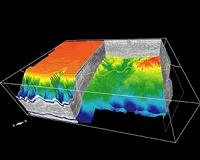
A 3-D model of a volcanic explosion, based on the 1980 eruption of Mount St. Helens in Washington state, may enhance our understanding of how some volcanic explosions occur and help identify of blast zones for potentially dangerous locations, according to an international team of volcanologists. "We took on the modeling of enormously complicated pyroclastic density currents, notably the classic, notorious May 1980 lateral blast that destroyed 500 square kilometers of forested terrain at Mount St. Helens," said Barry Voight, professor emeritus of geology and geological engineering, Penn State. Mount St. Helens erupted catastrophically on May 18, 1980, creating a low-angle lateral blast with an astonishing energy and particle content. The blast lasted less than five minutes, but caused severe damage over 230 square miles, killing 57 people and destroying 250 homes and 47 bridges. The damage was not caused by lava flows, but by a fast moving current of superheated gas that carried with it a heavy load of debris. "Volcanic lateral blasts are among the most spectacular and devastating of natural phenomena, but their dynamics are still poorly understood," the researchers reported in the current issue of the journal Geology. The researchers created the 3-D model using the parameters of the Mount St. Helens blast including equations to determine mass, momentum and the heat energy of the gas, along with the size, density, specific heat and thermal conductivity of the solid particles. "We integrated a wide range of geophysical and geochemical data to develop rigorous initial and boundary conditions for hydrodynamics calculations that reproduced, to an amazing degree, the observed dynamics of the blast envelope," said Voight. The 3-D model reproduced the Mount St. Helens blast, closely matching the complicated boundaries of the region of devastation and observed results on the ground. In the model, the areas of ground where pressures imply that trees would be blown down fit the actual locations of destroyed forests. "The calculations provided much insight into internal dynamics of the blast explosion cloud that could not be observed directly," said Voight. According to the researchers, the most important factors controlling where the blast travels and causes damage are a combination of gravity and the shape of the terrain. Pyroclastic blasts are blocked by mountains and channeled down river ravines and canyons. Previous models of the Mount St. Helens blast considered it to be dominated by a supersonic expanding jet of gas that originated at the volcanic vent. However, the research team suggests that apart from an initial burst that impacted a region less than 3.6 miles from the vent, the blast current was gravity driven. The researchers found that as the distance from the vent increased, the blast current weakened because of the energy lost while trying to go over obstacles. They also show spreading in all directions caused a slowing of the flow and that particle sedimentation removed energy from the flow. "Our present results demonstrate that, where detailed geological constraints are available and thanks to the availability of modern supercomputers, 3-D transient and multiphase flow models can fairly accurately reproduce the main large-scale features of blast scenarios," said Voight. The researchers note that "such an improvement in our modeling capability will make it possible to more effectively map potential blast flows at blast-dangerous volcanoes worldwide." Other researchers on the team are Tomaso Esposti Ongaro and Augusto Neri, Istituto Nazionale di Geofisica e Vulcanologia, Pisa, Italy; C. Widiwidjayanti, formerly at Penn State but now at Nanyang Technological University, Singapore; and Amanda B. Clarke, Arizona State University.
|
. |
|
| The content herein, unless otherwise known to be public domain, are Copyright 1995-2011 - Space Media Network. AFP and UPI Wire Stories are copyright Agence France-Presse and United Press International. ESA Portal Reports are copyright European Space Agency. All NASA sourced material is public domain. Additional copyrights may apply in whole or part to other bona fide parties. Advertising does not imply endorsement,agreement or approval of any opinions, statements or information provided by Space Media Network on any Web page published or hosted by Space Media Network. Privacy Statement |

 del.icio.us
 Digg
Digg Reddit
 Google