
. Military Space News .
SPACEWAR
AFCENT Airmen fight from ultimate high ground
by Staff Writers
Al Udeid Air Bas, Qatar (AFNS) Feb 15, 2017


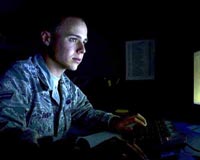
Airman 1st Class Tyler C. Santy, a 460th Space Communication Squadron network administrator, reviews information Oct. 20, 2016, at Buckley Air Force Base, Colo. The Combined Air Operations Center at Al Udeid Air Base, Qatar, serves as the tip of the spear of an enterprise of more than 35,000 space Airmen working together from more than 130 locations worldwide to fight the Islamic State of Iraq and the Levant. Image courtesy USAF and Airman Holden S. Faul.

As adversaries and challenges evolve in dynamic battlefields across the globe, U.S. service members from U.S. Air Forces Central Command are using cutting-edge technology to support and defend joint and coalition warfighters.

Before combatants meet on the battlefield, a war occurs in a domain where Airmen from space-centric career fields bring a global network of assets and experts together at the Combined Air Operations Center (CAOC) here to aid operations in the fight against the Islamic State of Iraq and the Levant.

From a global communication network to GPS to intelligence imagery, Col. Michael Jackson, the AFCENT director of space forces, said the battlespace would look vastly different without the work of space professionals around the globe.

"Modern warfare, whether air, land or maritime, is dependent on communications and information, meaning it's dependent on space operations," he said. "A day without space used in combat is like a day without oxygen."

Across the Defense Department, the Air Force is responsible for 90 percent of space assets and the team here uses these resources to provide support throughout U.S. Central Command's area of responsibility.

"Space is a key dimension of the battlespace just like air, land or sea - it's one we work to leverage against our enemies," said Lt. Gen. Jeff Harrigian the Combined Force Air Component commander. "It allows our forces to navigate with confidence, communicate with clarity, strike with accuracy and assess with assurance."

The CAOC serves as the tip of the spear of an enterprise of more than 35,000 space Airmen working together from more than 130 locations worldwide. Here, space personnel are integrated into every section of operations planning and execution to leverage the information for mission success.

Jackson said this reflects the impact his Airmen play in each aspect of the fight.

"We are involved in every aspect of the CAOC which allows us to integrate information at the speed of combat," he said. "If the enemy cannot respond as fast as we can, that means we have the advantage. We exercise a high standard and our Airmen have technological know-how to rise to those standards."

Across the CENTCOM AOR, space professionals protect the satellite communication network to ensure intelligence personnel and combat leaders can review and exploit information in real time. Once captured, the data is sent to processing centers around the world, then reviewed, packaged and sent to leaders for planning and decision making.

At any given moment, an unblinking constellation of remotely piloted aircraft flying across the Middle East transfer intelligence, surveillance and reconnaissance data across a web of military satellites, transmitting approximately 50 gigabytes of information, or the equivalent of 10 DVDs, every second.

This capability allows today's U.S. military unprecedented flexibility and immediacy never before seen in military history.

"In World War II, it could take days or weeks to determine a target and launch hundreds of bombers to drop thousands of pounds of ordinance. Then, leaders would have to wait until the planes returned and developed film to assess the strike," Jackson said. "Today, using our space resources, we can determine a target quickly, send one pilot in a single aircraft, strike the target and know within seconds if we need to reengage."

Jackson said this ability has directly allowed the U.S.-led coalition to lead the most accurate air campaign in history. Leveraging GPS technology, more than 90 percent of all weapons dropped strike within mere feet of the intended destination.

"Even just two years ago, the things we can do now were unthinkable," he said. "We've invested a lot in research and training to increase the effectiveness of our space program and now we see it saving lives and force multiplying."

While technological advantages empower joint and coalition forces to bring the fight to the enemy, Jackson said the space Airmen behind the scenes will continue to enable the mission across the globe.

"Our adversaries are increasingly competent in the digital campaign. We must continue to improve, increase and invest in our domination," he said. "Technology helps, but our Airmen are critical to leveraging our capabilities and they will keep fighting."


Comment on this article using your Disqus, Facebook, Google or Twitter login.


Thanks for being here;
We need your help. The Space Media Network continues to grow but revenues have never been harder to maintain.

With the rise of Ad Blockers, and Facebook - our traditional revenue sources via quality network advertising continues to decline. And unlike so many other news sites, we don't have a paywall - with those annoying usernames and passwords.

Our news coverage takes time and effort to publish 365 days a year.

If you find our news sites informative and useful then please consider becoming a regular supporter or for now make a one off contribution.
SpaceMediaNetwork Contributor
$5 Billed Once


credit card or paypal
SpaceMediaNetwork Monthly Supporter
$5 Billed Monthly


paypal only


.


Related Links
by Staff Sgt. R. Alex Durbin for USAF News
Military Space News at SpaceWar.com


Share this article via these popular social media networks
del.icio.usdel.icio.us DiggDigg RedditReddit GoogleGoogle

Previous Report
SPACEWAR
Goldfein shares space focus
Washington DC (AFNS) Feb 07, 2017
Space is no longer the final frontier for the joint warfighter as the Air Force will organize, train and equip those who rely on the critical domain of space. During the Mitchell Institute's Space Power Breakfast Feb. 3 at the Capitol Hill Club, Air Force Chief of Staff Gen. David L. Goldfein described space as a warfighting domain, and said the Air Force is responsible for 90 percent of t ... read more


SPACEWAR
Raytheon developing new tool for war game assessment

U.S. Army awards $3 billion in missile defense contracts

New US Missile Hits Target in Space

New Age, New Aims: CIS Air Defense to Be Upgraded for Aerospace Tasks

SPACEWAR
Thales, Bharat Dynamics ink STARStreak capability transfer deal

DARPA's MAD-FIRES project to enter Phase II

Textron announces successful test of G-CLAW missile

Boeing contracted for Harpoon, SLAM-ER spares

SPACEWAR
Wide-area sensor flight-tested on small drone

U.S. Marines test 'Instant Eye' mini drone

NS Mayport picked as forward operating base for drones

Indonesia first to purchase Skeldar V-200 drone

SPACEWAR
IAI secures $30 million in signals intelligence contracts

Terahertz wireless could make spaceborne satellite links as fast as fiber-optic links

Airbus provides satcom for EU security missions in Mali, Niger and Somalia

Engie, Airbus tapped to support French defense networks

SPACEWAR
Honeywell's Gold Shield to be used in vests for Brazil's police

Elbit supplying mortar fire control units to U.S. Army

U.S. Navy to buy 40 MRAP MaxxPro Dash DXM vehicles

Chinese weapons reaching 'near-parity' with West: study

SPACEWAR
Germany, Norway expand defense industry coooperation

NATO chief says increased defence spending top priority after Trump calls

Pentagon seeks to rent space in Trump Tower

Tales of woe from US military ahead of likely spending boost

SPACEWAR
US and Russia agree to boost military communications: Pentagon

China FM to attend G20 meeting alongside Tillerson

Flynn resignation has 'no impact' on US message to NATO: Pentagon chief

NATO to boost naval presence in Black Sea

SPACEWAR
Nano-level lubricant tuning improves material for electronic devices and surface coatings

Supercomputing, experiment combine for first look at magnetism of real nanoparticle

Scientists determine precise 3-D location 23,000 atoms in a nanoparticle

1,000 times more efficient nano-LED opens door to faster microchips


The content herein, unless otherwise known to be public domain, are Copyright 1995-2024 - Space Media Network. All websites are published in Australia and are solely subject to Australian law and governed by Fair Use principals for news reporting and research purposes. AFP, UPI and IANS news wire stories are copyright Agence France-Presse, United Press International and Indo-Asia News Service. ESA news reports are copyright European Space Agency. All NASA sourced material is public domain. Additional copyrights may apply in whole or part to other bona fide parties. All articles labeled "by Staff Writers" include reports supplied to Space Media Network by industry news wires, PR agencies, corporate press officers and the like. Such articles are individually curated and edited by Space Media Network staff on the basis of the report's information value to our industry and professional readership. Advertising does not imply endorsement, agreement or approval of any opinions, statements or information provided by Space Media Network on any Web page published or hosted by Space Media Network. General Data Protection Regulation (GDPR) Statement Our advertisers use various cookies and the like to deliver the best ad banner available at one time. All network advertising suppliers have GDPR policies (Legitimate Interest) that conform with EU regulations for data collection. By using our websites you consent to cookie based advertising. If you do not agree with this then you must stop using the websites from May 25, 2018. Privacy Statement. Additional information can be found here at About Us.