
 |
 |
 |
 |
 |
 |
 |
 |
 |
 |

| . |  |
. |
APEX Reveals Glowing Stellar Nurseries
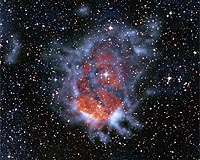
Paris, France (SPX) Nov 12, 2008 Illustrating the power of submillimetre-wavelength astronomy, an APEX image reveals how an expanding bubble of ionised gas about ten light-years across is causing the surrounding material to collapse into dense clumps that are the birthplaces of new stars. Submillimetre light is the key to revealing some of the coldest material in the Universe, such as these cold, dense clouds. The region, called RCW120, is about 4200 light years from Earth, towards the constellation of Scorpius. A hot, massive star in its centre is emitting huge amounts of ultraviolet radiation, which ionises the surrounding gas, stripping the electrons from hydrogen atoms and producing the characteristic red glow of so-called H-alpha emission. As this ionised region expands into space, the associated shock wave sweeps up a layer of the surrounding cold interstellar gas and cosmic dust. This layer becomes unstable and collapses under its own gravity into dense clumps, forming cold, dense clouds of hydrogen where new stars are born. However, as the clouds are still very cold, with temperatures of around -250 degrees Celsius, their faint heat glow can only be seen at submillimetre wavelengths. Submillimetre light is therefore vital in studying the earliest stages of the birth and life of stars. The submillimetre-wavelength data were taken with the LABOCA camera on the 12-m Atacama Pathfinder Experiment (APEX) telescope, located on the 5000 m high plateau of Chajnantor in the Chilean Atacama desert. Thanks to LABOCA's high sensitivity, astronomers were able to detect clumps of cold gas four times fainter than previously possible. Since the brightness of the clumps is a measure of their mass, this also means that astronomers can now study the formation of less massive stars than they could before. The plateau of Chajnantor is also where ESO, together with international partners, is building a next generation submillimetre telescope, ALMA, the Atacama Large Millimeter/submillimeter Array. ALMA will use over sixty 12-m antennas, linked together over distances of more than 16 km, to form a single, giant telescope. APEX is a collaboration between the Max-Planck-Institute for Radio Astronomy (MPIfR), the Onsala Space Observatory (OSO) and ESO. The telescope is based on a prototype antenna constructed for the ALMA project. Operation of APEX at Chajnantor is entrusted to ESO. Share This Article With Planet Earth
Related Links ESO Stellar Chemistry, The Universe And All Within It
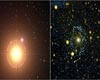
 Ghost Of Mirach Materializes
 Pasadena CA (SPX) Nov 03, 2008
NASA's Galaxy Evolution Explorer has lifted the veil off a ghost known to haunt the local universe, providing new insight into the formation and evolution of galaxies. |
|
|

| The content herein, unless otherwise known to be public domain, are Copyright 1995-2007 - SpaceDaily.AFP and UPI Wire Stories are copyright Agence France-Presse and United Press International. ESA Portal Reports are copyright European Space Agency. All NASA sourced material is public domain. Additional copyrights may apply in whole or part to other bona fide parties. Advertising does not imply endorsement,agreement or approval of any opinions, statements or information provided by SpaceDaily on any Web page published or hosted by SpaceDaily. Privacy Statement |
 del.icio.us
 Digg
Digg Reddit
 YahooMyWeb
 Google
 Facebook