|
 |
 |
 |
 |
 |
 |
 |
 |
 |

| . |  |
. |
 by Staff Writers Tempe AZ (SPX) Oct 21, 2015
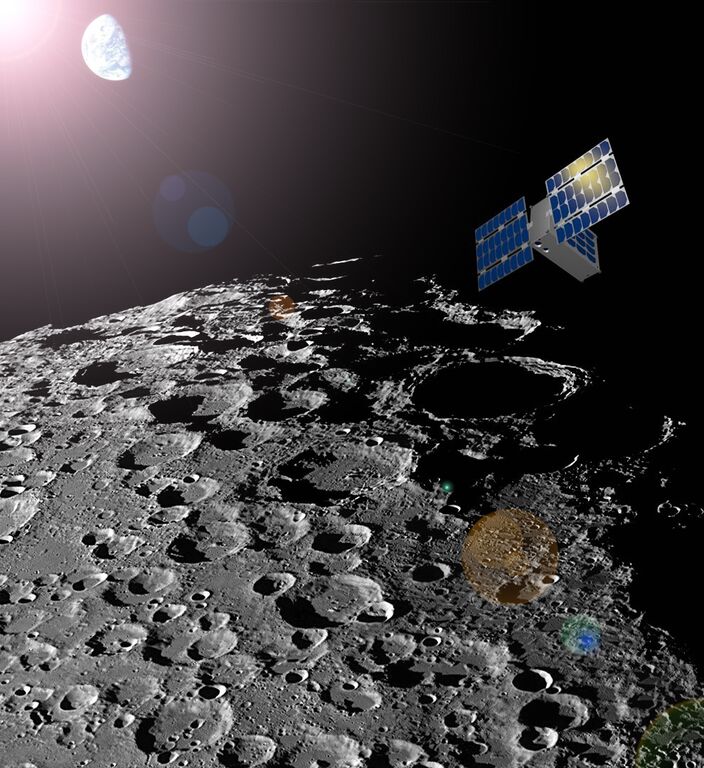
The White House has announced the creation of a nationwide "CubeSat competition" that partners high school students with leading universities for the development and operation of small space satellites. The announcement was part of the festivities surrounding White House Astronomy Night on Oct. 19. The CubeSat competition is being organized by Cornell University and the Museum of Science Fiction in Washington, D.C. Seven universities, including Arizona State University, will be participating partners. ASU's participation will be led and organized by Jim Bell, director of the ASU Space Technology and Science ("NewSpace") Initiative, and Ed Finn, director of ASU's Center for Science and the Imagination. CubeSats are a new and revolutionary way of doing space science. Because of their small size (roughly the size of a shoebox) and low cost of construction and operation, CubeSats have the potential to democratize space science, providing opportunities for students and citizens to design and even operate missions of their own. CubeSats are typically carried into space as secondary payloads on larger, more traditional space missions. "The CubeSat competition provides a great opportunity for students to get direct, hands-on experience in space science, engineering and exploration," said Bell, an ASU professor in the School of Earth and Space Exploration. "Part of our mission is to engage the community, especially young people, in the excitement of science, technology, engineering and mathematics (STEM) topics like space exploration." "This contest invites a new generation of explorers, researchers and entrepreneurs to dream big," said Finn, an assistant professor in the School of Arts, Media and Engineering and the Department of English. "Space has long been a canvas for great stories and grand ambitions, from the Apollo Program to 'Star Trek,' and the CubeSat competition gives winners the chance to see their ideas not just realized but launched into orbit." In the CubeSat competition, teams of high school students nationwide will propose inexpensive (less than $10,000) CubeSat missions to test technologies or conduct small-scale science experiments in space. Those proposals will be submitted by early 2016 and judged during the spring, with winners announced in summer 2016. The students will be encouraged, but not required, to reach out to participating universities, NASA Centers or aerospace companies for help with their proposal as they see fit. CubeSat competition judges will work with participating universities to match up their researchers' expertise with the best-fit high school proposals (based on geography, research or technology synergies, etc.). It is expected that the universities will develop the technology and engineering solutions needed to make the high school students' proposals functional and fit for flight. University researchers and high school students will interact by teleconference, videoconference and email. Some universities might bring students to campus to participate in various aspects of the design and build work. In some cases, university teams may be able to carve off one component of the CubeSat system for the students to work on and then integrate it into the larger system later in the program. The collaborative high school-university teams will apply for free NASA CubeSat launches through its CubeSat Launch Initiative. For Bell, the benefits of the competition are both inspirational and real. "The kinds of skills needed to plan, design, test, build and fly a spacecraft mission are directly translatable to a wide variety of careers in STEM and high-tech fields," he said. "Employers out there want not only book-smart students for these careers, but students who have gotten their hands dirty - literally or figuratively - building real-world mechanical, electrical or even software systems. "Projects like this provide a great opportunity for practical, pragmatic teaching moments for budding engineers and scientists, as well as great foundational skills in teamwork, critical thinking and problem solving even for students who do not go directly into careers in those fields."
Related Links Arizona State University Microsat News and Nanosat News at SpaceMart.com
|
|||||||||||||
|
|
| The content herein, unless otherwise known to be public domain, are Copyright 1995-2024 - Space Media Network. All websites are published in Australia and are solely subject to Australian law and governed by Fair Use principals for news reporting and research purposes. AFP, UPI and IANS news wire stories are copyright Agence France-Presse, United Press International and Indo-Asia News Service. ESA news reports are copyright European Space Agency. All NASA sourced material is public domain. Additional copyrights may apply in whole or part to other bona fide parties. All articles labeled "by Staff Writers" include reports supplied to Space Media Network by industry news wires, PR agencies, corporate press officers and the like. Such articles are individually curated and edited by Space Media Network staff on the basis of the report's information value to our industry and professional readership. Advertising does not imply endorsement, agreement or approval of any opinions, statements or information provided by Space Media Network on any Web page published or hosted by Space Media Network. General Data Protection Regulation (GDPR) Statement Our advertisers use various cookies and the like to deliver the best ad banner available at one time. All network advertising suppliers have GDPR policies (Legitimate Interest) that conform with EU regulations for data collection. By using our websites you consent to cookie based advertising. If you do not agree with this then you must stop using the websites from May 25, 2018. Privacy Statement. Additional information can be found here at About Us. |


 del.icio.us
 Digg
Digg Reddit
 Google