|
 |
 |
 |
 |
 |
 |
 |

| . |  |
. |

|
|
. |

 by Staff Writers Boston MA (SPX) Aug 12, 2011
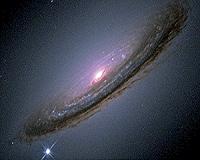
VV 340, also known as Arp 302, provides a textbook example of colliding galaxies seen in the early stages of their interaction. The edge-on galaxy near the top of the image is VV 340 North and the face-on galaxy at the bottom of the image is VV 340 South. Millions of years later these two spirals will merge - much like the Milky Way and Andromeda will likely do billions of years from now. Data from NASA's Chandra X-ray Observatory (purple) are shown here along with optical data from the Hubble Space Telescope (red, green, blue). VV 340 is located about 450 million light years from Earth. Because it is bright in infrared light, VV 340 is classified as a Luminous Infrared Galaxy (LIRG). These observations are part of the Great Observatories All-Sky LIRG Survey (GOALS) combining data from Chandra, Hubble, NASA's Spitzer Space Telescope and Galaxy Evolution Explorer (GALEX) and ground-based telescopes. The survey includes over two hundred LIRGs in the local Universe. A chief motivation of this study is to understand why LIRGs emit so much infrared radiation. These galaxies generate energy at a rate this is tens to hundreds of times larger than that emitted by a typical galaxy. An actively growing supermassive black hole or an intense burst of star formation is often invoked as the most likely source of the energy. Work on the full GOALS survey is ongoing, but preliminary analysis of data for VV 340 provides a good demonstration of the power of observing with multiple observatories. The Chandra data show that the center of VV 340 North likely contains a rapidly growing supermassive black hole that is heavily obscured by dust and gas. The infared emission of the galaxy pair, as observed by Spitzer, is dominated by VV 340 North, and also provides evidence for a growing supermassive black hole. However, only a small fraction of the infrared emission is generated by this black hole. By contrast most of the ultraviolet and short wavelength optical emission in the galaxy pair - as observed by GALEX and HST - comes from VV 340 South. This shows that VV 340 South contains a much higher level of star formation. (The Spitzer and GALEX images are not shown here because they strongly overlap with the optical and X-ray images, but they are shown in a separate composite image.) VV 340 appears to be an excellent example of a pair of interacting galaxies evolving at different rates. These results on VV 340 were published in the June 2009 issue of the Publications of the Astronomical Society of the Pacific. The lead author was Lee Armus from the Spitzer Science Center in Pasadena, CA.
|
. |
|
| The content herein, unless otherwise known to be public domain, are Copyright 1995-2011 - Space Media Network. AFP and UPI Wire Stories are copyright Agence France-Presse and United Press International. ESA Portal Reports are copyright European Space Agency. All NASA sourced material is public domain. Additional copyrights may apply in whole or part to other bona fide parties. Advertising does not imply endorsement,agreement or approval of any opinions, statements or information provided by Space Media Network on any Web page published or hosted by Space Media Network. Privacy Statement |

 del.icio.us
 Digg
Digg Reddit
 Google