
 |
 |
 |
 |
 |
 |
 |
 |
 |
 |

| . |  |
. |
A Dark Matter Disk In Our Galaxy
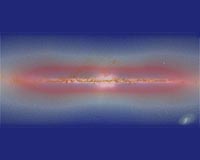
Zurich, Switzerland (SPX) Sep 17, 2008 An international team of scientists predict that our Galaxy, the Milky Way, contains a disk of 'dark matter'. In a paper published in Monthly Notices of the Royal Astronomical Society, astronomers Dr Justin Read, Professor George Lake and Oscar Agertz of the University of Zurich, and Dr Victor Debattista of the University of Central Lancashire use the results of a supercomputer simulation to deduce the presence of this disk. They explain how it could allow physicists to directly detect and identify the nature of dark matter for the first time. Unlike the familiar 'normal' matter that makes up stars, gas and dust, 'dark' matter is invisible but its presence can be inferred through its gravitational influence on its surroundings. Physicists believe that it makes up 22% of the mass of the Universe (compared with the 4% of normal matter and 74% comprising the mysterious 'dark energy'). But, despite its pervasive influence, no-one is sure what dark matter consists of. Prior to this work, it was thought that dark matter forms in roughly spherical lumps called 'halos', one of which envelopes the Milky Way. But this 'standard' theory is based on supercomputer simulations that model the gravitational influence of the dark matter alone. The new work includes the gravitational influence of the stars and gas that also make up our Galaxy. Stars and gas are thought to have settled into disks very early on in the life of the Universe and this affected how smaller dark matter halos formed. The team's results suggest that most lumps of dark matter in our locality merged to form a halo around the Milky Way. But the largest lumps were preferentially dragged towards the galactic disk and were then torn apart, creating a disk of dark matter within the Galaxy. "The dark disk only has about half of the density of the dark matter halo, which is why no one has spotted it before," said lead author Justin Read. "However, despite its low density, if the disk exists it has dramatic implications for the detection of dark matter here on Earth." The Earth and Sun move at some 220 kilometres per second along a nearly circular orbit about the centre of our Galaxy. Since the dark matter halo does not rotate, from an Earth-based perspective it feels as if we have a 'wind' of dark matter flowing towards us at great speed. By contrast, the 'wind' from the dark disk is much slower than from the halo because the disk co-rotates with the Earth. "It's like sitting in your car on the highway moving at a hundred kilometres an hour", said team member Dr Victor Debattista. "It feels like all of the other cars are stationary because they are moving at the same speed." This abundance of low-speed dark matter particles could be a real boon for researchers because they are more likely to excite a response in dark matter detectors than fast-moving particles. "Current detectors cannot distinguish these slow moving particles from other background 'noise'," said Prof. Laura Baudis, a collaborator at the University of Zurich and one of the lead investigators for the XENON direct detection experiment, which is located at the Gran Sasso Underground Laboratory in Italy. "But the XENON100 detector that we are turning on right now is much more sensitive. For many popular dark matter particle candidates, it will be able to see something if it's there." This new research raises the exciting prospect that the dark disk - and dark matter - could be directly detected in the very near future. Community Email This Article Comment On This Article Share This Article With Planet Earth
Related Links University of Zurich Stellar Chemistry, The Universe And All Within It
 A Clash Of Clusters Provides Another Clue To Dark Matter
 Boston MA (SPX) Aug 28, 2008
A powerful collision of galaxy clusters has been captured with NASA's Chandra X-ray Observatory and Hubble Space Telescope. Like its famous cousin, the so-called Bullet Cluster, this clash of clusters provides striking evidence for dark matter and insight into its properties. |
|
|

| The content herein, unless otherwise known to be public domain, are Copyright 1995-2007 - SpaceDaily.AFP and UPI Wire Stories are copyright Agence France-Presse and United Press International. ESA Portal Reports are copyright European Space Agency. All NASA sourced material is public domain. Additional copyrights may apply in whole or part to other bona fide parties. Advertising does not imply endorsement,agreement or approval of any opinions, statements or information provided by SpaceDaily on any Web page published or hosted by SpaceDaily. Privacy Statement |
 del.icio.us
 Digg
Digg Reddit
 YahooMyWeb
 Google
 Facebook