|
 |
 |
 |
 |
 |
 |
 |
 |
 |

| . |  |
. |
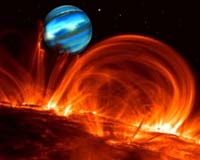
A Giant Planet Embedded In The Magnetosphere Of Its Star
Mauna Kea HI (SPX) Nov 28, 2006 Using the ESPaDOnS spectropolarimeter installed on the Canada-France-Hawaii telescope (Mauna Kea, Hawaii), an international team of researchers, led by two French astronomers (C. Catala, LESIA, Observatoire de Paris, and J. F. Donati, LATT, Observatoire Midi-Pyrenees), has just discovered a magnetic field on tau Bootis, a star orbited by a giant planet on a close-in orbit: the first ever detection of this kind! Up to now, only indirect clues pointed to the presence of magnetic fields on stars hosting giant extra-solar planets. This result opens major prospects, in particular the study of the interaction between the planet and the magnetosphere of its star. This discovery is published in a Letter to the Journal MNRAS (Monthly Notices of Royal Astronomical Society). The catalogue of extrasolar planets is growing continuously, containing today more than 200 objects, and the detection of these exoplanets has almost become a routine. But what are the characteristics of the stellar hosts, how can we explain the formation of these planetary systems, or why are some of these giant exoplanets, which are called 'hot jupiters', migrating down to very close-in orbits? Astrophysicists suspect the magnetic field to play a crucial role in some of these questions. However, although indirect effects of magnetic fields have already been detected on stars hosting giant extrasolar planets, no direct measurement had ever been done until now. This first measurement of a magnetic field in a planet-hosting star has been obtained by an international team of astronomers with the ESPaDOnS spectropolarimeter installed on the Canada-France-Hawaii telescope. They detected the magnetic field of tau Bootis, a one billion year old star, having a mass of one and a half solar masses and located at nearly 50 light years from the Earth. This cool and weakly active star, orbited by a giant planet with 4.4 Jupiter masses on a very close-in orbit at 0.049 AU (i. e. 5% of the Sun-Earth distance), possesses a magnetic field of a few gauss, just a little more than the Sun's, but showing a more complex structure. Moreover, astronomers have also measured the level of differential rotation of the star, a crucial parameter in the generation of magnetic fields. In the present case, the matter located at the equator rotates 18% faster than that located at the poles, leading by one full turn in approximately 15 days. By comparing the differential rotation of the star with the revolution of the giant extrasolar planet, astronomers have noticed that the planet is synchronized with stellar material located at about 45 degrees. This observation suggests very complex interactions between the magnetosphere of the star and its companion, perhaps similar to the interaction of the magnetosphere of Jupiter with its satellite Io, giving rise to the so-called "Io torus". The data collected for this study are not sufficient to describe precisely these interactions, but this first measurement is opening new prospects for detailed studies of star-planet systems. Notes: ESPaDOnS is a collaborative project funded by France (CNRS/INSU, Minist�re de la Recherche, LATT - Observatoire Midi Pyrenees, Laboratoire d'Etudes Spatiales et d'Instrumentation en Astrophysique - Observatoire de Paris), Canada ((NSERC), CFHT and ESA (ESTEC/RSSD). CFHT is operated by the National Research Council of Canada, the Institut National des Sciences de l'Univers of the Centre National de la Recherche Scientifique of France, and the University of Hawaii. Related Links Canada-France-Hawaii telescope Beyond Sol  Corot And The New Chapter Of Planetary Searches
 Paris, France (ESA) Nov 16, 2006
The launch of COROT on 21 December 2006 is a long awaited event in the quest to find planets beyond our Solar System. Searching from above the Earth's atmosphere, COROT - the CNES project with ESA participation - will be the first space mission specifically dedicated to the search for extrasolar planets. |
|
|

| The content herein, unless otherwise known to be public domain, are Copyright 1995-2006 - SpaceDaily.AFP and UPI Wire Stories are copyright Agence France-Presse and United Press International. ESA PortalReports are copyright European Space Agency. All NASA sourced material is public domain. Additionalcopyrights may apply in whole or part to other bona fide parties. Advertising does not imply endorsement,agreement or approval of any opinions, statements or information provided by SpaceDaily on any Web page published or hosted by SpaceDaily. Privacy Statement |