. Military Space News .


.
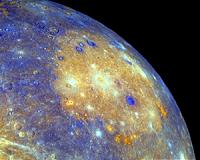
MERCURY RISING
A Mariner 10 Perspective on MESSENGER: A First-person Account
by Staff Writers
Laurel MD (SPX) Jun 09, 2011

Comparison of Mariner 10 (left) and MESSENGER (right) images of the Tolstoj impact basin, approximately 350 km in diameter. The level of detail visible in the MESSENGER mosaic (~220 m/pixel) is much greater than that in the Mariner 10 mosaic (~1 km/pixel). MESSENGER will image more than 90% of Mercury's surface at an average resolution of 250 m/pixel or better, a feat that could never have been accomplished by Mariner 10. MESSENGER is also taking higher-resolution targeted images at resolutions of 10-25 m/pixel! For a larger version of this image please go here.

Forty years ago, in 1971, I became a member of the Mariner 10 imaging science team. This Mercury flyby mission was intended to gather atmospheric data at Venus and geological and geophysical data at Mercury in preparation for a Mercury orbiter mission. At that time we knew almost nothing about the innermost planet, and the Mariner 10 flybys were intended to help in the selection of an instrument payload for an orbital mission.

The Mariner 10 spacecraft flew by Venus once and Mercury three times. Because of the configuration of the flybys and the orbit of Mercury, Mariner 10 imaged the same hemisphere of Mercury on each of its three flybys, for a total surface coverage of only 45%. Much of this coverage was taken with the Sun high in the sky, a situation that makes it difficult to see topography. As a result, we could perform geological analyses on only about 30% of the surface.

The technique of sending a spacecraft to orbit Mercury using multiple planetary flybys was discovered in the mid-1980s. However, the difficulties and expense of a Mercury orbital mission (estimated at ~$1 billion in 1985 dollars), coupled with a perception that Mercury was similar to the Moon and therefore of low scientific priority, meant that no such mission was developed for decades.

It was not until the Carnegie Institution of Washington and the John Hopkins University Applied Physics Laboratory devised a low-cost Mercury orbiter concept that an orbital mission was approved, as part of NASA's Discovery Program. I am very privileged to be the only person on the MESSENGER Science Team who also participated in the Mariner 10 mission.

When MESSENGER went into orbit about Mercury on March 18, 2011, I was overjoyed. I had waited almost 40 years for that moment. When the spacecraft sent back its first images on March 29, 2011, the date was 37 years to the day after Mariner 10's historic first flyby. What a coincidence!

Since then I have been overwhelmed by the quality of the MESSENGER's Mercury Dual Imaging System (MDIS) images and the data from the six other instruments on the spacecraft, and how much better they are than the Mariner 10 data.

Although the Moon and Mercury are both heavily cratered surfaces, Mercury's history is very different from that of the Moon, and the new images are making that extremely clear. The MESSENGER mission has started a new era in planetary exploration and will finally provide information that will allow us to better understand this strange and wonderful planet.


Related Links
MESSENGER
News Flash at Mercury
Mars News and Information at MarsDaily.com
Lunar Dreams and more

.
Get Our Free Newsletters Via Email
...
Buy Advertising Editorial Enquiries


. Comment on this article via your Facebook, Yahoo, AOL, Hotmail login.

Share this article via these popular social media networks
del.icio.usdel.icio.us DiggDigg RedditReddit GoogleGoogle


MERCURY RISING
The Shape of Mercury
Bethesda MD (SPX) Jun 01, 2011
The MESSENGER spacecraft, recently injected into orbit about the Solar Systems' inner-most planet is already yielding important new information about Mercury. This spacecraft carries a laser altimeter and, in its first two months of operation, has already built up a grid of ground tracks that span most of Mercury's surface in its northern hemisphere. This grid provides a very good measure ... read more


MERCURY RISING
Seoul deploys second Aegis destroyer

Russia says NATO not listening on missile shield

NATO chief rejects Russia's missile defence proposal

Russia softens stance on missile defence: report

MERCURY RISING
India tests nuclear-capable missile

MBDA Qualifies the New Naval Version of the Marte MK2 Missile

JAGM Tri-Mode Seeker Demonstrated Against Moving Sea Targets

Raytheon-Boeing Team Responds to Warfighter's Call for Joint Air-To-Ground Missile

MERCURY RISING
Heron One achieves full operational capability in ISAF mission

Elbit to Supply a Latin-American Country with Hermes 900 UAS

AeroVironment Receives New Orders for Digital Raven Systems

NMSU stages successful UAV test over Hatch

MERCURY RISING
New military radio unveiled

Indra To Supply Satellite Communications Systems To Brazil's MoD

Lockheed system proves its worth

Intelsat General To Support Armed Forces Radio And Television Service

MERCURY RISING
MBDA Produces 10,000th Diamond Back Wing for SDB Program

Advanced Firefinder Radar System Supporting US Troops

Otokar Awarded Contract for ARMA 6x6

BAE Delivers 20,000th Warning Sensor to Protect Military Aircraft

MERCURY RISING
Australian forces receive 'very many' abuse claims

France to pay 460 mn euros to Taiwan over frigate deal

Saudis mount cleanup amid defense scandal

Boeing Leads Team to Pursue USAF Launch Range Consolidation Contract

MERCURY RISING
Rule of law index finds faults in China, Russia, US

Russia protests arrival of US Navy cruiser in Black Sea

Commentary: Half pregnant strategy

NATO, Russian jets hold first ever joint exercise

MERCURY RISING
MLD Test Moves Navy A Step Closer To Lasers For Ship Self-Defense

US Navy And Northrop Grumman Accomplish Goals For At-Sea Demonstration Of Maritime Laser


Memory Foam Mattress Review
Newsletters :: SpaceDaily Express :: SpaceWar Express :: TerraDaily Express :: Energy Daily
XML Feeds :: Space News :: Earth News :: War News :: Solar Energy News
.

The content herein, unless otherwise known to be public domain, are Copyright 1995-2011 - Space Media Network. AFP and UPI Wire Stories are copyright Agence France-Presse and United Press International. ESA Portal Reports are copyright European Space Agency. All NASA sourced material is public domain. Additional copyrights may apply in whole or part to other bona fide parties. Advertising does not imply endorsement,agreement or approval of any opinions, statements or information provided by Space Media Network on any Web page published or hosted by Space Media Network. Privacy Statement