|
 |
 |
 |
 |
 |
 |
 |
 |
 |

| . |  |
. |
A New Class of Planet?
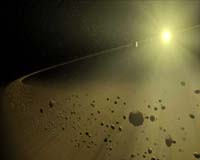
Moffett Field CA (SPX) Jul 14, 2005 Over the past decade, astronomers using a planet-hunting technique that measures small changes in a star's speed relative to Earth, have discovered more than 130 extrasolar planets. The first such planets were gas giants, the mass of Jupiter or larger. After several years, the scientists began to detect Saturn-mass planets. And last August, they announced the discovery of a handful of Neptune-mass planets. Could these be super-Earths? In a recent talk at a symposium on extrasolar planets, Carnegie Institution of Washington astronomer Alan Boss explained the possibilities. Radial-velocity planet-hunting techniques recently have pushed our discovery capability below the Saturn-mass limit down into what we would call the ice-giant limit. So we are now able to find planets, close to their host stars, with masses comparable to that of Uranus and Neptune (14 to 17 times the mass of Earth). In large part this is due to Michel Mayor and his colleagues having a new spectrometer in La Silla, which has unprecedented spectral resolution down to about 1 meter per second or so. And I think Geoff Marcy and Paul Butler's group are quite close behind that as well. The interesting question, though, is: What are these things? Are they ice giants that formed several AUs out and migrated in, or are they something else? Unfortunately, we don't know exactly what their masses are. Even more importantly, we don't really know what their density is. So they could be 15-Earth-mass rocks, or they could be 15-Earth-mass ice giants. What we really need to do is to have folks go out and discover another 7 or so. We've got 3 so far. If we had 10 altogether, then we'll have enough that 1 of them, at least, should transit its star and then we'll be able to get some idea of what its density is. I think, though, that there's a good chance that these might actually be a new class of planet altogether: super-Earths. The reason I would argue that is that, at least in 2 of the systems where they've been found, these "hot Neptunes" are accompanied by a larger Jupiter-mass planet with a longer-period orbit. If the lower-mass planets are ice giants that formed far from their stars, unless you have some highly contrived scenario, you wouldn't imagine them to end up migrating inward, past the larger guys. These systems look more like our own solar system, where you have the low-mass fellows inside of the gas giants. The planets in a system like our system presumably did not undergo very much migration. So I would claim that perhaps these guys are objects which formed inside the gas giants and only migrated in a little bit, ending up where we can detect them with the short-period spectroscopy surveys. In support of this idea, there's some theoretical work from Carnegie's George Wetherill from almost 10 years ago, now, where he had done some calculations of the accumulation process of rocky planets. He often found there was quite a spread in the masses of what you got out, because accumulation's a very stochastic process. For the typical parameters he used, at the end of 100 million years or so, he would not only get objects of 1 Earth mass, but also objects ranging up to 3 Earth masses. Well, at the time, he assumed for his calculations a fairly low surface density at 1 AU, where these planets were forming. Given what we know now, if you want to be able to make a Jupiter at 5 AU using the core-accretion model of planetary formation, you have to crank up the density in the protoplanetary disk by a factor of 7 or so over what Wetherill assumed. That scales directly with the mass of the planets you'd expect to find as a result. So if you did these calculations over again, assuming this higher initial density, the upper limit on the mass of the inner planets would go from 3 Earth masses, which is what Wetherill got, up to say 21 Earth masses. That is in the range of what we are estimating for these newly discovered hot Neptune-mass objects. So perhaps what we really are seeing is a new class of objects, super-Earths, rather than ice giants. Related Links SpaceDaily Search SpaceDaily Subscribe To SpaceDaily Express  First Planet Under Three Suns Is Discovered
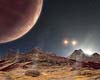 Pasadena CA (SPX) Jul 14, 2005
An extrasolar planet under three suns has been discovered in the constellation Cygnus by a planetary scientist at the California Institute of Technology using the 10-meter Keck I telescope in Hawaii. |
|
|

| The content herein, unless otherwise known to be public domain, are Copyright 1995-2006 - SpaceDaily.AFP and UPI Wire Stories are copyright Agence France-Presse and United Press International. ESA PortalReports are copyright European Space Agency. All NASA sourced material is public domain. Additionalcopyrights may apply in whole or part to other bona fide parties. Advertising does not imply endorsement,agreement or approval of any opinions, statements or information provided by SpaceDaily on any Web page published or hosted by SpaceDaily. Privacy Statement |