
 |
 |
 |
 |
 |
 |
 |
 |
 |
 |

| . |  |
. |

Moffett Field CA (SPX) Apr 13, 2011 Astronomers have come up with a new way of identifying close, faint stars with NASA's Galaxy Evolution Explorer satellite. The technique should help in the hunt for planets that lie beyond our solar system, because nearby, hard-to-see stars could very well be home to the easiest-to-see alien planets. The glare of bright, shining stars has frustrated most efforts at visualizing distant worlds. So far, only a handful of distant planets, or exoplanets, have been directly imaged. Small, newborn stars are less blinding, making the planets easier to see, but the fact that these stars are dim means they are hard to find in the first place. Fortunately, the young stars emit more ultraviolet light than their older counterparts, which makes them conspicuous to the ultraviolet-detecting Galaxy Evolution Explorer. "We've discovered a new technique of using ultraviolet light to search for young, low-mass stars near the Earth," said David Rodriguez, a graduate student of astronomy at UCLA, and lead author of a recent study. "These young stars make excellent targets for future direct imaging of exoplanets."
Tantrum-Throwing Baby Stars Rodriguez and his team figured the Galaxy Evolution Explorer, which has scanned about three- quarters of the sky in ultraviolet light, could fill this gap. Astronomers compared readings from the telescope with optical and infrared data to look for the telltale signature of rambunctious junior stars. Follow-up observations of 24 candidates identified in this manner determined that 17 of the stars showed clear signs of youth, validating the team's approach. "The Galaxy Evolution Explorer can readily select young, low-mass stars that are too faint to turn up in all-sky X-ray surveys, which makes the telescope an incredibly useful tool," Rodriguez said.
Cool, Red, and in the Neighborhood In many ways, these stars represent a best-case scenario for the direct imaging of exoplanets. They are close and in clear lines-of-sight, which generally makes viewing easier. Their low mass means they are dimmer than heavier stars, so their light is less likely to mask the feeble light of a planet. And because they are young stars, their planets are freshly formed, and thus warmer and brighter than older planetary bodies.
The Better to See Planets With At a very basic level, directly imaging an exoplanet is worthwhile because, after all, "seeing is believing," Rodriguez said. But catching a glimpse of an exoplanet also opens up novel scientific avenues. Direct imaging is well suited for seeing big planets circling host stars at considerable distances, comparable to Uranus and Neptune in our solar system. Observing such arrangements is useful for testing concepts of solar system evolution, Rodriguez said. Plus, gleaning details about the atmospheres of imaged exoplanets is less difficult than indirectly investigating worlds that transit their stars. As for actually imaging clouds or surface features of exoplanets, however, that will have to wait. Current images of exoplanets, while full of information, resemble fuzzy dots. But as technology advances, ever more information about our close-by planetary brethren will emerge. Data from NASA's Wide-field Infrared Survey Explorer (WISE) mission could also reveal stars that would make good candidates for imaging planets. Its all-sky maps will allow scientists to pick out nearby, young stars surrounded by warm disks of planetary debris that glow with infrared light. Such stars are similar to the ones where planets have already been successfully imaged. The new study was published in the February issue of The Astrophysical Journal and includes co- authors Mike Bessell (Australian National University), Ben Zuckerman (UCLA), and Joel Kastner (Rochester Institute of Technology).
Share This Article With Planet Earth
Related Links Galaxy Evolution Explorer Lands Beyond Beyond - extra solar planets - news and science Life Beyond Earth

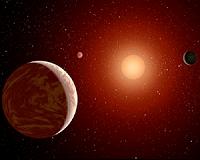 Telescope Ferrets Out Planet-Hunting Targets
Pasadena CA (JPL) Apr 11, 2011 Astronomers have come up with a new way of identifying close, faint stars with NASA's Galaxy Evolution Explorer satellite. The technique should help in the hunt for planets that lie beyond our solar system, because nearby, hard-to-see stars could very well be home to the easiest-to-see alien planets. The glare of bright, shining stars has frustrated most efforts at visualizing distant worl ... read more |
|
|
| The content herein, unless otherwise known to be public domain, are Copyright 1995-2010 - SpaceDaily. AFP and UPI Wire Stories are copyright Agence France-Presse and United Press International. ESA Portal Reports are copyright European Space Agency. All NASA sourced material is public domain. Additional copyrights may apply in whole or part to other bona fide parties. Advertising does not imply endorsement,agreement or approval of any opinions, statements or information provided by SpaceDaily on any Web page published or hosted by SpaceDaily. Privacy Statement |


 del.icio.us
 Digg
Digg Reddit
 YahooMyWeb
 Google
 Facebook


