
 |
 |
 |
 |
 |
 |
 |
 |
 |
 |

| . |  |
. |
A Strategy For Detecting Earth-Like Planets
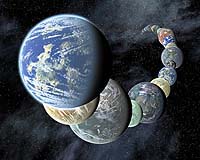
Washington DC (SPX) Oct 13, 2008 The Exoplanet Task Force of the Astronomy and Astrophysics Advisory Committee has released its report detailing a strategy for obtaining the first detection and characterization of Earth-like planets around other stars within a time frame as short as 15 years. Finding such planets would answer one of the great questions of modern science: are planets like Earth common or rare? We stand on a great divide in the detection and study of "exoplanets''-planets orbiting other stars. On one side of this divide are the hundreds of known massive exoplanets that we have discovered over the last 10 years. We have expanded our knowledge of these extraordinary and unexpected planets by measuring the densities and atmospheric temperatures for some of the hottest exoplanets. On the other side of the divide lies the possibility, as yet unrealized, of detecting and characterizing a true Earth analog-a planet of one Earth mass or Earth radius orbiting a sun-like star at a distance similar to the Earth-Sun separation. The Exoplanet Task Force Report describes potentially how to bridge this divide. Sixteen astronomers carried out the study, chartered by the National Aeronautics and Space Administration and the National Science Foundation. The larger astronomical community participated through a call for "white papers" that yielded 84 submissions on planet detection techniques. The recommendations of the Task Force emphasize immediate investment in technology and space mission development that will lead to discovering and characterizing Earth analogs. Central to the strategy is a two-pronged approach that includes both ground- and space-based techniques. The first prong uses ground-based and space-based systems in existence or under development to search for and characterize Earth-sized planets around the smallest stars-the "M-dwarfs." This strategy provides short-term payback but won't find true Earth analogs since M-dwarfs are quite different from solar-like stars. The second prong develops more advanced techniques to search for Earths around stars like the Sun. The strategy calls for a spaceborne astrometric telescope, specifically designed to identify nearby Sun-like stars with Earth-mass planets. Once we have the "addresses" of such stars and know where to look, an imaging system in space could determine the atmospheric composition of such bodies. Although the latter step is extraordinarily challenging, such a capability would be a major step along the way to answering the question, "Are we alone?" The Executive Summary of the report is in press in the journal Astrobiology. The report, with a list of Task Force Members, can be obtained from the NSF. Community Email This Article Comment On This Article Share This Article With Planet Earth
Related Links Exoplanet Task Force Report Lands Beyond Beyond - extra solar planets - news and science Life Beyond Earth
 COROT Discovers Exotic Object
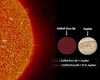 Paris, France (ESA) Oct 07, 2008
COROT has discovered a massive planet-sized object orbiting its parent star closely, unlike anything ever spotted before. It is so exotic, that scientists are unsure as to whether this oddity is actually a planet or a failed star. |
|
|

| The content herein, unless otherwise known to be public domain, are Copyright 1995-2007 - SpaceDaily.AFP and UPI Wire Stories are copyright Agence France-Presse and United Press International. ESA Portal Reports are copyright European Space Agency. All NASA sourced material is public domain. Additional copyrights may apply in whole or part to other bona fide parties. Advertising does not imply endorsement,agreement or approval of any opinions, statements or information provided by SpaceDaily on any Web page published or hosted by SpaceDaily. Privacy Statement |
 del.icio.us
 Digg
Digg Reddit
 YahooMyWeb
 Google
 Facebook