
. Military Space News .
BIO FUEL
A new strategy for efficient hydrogen production
by Staff Writers
Ulsan, South Korea (SPX) Jan 02, 2018


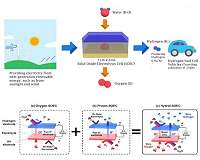
The economic impact of SOEC, developed by Professor Guntae Kim in September, 2016. and a schematic diagrams of the working principle.

A joint research team, affiliated with UNIST has introduced the Hybrid-Solid Electrolysis Cell (Hybrid-SOEC) system with highest reported electrochemical performance in hydrogen production. The proposed system has attracted much attention as a new promising option for the cost-effective and highly-efficient hydrogen production, as it shows excellent performance compared with other water-electrolysis systems.

This breakthrough has been led by Professor Guntae Kim in the School of Energy and Chemical Engineering at UNIST in collaboration with Professor Tak-Hyoung Lim of Korea Institute of Energy Research (KIER) and Professor Jeeyoung Shin of Sookmyung Women's University.

A solid oxide electrolyzer cell (SOEC) consists of two electrodes and an electrolyte that are all in solid-state. They are strongly desired as novel candidates for the hydrogen production, as they require no need to replenish lost electrolytes, while eliminating the corrosion problems. Besides, SOECs also operate at relatively high temperatures (700-1000 C), which helps to offer reduced electrical energy consumption.

Professor Kim and his research team have been seeking ways to improve energy efficiency of hydrogen production, using SOEC. In the study, the research team has demonstrated the novel concept of Hybrid-SOEC based on the mixed ionic conducting electrolyte, allowing water electrolysis to be occurred at both hydrogen and air electrodes.

The existing SOEC electrolytes allows the transport of either only one of the hydrogen or oxygen ions to the other electrode. For the cases like the SOEC electrolytes that transport oxygen ions, water electrolysis occurs at the anode and this results in the production of hydrogen.

In contrast, the SOEC electrolytes that transport hydrogen ions cause water electrolysis to occur at the cathode and this results in the production of oxygen. Here, hydrogen travels through the electrolyte to the anode.

Theoretically, using electrolytes that transport both hydrogen and oxygen ions, allows the production of two electrolysis products, hydrogen and oxygen, on both sides of the cell. This could improve hydrogen production rate greatly. In the study, the research team paid attention to the control of properties of electrolytes.

In this study, Professor Kim and his research team reported their new findings in exploring a SOEC based on a mixed-ion conductor that can transport both oxygen ion and proton at the same time, which is denoted as Hybrid-SOEC.

In comparison to other SOECs and representative water-electrolysis devices reported in the literatures, the proposed system demands less electricity for hydrogen production, while exhibiting outstanding electrochemical performance with stability. Moreover, the Hybrid SOEC exhibits no observable degradation in performance for more than 60 hours of continuous operation, implying a robust system for hydrogen production.

"By controlling the driving environment of the hydrogen ion conductive electrolyte, a 'mixed ion conductive electrolyte' in which two ions pass can be realized," says Junyoung Kim in the doctoral program of Energy and Chemical Engineering, the first author of the study.

"In Hybrid-SOEC where this electrolyte was first introduced, water electrolysis occurred at both electrodes, which results in significant increase in total hydrogen production."

The layered perovskite with excellent electrochemical properties was used as the electrode of Hybrid-SOEC. By adding an excellent electrode material on mixed ionic conducting electrolyte, resulting in enhanced electrochemical performance.

As a result, the corresponding yields of hydrogen produced were 1.9 L per hour at a cell voltage of 1.5 V at 700 C. This is four times higher hydrogen production efficiency than the existing high-efficient water electrolytic cells.

Junyoung Kim et al., "Hybrid-solid oxide electrolysis cell: A new strategy for efficient hydrogen production," (2017), Nano Energy.

BIO FUEL
Microbes help turn Greek yogurt waste into fuel
Washington DC (SPX) Dec 19, 2017
Consumers across the world enjoy Greek yogurt for its taste, texture, and protein-packed punch. Reaching that perfect formula, however, generates large volumes of food waste in the form of liquid whey. Now researchers in the United States and Germany have found a way to use bacteria to turn the leftover sugars and acids from Greek yogurt into molecules that could be used in biofuels or safe feed ... read more

Related Links
Ulsan National Institute of Science and Technology
Bio Fuel Technology and Application News


Thanks for being here;
We need your help. The Space Media Network continues to grow but revenues have never been harder to maintain.

With the rise of Ad Blockers, and Facebook - our traditional revenue sources via quality network advertising continues to decline. And unlike so many other news sites, we don't have a paywall - with those annoying usernames and passwords.

Our news coverage takes time and effort to publish 365 days a year.

If you find our news sites informative and useful then please consider becoming a regular supporter or for now make a one off contribution.
SpaceMediaNetwork Contributor
$5 Billed Once


credit card or paypal
SpaceMediaNetwork Monthly Supporter
$5 Billed Monthly


paypal only


Comment using your Disqus, Facebook, Google or Twitter login.

Share this article via these popular social media networks
del.icio.usdel.icio.us DiggDigg RedditReddit GoogleGoogle

BIO FUEL
Lockheed Martin to support AEGIS system for Japanese self defense forces

Pentagon works to 'understand' missile strike on Saudi

Saudi says it intercepted Yemen rebel missile over Riyadh

Japan to beef up missile defence system against N. Korea

BIO FUEL
Russia finalises S-400 missile system deal with Turkey

Is Iran really arming Yemen's Huthi rebels?

Raytheon contracted to support anti-ship missile system

Iran supplied ballistic missile to Yemen rebels: US

BIO FUEL
Boeing unveils entry in unmanned aerial tanker competition for the Navy

Insitu to support Navy's ScanEagle UAV system

Dutch police ground drone-fighting eagles

Jet-powered drone tested by BAE Systems

BIO FUEL
Military defense market faces new challenges to acquiring SatCom platforms

Harris contracted by Army for radios for security force assistance brigades

Joint Hellas-Sat-4 and SaudiGeoSat-1 satellite ready for environmental tests

Government outsourcing disrupts space as SatComm services commercialised

BIO FUEL
Navy taps ManTech for engineering and technical services

Raytheon finishes first lot production of new small diameter bomb

Air Force awards more than $10.5M for laser-guided bombs

Saab producing artillery training rounds for unidentified client

BIO FUEL
Raytheon to support inventory management for Army

Department of Defense seeks to speed up acquisition process

EU launches defence pact with submarine drones

Dutch want arms dealer's extradition after S.Africa arrest

BIO FUEL
British navy frigate escorts Russian warship in North Sea

China island expansion moves ahead in South China Sea

US to provide Ukraine with 'enhanced defensive capabilities'

Japan unveils record defence budget against N. Korea threat

BIO FUEL
Researchers find simpler way to deposit magnetic iron oxide onto gold nanorods

Discovery sets new world standard in nano generators

A 100-fold leap to GigaDalton DNA nanotech

New nanowires are just a few atoms thick


The content herein, unless otherwise known to be public domain, are Copyright 1995-2024 - Space Media Network. All websites are published in Australia and are solely subject to Australian law and governed by Fair Use principals for news reporting and research purposes. AFP, UPI and IANS news wire stories are copyright Agence France-Presse, United Press International and Indo-Asia News Service. ESA news reports are copyright European Space Agency. All NASA sourced material is public domain. Additional copyrights may apply in whole or part to other bona fide parties. All articles labeled "by Staff Writers" include reports supplied to Space Media Network by industry news wires, PR agencies, corporate press officers and the like. Such articles are individually curated and edited by Space Media Network staff on the basis of the report's information value to our industry and professional readership. Advertising does not imply endorsement, agreement or approval of any opinions, statements or information provided by Space Media Network on any Web page published or hosted by Space Media Network. General Data Protection Regulation (GDPR) Statement Our advertisers use various cookies and the like to deliver the best ad banner available at one time. All network advertising suppliers have GDPR policies (Legitimate Interest) that conform with EU regulations for data collection. By using our websites you consent to cookie based advertising. If you do not agree with this then you must stop using the websites from May 25, 2018. Privacy Statement. Additional information can be found here at About Us.