|
 |
 |
 |
 |
 |
 |
 |
 |
 |

| . |  |
. |
Absence Of Water In Distant Exo Planet Atmosphere Surprises Astronomers
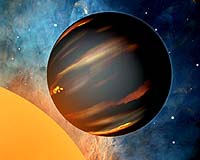
Cambridge MA (SPX) Feb 23, 2007 A team of astronomers led by Carl Grillmair (Spitzer Science Center) and David Charbonneau (Harvard-Smithsonian Center for Astrophysics) announced today that they have directly measured the first spectrum from a known planet orbiting a distant star. Two other teams made a similar measurement of a different extrasolar planet. Taken together, this pioneering work opens a new field of planetary exploration, allowing astronomers to directly analyze the atmospheres of worlds beyond our solar system. "In a sense, we're getting our first sniffs of air from an alien world," said Charbonneau. "And what we found surprised us. Or more accurately, what we DIDN'T find surprised us." "We expected to see common molecules like water, methane, or carbon dioxide," explained Grillmair. "But we didn't see any of those. The spectrum was flat, with no molecular fingerprints that we could detect." The planet studied by Charbonneau and his colleagues is known as HD 189733b. It orbits a star slightly cooler and less massive than the Sun located about 60 light-years from Earth in the direction of the constellation Vulpecula. It is the closest known "transiting" planet to Earth. HD 189733b is a type of planet known as a "hot Jupiter." It orbits very close to its star, completing one revolution every 2.2 days. Its mass and physical size are both slightly larger than Jupiter. At a distance of only three million miles from its star, HD 189733b is heated to a broiling temperature of 1700 degrees Fahrenheit. HD 189733b was selected for study because it periodically crosses in front of and behind its star. When transiting in front, the planet partially eclipses the star and blocks a small portion of the star's light. Similarly, the system dims slightly when the planet disappears behind its star since the star blocks the planet's light. By observing this "secondary eclipse," astronomers can tease out the faint signal of the planet from the overwhelming light of the nearby star. The team studied HD 189733b using the Infrared Spectrograph instrument aboard NASA's Spitzer Space Telescope. Spitzer detects infrared light, or light beyond the red end of the visible light spectrum. When light is split into a rainbow-like spectrum, certain atoms or molecules can leave "fingerprints" in the spectrum. Those fingerprints tell astronomers what molecules are there, just as crime scene investigators use real fingerprints to determine what person was in the area. Missing Fingerprints Theoretical calculations by different teams unanimously predicted that water vapor should be the most obvious spectral feature. However, the fingerprint of water was missing from HD 189733b. Astronomers also expected a prominent signature of methane, but that was missing as well. "The most fundamental thing we predicted was wrong," said Grillmair. Since planet formation works the same way everywhere, and since the molecules in question should be just as abundant on a distant world orbiting a Sun-like star as they are in our solar system, astronomers speculate that something is hiding the molecules from sight. One clue comes from the spectrum of a second planet, HD 209458b, which orbits a different star. That spectrum, obtained by a team led by Jeremy Richardson (NASA's Goddard Space Flight Center), shows hints of silicates - molecules containing silicon and oxygen. Such molecules form rocks on the Earth, but on the scorching-hot worlds studied with Spitzer, silicates exist as tiny dust grains that can form clouds. "We think that both planets may be cloaked in dark silicate clouds," said Charbonneau. "These worlds are blacker than any planet in our solar system." The best way to clear up the mystery is to study additional "hot Jupiters" to determine if they show similar signs in their atmospheres. Astronomers also will continue to study HD 189733b and HD 209458b in more detail. "Right now, it's a puzzle," said Charbonneau. "With a few more puzzle pieces, the picture should become clearer." The Grillmair/Charbonneau study of HD 189733b will be published in an upcoming issue of The Astrophysical Journal Letters. The Richardson study of HD 209458b is being published in the February 22 issue of the journal Nature. A third team led by Mark Swain (NASA's Jet Propulsion Laboratory) also has submitted a study of the spectrum of HD 209458b to The Astrophysical Journal Letters. Email This Article
Related Links  Moffet Field CA (SPX) Feb 02, 2007
More than 200 extrasolar planets have been found so far, but our knowledge about those distant worlds is very limited. In most cases we haven't seen the planets; we only know they exist because of the effect they have on the star they orbit. But we do know that most of those planets are gas giants like Jupiter. Such massive worlds exert a much greater and therefore more detectable effect on a star than a tiny planet like Earth does. |
|
|

| The content herein, unless otherwise known to be public domain, are Copyright 1995-2006 - SpaceDaily.AFP and UPI Wire Stories are copyright Agence France-Presse and United Press International. ESA PortalReports are copyright European Space Agency. All NASA sourced material is public domain. Additionalcopyrights may apply in whole or part to other bona fide parties. Advertising does not imply endorsement,agreement or approval of any opinions, statements or information provided by SpaceDaily on any Web page published or hosted by SpaceDaily. Privacy Statement |