|
 |
 |
 |
 |
 |
 |
 |
 |
 |

| . |  |
. |
Active Stellar Remnants Could Present Interesting Challenge For LISA
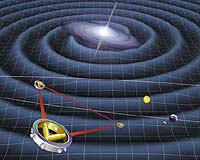
Kingston, Canada (SPX) Jun 07, 2007 A team of astronomers has found that a certain class of double white dwarf stars, millions of which populate the Milky Way Galaxy, are expected to be a prominent source of gravitational waves for the Laser Interferometer Space Antenna (LISA). These results are different from previous studies of a similar nature, which showed that active (interacting) white dwarf binary stars will not be a very significant source of gravitational waves, compared to their detached (non-interacting) counterparts. The new results are being presented by graduate student Ashley J. Ruiter and Dr. Krzysztof Belczynski from New Mexico State University (Las Cruces, NM), during the annual meeting of the Canadian Astronomical Society (CASCA) held at the Royal Military College of Canada in Kingston (ON). Other members of the team include Dr. Matthew Benacquista at the Center for Gravitational Wave Astronomy at the University of Texas (Brownsville, TX), and Dr. Shane L. Larson at Weber State (Ogden, UT). LISA is a proposed joint ESA/NASA mission, and will be the first space-based gravitational wave detector. Gravitational waves have been predicted to exist based on Einstein's theory of general relativity, though as of yet these waves have never been directly observed since they are extremely difficult to detect. LISA will observe gravitational waves arising from colliding distant galaxies among other energetic astrophysical phenomena. Galactic double white dwarfs - pairs of 'Sun-like' stars which have exhausted their nuclear fuel - have been predicted to inhabit the Milky Way in great numbers, and pioneering work by other research groups has shown that non-interacting double white dwarfs should be prominent sources of gravitational waves for LISA. However, in some previous studies, interacting double white dwarfs were shown to be relatively unimportant for LISA, in contrast to the results presented here, which show that both types of double white dwarfs are important. "These active binaries could potentially make it more difficult to extract data from individual gravitational radiation sources at certain gravitational wave frequencies and may require the development of new or different data analysis techniques." says Dr. Benacquista. If there are too many sources at a certain gravitational wave frequency, the LISA spectrum becomes 'crowded', and it's harder to figure out which waves come from which object - which one needs to do in order to learn about the nature of the astronomical source. "There is still a lot which we don't understand about binary star evolution, and these uncertainties can sometimes greatly impact our model results" says Ms. Ruiter, a York U and Saint Mary's U alumnus who is a PhD student at New Mexico State University. "The good news is that there are active research groups working to determine the best methods for extracting information about a particular LISA source which appears in a crowded region of the signal. If in fact the interacting binaries do dominate the LISA signal at some level, there should be a way to disentangle the various gravitational wave signals". The fact that now many more interacting double white dwarfs may be detectable with LISA could allow for further constraints on the origin of Type Ia Supernovae - important cosmological distance indicators - for which the precursors are thought to be interacting white dwarfs. This work has been supported by NASA, the Aspen Center for Physics, the Nicolaus Copernicus Astronomical Center and Polish State Committee for Scientific Research, the NSF, and Sigma Xi. Community Email This Article Comment On This Article Related Links LISA New Mexico State University The Physics of Time and Space
 A New Look At Abandoned Math Model May Help Search For Gravitational Waves
 Huntsville AL (SPX) Jun 06, 2007
A new way of looking at a previously abandoned mathematical model might help astronomers study and accurately identify an exotic clan of gravitational waves. The waves in question come from small black holes or neutron stars in extremely elongated orbits around vastly larger black holes, says Dr. Lior Burko, an assistant physics professor at The University of Alabama in Huntsville (UAH). "This reopens an area of research that was closed several years ago." |
|
|

| The content herein, unless otherwise known to be public domain, are Copyright 1995-2006 - SpaceDaily.AFP and UPI Wire Stories are copyright Agence France-Presse and United Press International. ESA PortalReports are copyright European Space Agency. All NASA sourced material is public domain. Additionalcopyrights may apply in whole or part to other bona fide parties. Advertising does not imply endorsement,agreement or approval of any opinions, statements or information provided by SpaceDaily on any Web page published or hosted by SpaceDaily. Privacy Statement |