|
 |
 |
 |
 |
 |
 |
 |
 |
 |

| . |  |
. |
Adaptive Array Network Could Improve Access To NASA's EO Satellites
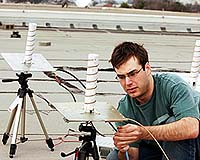
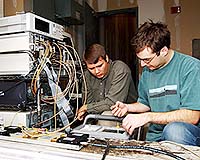
Atlanta GA (SPX) May 26, 2005 Sophisticated signal processing techniques and simple proof-of-principle antenna arrays built from PVC pipe, aluminum foil and copper wire could revolutionize the way NASA obtains data from its Earth observing satellites. If the adaptive array system being studied by NASA and Georgia Institute of Technology researchers ultimately proves feasible, it could dramatically decrease the cost of building and maintaining ground stations, thus enabling the cost-effective construction of many more ground stations. Ultimately, that could make information from the space agency's Earth-observing satellites more widely and rapidly available. The "off-the-shelf" technology has already demonstrated that it can successfully receive one satellite telemetry frequency. "The dream would be to provide total global coverage with these antenna systems and to network the systems together to make these NASA information services available to anybody sitting at a computer, almost like video-on-demand," explained Mary Ann Ingram, a professor in Georgia Tech's School of Electrical and Computer Engineering. "Timely information from Earth-observing satellites could be useful in many ways, such as directing operations to fight a forest fire, for instance." Information from satellites such as Earth Observing-1 (EO-1) is now downlinked to various 11-meter dishes, primarily in the Arctic Circle, where sub-zero temperatures create maintenance and reliability issues for their complex aiming mechanisms. Typically, satellites such as EO-1 are in contact with these antenna systems between five and eight times per day for ten minutes at a time. The present antenna systems cost about $4 million each, and require resident crews to operate and maintain them. The NASA/Georgia Tech project envisions replacing these antennas with a network of inexpensive antenna arrays that would have no moving parts and use sophisticated software � instead of careful aiming � to gather data from the satellites. The network could lower operational costs while improving access to the information. "When people use cell phones to make calls, there are no moving parts on the antennas," noted Dan Mandl, mission director for NASA's EO-1 program at Goddard Space Flight Center near Washington. "What I would like to do is build a continuous cell-like network around the world that would provide almost unlimited opportunities to downlink data." Mandl compared NASA's existing downlink system to old-fashioned pay phones located off expressway exits. "If you witness an accident, you can open your cell phone and call for assistance," he said. "But if you don't have a cell phone, you have to get off the highway at the next exit and hunt for a pay phone. What we would like to do is give these satellites the equivalent of cell phones to allow anytime, anywhere contact." The proof-of-principle adaptive arrays being tested by Ingram and her research team are built from inexpensive components, including common PVC piping and aluminum foil. Signals from the four antennas are analyzed using a processing technique that learns to improve its performance by constructively combining scattered and reflected versions of the signal, and by suppressing noise and interference.

|