|
 |
 |
 |
 |
 |
 |
 |
 |
 |

| . |  |
. |
Aerogels: 'Solid Smoke' May Have Many Uses
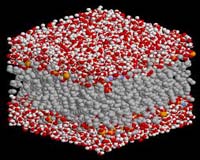
Davis - Apr 05, 2004 It looks like glass and feels like solidified smoke, but the most interesting features of the new silica aerogels made by UC Davis and Lawrence Livermore National Laboratory researchers are too small to see or feel. Lighter than styrofoam, this strange material is riddled with pores just nanometers in size, leaving it 98 percent empty. Water can soak into the material, but in the confined space the water molecules arrange themselves in unusual ways, said Subhash Risbud, professor of chemical engineering and materials science at UC Davis. For example, a lipid membrane can spread across a wet aerogel just as it does around a living cell. Scientists studying such lipid membranes usually put them on a wafer of silicon or gold. Instead, the aerogel provides a wet cushion for the membrane, allowing it to have moisture on both sides and act more like a real cell in which membranes are studded with proteins. Researchers at Stanford University, led by engineering professor Curtis Frank and Risbud, recently patented the concept. The invention could be used for investigating diseases such as lupus and rheumatoid arthritis and for biological testing devices. Aerogels are made by taking a wet gel -- a meshwork of molecules in liquid, such as water -- and removing the water to leave a spongy structure. The first aerogels were made in the 1930s by Samuel Kistler, and the technology was further developed by Lawrence Hrubesh and colleagues at the Lawrence Livermore National Laboratory over 40 years later. Silica aerogels also have many other applications in fiber optics, insulation against sound or heat, and miniature pumps for built-in refrigeration systems in packaging, Risbud said. The research project was part of the Center on Polymer Interfaces and Macromolecular Assemblies, a collaboration between Stanford, UC Davis, UC Berkeley and the IBM Almaden Research Center. Risbud also continues to collaborate with Joe Satcher and John Poco of the Lawrence Livermore National Laboratory on silica aerogels. Related Links Center on Polymer Interfaces and Macromolecular Assemblies UC Davis Lawrence Livermore National Laboratory SpaceDaily Search SpaceDaily Subscribe To SpaceDaily Express  World's Most Precise Gyroscopes Ready To Test Einstein Theory
 Vandenberg AFB - Apr 05, 2004
NASA's Gravity Probe B mission, also known as GP-B, will use four ultra-precise gyroscopes, orbiting the Earth in a unique satellite, to experimentally test two extraordinary predictions of Einstein's 1916 theory that space and time are distorted by the presence of massive objects. |
|
|

| The content herein, unless otherwise known to be public domain, are Copyright 1995-2006 - SpaceDaily.AFP and UPI Wire Stories are copyright Agence France-Presse and United Press International. ESA PortalReports are copyright European Space Agency. All NASA sourced material is public domain. Additionalcopyrights may apply in whole or part to other bona fide parties. Advertising does not imply endorsement,agreement or approval of any opinions, statements or information provided by SpaceDaily on any Web page published or hosted by SpaceDaily. Privacy Statement |