
 |
 |
 |
 |
 |
 |
 |
 |
 |
 |

| . |  |
. |

Paris, France (SPX) Aug 12, 2010 Astronomers scanning the skies as part of ESO's VISTA Magellanic Cloud survey have now obtained a spectacular picture of the Tarantula Nebula in our neighbouring galaxy, the Large Magellanic Cloud. This panoramic near-infrared view captures the nebula itself in great detail as well as the rich surrounding area of sky. The image was obtained at the start of a very ambitious survey of our neighbouring galaxies, the Magellanic Clouds, and their environment. The leader of the survey team, Maria-Rosa Cioni (University of Hertfordshire, UK) explains: "This view is of one of the most important regions of star formation in the local Universe - the spectacular 30 Doradus star-forming region, also called the Tarantula Nebula. At its core is a large cluster of stars called RMC 136, in which some of the most massive stars known are located." ESO's VISTA telescope is a new survey telescope at the Paranal Observatory in Chile (eso0949). VISTA is equipped with a huge camera that detects light in the near-infrared part of the spectrum, revealing a wealth of detail about astronomical objects that gives us insight into the inner workings of astronomical phenomena. Near-infrared light has a longer wavelength than visible light and so we cannot see it directly for ourselves, but it can pass through much of the dust that would normally obscure our view. This makes it particularly useful for studying objects such as young stars that are still enshrouded in the gas and dust clouds from which they formed. Another powerful aspect of VISTA is the large area of the sky that its camera can capture in each shot. This image is the latest view from the VISTA Magellanic Cloud Survey (VMC). The project will scan a vast area - 184 square degrees of the sky (corresponding to almost one thousand times the apparent area of the full Moon) including our neighbouring galaxies the Large and Small Magellanic Clouds. The end result will be a detailed study of the star formation history and three-dimensional geometry of the Magellanic system. Chris Evans from the VMC team adds: "The VISTA images will allow us to extend our studies beyond the inner regions of the Tarantula into the multitude of smaller stellar nurseries nearby, which also harbour a rich population of young and massive stars. Armed with the new, exquisite infrared images, we will be able to probe the cocoons in which massive stars are still forming today, while also looking at their interaction with older stars in the wider region." The wide-field image shows a host of different objects. The bright area above the centre is the Tarantula Nebula itself, with the RMC 136 cluster of massive stars in its core. To the left is the NGC 2100 star cluster. To the right is the tiny remnant of the supernova SN1987A (eso1032). Below the centre are a series of star-forming regions including NGC 2080 - nicknamed the "Ghost Head Nebula" - and the NGC 2083 star cluster. The VISTA Magellanic Cloud Survey is one of six huge near-infrared surveys of the southern sky that will take up most of the first five years of operations of VISTA.
Share This Article With Planet Earth
Related Links ESO Stellar Chemistry, The Universe And All Within It

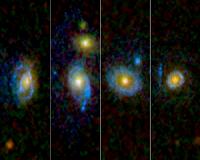 Giant Ultraviolet Rings Found In Resurrected Galaxies
Pasadena CA (JPL) Aug 12, 2010 Astronomers have found mysterious, giant loops of ultraviolet light in aged, massive galaxies, which seem to have a second lease on life. Somehow these "over-the-hill galaxies" have been infused with fresh gas to form new stars that power these truly gargantuan rings, some of which could encircle several Milky Way galaxies. The discovery of these rings implies that bloated galaxies presume ... read more |
|
|
| The content herein, unless otherwise known to be public domain, are Copyright 1995-2010 - SpaceDaily. AFP and UPI Wire Stories are copyright Agence France-Presse and United Press International. ESA Portal Reports are copyright European Space Agency. All NASA sourced material is public domain. Additional copyrights may apply in whole or part to other bona fide parties. Advertising does not imply endorsement,agreement or approval of any opinions, statements or information provided by SpaceDaily on any Web page published or hosted by SpaceDaily. Privacy Statement |


 del.icio.us
 Digg
Digg Reddit
 YahooMyWeb
 Google
 Facebook


