
 |
 |
 |
 |
 |
 |
 |
 |
 |
 |

| . |  |
. |

Moffett Field CA (SPX) May 02, 2011 A planet that we thought we knew turns out to be rather different than first suspected. A revised view comes from new data released by an international team of astronomers, who made their observations of the planet "55 Cancri e" based on calculations by Harvard graduate student Rebekah Dawson (Harvard-Smithsonian Center for Astrophysics). Dawson worked with Daniel Fabrycky (now at the University of California, Santa Cruz) to predict when the planet crosses in front of its star as seen from Earth. Such transits give crucial information about a planet's size and orbit. The team found that 55 Cancri e is 60 percent larger in diameter than Earth but eight times as massive. (A super-Earth has one to 10 times the mass of Earth.) It's the densest solid planet known, almost as dense as lead. Even better, the star it orbits is so close and bright that it's visible to the naked eye in the constellation Cancer the Crab. This makes it an excellent target for follow-up studies. Dawson and Fabrycky's prediction played a crucial role in this new work by motivating the search for transits. When the planet was discovered by a Texas team in 2004, it was calculated to orbit its star every 2.8 days. Dawson and Fabrycky reanalyzed the data and found that 55 Cancri e was much closer to its star, orbiting it in less than 18 hours. As a result, the chances of seeing a transit were much higher. Josh Winn of MIT and Smithsonian astronomer Matthew Holman brought the new calculation to Jaymie Matthews (University of British Columbia), who scheduled observations with Canada's MOST (Microvariability and Oscillations of STars) satellite. The research team found that 55 Cancri e transits its star every 17 hours and 41 minutes, just as Dawson and Fabrycky predicted. "I'm excited that by calculating the planet's true orbital period, we were able to detect transits, which tell us so much more about it," said Dawson. The new technique applies to planets discovered by the radial velocity method, in which astronomers hunt for a star that "wobbles" from the gravitational tug of an orbiting world. The initial confusion about the orbit of 55 Cancri e arose because of natural gaps in the radial velocity data (because astronomers can only observe a star at night and when it's above the horizon). Sometimes these gaps introduce "ghost" signals that can masquerade as the planet's true signal. Dawson and Fabrycky chose to analyze six planetary systems where the data seemed particularly ambiguous. In two cases they confirmed previous results, while some remained unclear. For 55 Cancri e, a period revision was certainly needed. "It became very clear that the planet's actual orbital period was closer to 18 hours," stated Dawson. This places the planet so close to its star that it's blasted with heat, baked to a temperature of 4,900 degrees F. The star itself, 55 Cancri A, is a yellow star very similar to the Sun and located 40 light-years away. It's the brightest, closest star known to have a transiting planet. Dawson recommends that the analysis method she developed with Fabrycky be used on future planet discoveries. "We've cleared up some confusion in the systems we studied, and we believe we've provided a way to avoid future confusion," she said. Headquartered in Cambridge, Mass., the Harvard-Smithsonian Center for Astrophysics (CfA) is a joint collaboration between the Smithsonian Astrophysical Observatory and the Harvard College Observatory. CfA scientists, organized into six research divisions, study the origin, evolution and ultimate fate of the universe.
Share This Article With Planet Earth
Related Links Harvard-Smithsonian Center for Astrophysics (CfA) Lands Beyond Beyond - extra solar planets - news and science Life Beyond Earth

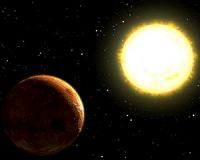 Astronomers unveil portrait of 'super-exotic super-Earth'
Vancouver, Canada (SPX) May 02, 2011 An international team of astronomers have revealed details of a "super-exotic" exoplanet that would make the planet Pandora in the movie Avatar pale in comparison. The planet, named 55 Cancri e, is 60 per cent larger in diameter than Earth but eight times as massive. Twice as dense as Earth - almost as dense as lead - it is the densest solid planet known, according to a team led by astrono ... read more |
|
|
| The content herein, unless otherwise known to be public domain, are Copyright 1995-2010 - SpaceDaily. AFP and UPI Wire Stories are copyright Agence France-Presse and United Press International. ESA Portal Reports are copyright European Space Agency. All NASA sourced material is public domain. Additional copyrights may apply in whole or part to other bona fide parties. Advertising does not imply endorsement,agreement or approval of any opinions, statements or information provided by SpaceDaily on any Web page published or hosted by SpaceDaily. Privacy Statement |


 del.icio.us
 Digg
Digg Reddit
 YahooMyWeb
 Google
 Facebook


