
. Military Space News .
INTERN DAILY
Ancient medicinal clay shows promise against today's worst bacterial infections
by Staff Writers
Vancouver, Canada (SPX) Jan 27, 2016


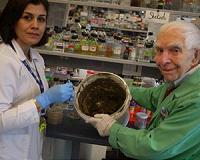
UBC researchers Julian Davies and Shekooh Behroozian with a bucket of the clay. Image courtesy University of British Columbia. For a larger version of this image please go here.

Naturally occurring clay from British Columbia, Canada - long used by the region's Heiltsuk First Nation for its healing potential - exhibits potent antibacterial activity against multidrug-resistant pathogens, according to new research from the University of British Columbia.

The researchers recommend the rare mineral clay be studied as a clinical treatment for serious infections caused by ESKAPE strains of bacteria.

The so-called ESKAPE pathogens - Enterococcus faecium, , Klebsiella pneumoniae, Acinetobacter baumannii, Pseudomonas aeruginosa, and Enterobacter species - cause the majority of U.S. hospital infections and effectively 'escape' the effects of antibacterial drugs.

"Infections caused by ESKAPE bacteria are essentially untreatable and contribute to increasing mortality in hospitals," says UBC microbiologist Julian Davies, co-author of the paper published in the American Society for Microbiology's mBio journal.

"After 50 years of over-using and misusing antibiotics, ancient medicinals and other natural mineral-based agents may provide new weapons in the battle against multidrug-resistant pathogens."

The clay deposit is situated on Heiltsuk First Nation's traditional territory, 400 kilometres (250 miles) north of Vancouver, Canada, in a shallow five-acre granite basin. The 400-million kilogram (400,000 tonne) deposit was formed near the end of the last Ice Age, approximately 10,000 years ago.

Local First Nations people have used the clay for centuries for its therapeutic properties - anecdotal reports cite its effectiveness for ulcerative colitis, duodenal ulcer, arthritis, neuritis, phlebitis, skin irritation, and burns.

"We're fortunate to be able to partner with UBC on this significant research program" says Lawrence Lund, president of Kisameet Glacial Clay, a business formed to market cosmetic and medicinal products derived from the clay. "We hope it will lead to the development of a novel and safe antimicrobial that can be added to the diminished arsenal for the fight against the ESKAPE pathogens and other infection-related health issues plaguing the planet."

In the in vitro testing conducted by Davies and UBC researcher Shekooh Behroozian, clay suspended in water killed 16 strains of ESKAPE bacteria samples from sources including Vancouver General Hospital, St. Paul's Hospital, and the University of British Columbia's wastewater treatment pilot plant.


Thanks for being here;
We need your help. The Space Media Network continues to grow but revenues have never been harder to maintain.

With the rise of Ad Blockers, and Facebook - our traditional revenue sources via quality network advertising continues to decline. And unlike so many other news sites, we don't have a paywall - with those annoying usernames and passwords.

Our news coverage takes time and effort to publish 365 days a year.

If you find our news sites informative and useful then please consider becoming a regular supporter or for now make a one off contribution.
SpaceMediaNetwork Contributor
$5 Billed Once


credit card or paypal
SpaceMediaNetwork Monthly Supporter
$5 Billed Monthly


paypal only


.


Related Links
University of British Columbia
Hospital and Medical News at InternDaily.com


Comment on this article via your Facebook, Yahoo, AOL, Hotmail login.

Share this article via these popular social media networks
del.icio.usdel.icio.us DiggDigg RedditReddit GoogleGoogle

Previous Report
INTERN DAILY
Catching heartbeats with millimeter-wave radar
Kyoto, Japan (SPX) Jan 25, 2016
Heartbeats can now be measured without placing sensors on the body, thanks to a new technology developed in Japan. Researchers at the Kyoto University Center of Innovation, together with Panasonic Corp, have come up with a way to measure heartbeats remotely, in real time, and under controlled conditions with as much accuracy as electrocardiographs. The researchers say this will allow for t ... read more


INTERN DAILY
South Korea, Japan Should Host US THAAD Missiles: Cohen

Aegis Combat System upgrade gets Navy approval

Serbia requests missile defense systems from Russia

Cavalier AFS significant link to missile warning/space defense

INTERN DAILY
Raytheon to research tactical missile capabilities

Pakistan test-launches homegrown cruise missile: military

Orbital ATK producing alternative rocket warhead

Latest N. Korea sub missile test a 'catastrophic failure': analysts

INTERN DAILY
Sikorsky tests unmanned ground vehicle with unmanned Black Hawk

A firefighter drone that flies and crawls up walls

Inside North Korea's secret UAV program

Germany to lease Israeli Heron TP UAVs

INTERN DAILY
General Dynamics MUOS-Manpack radio supports government testing of MUOS network

Raytheon to produce, test Navy Multiband Terminals

ADS to build one of two satellites for future COMSAT NG system

Thales and Airbus to supply French military satellite communications

INTERN DAILY
DARPA program aims to develop neural-digital connection

Telephonics to supply surveillance vehicles for U.S. border

General Dynamics to support U.S. Army Stryker program

Lockheed Martin to provide Pakistan with Target Sight Systems

INTERN DAILY
France doubles arms sales in 2015

Flextronics exits bid for Israel Military Industries

NATO awards Latvian construction contracts

Kuwait MPs approve extra $10 bn for arms

INTERN DAILY
NATO considers first formal talks with Russia since 2014: sources

Obama urgers stronger security, trade cooperation with Australia

China's Xi to visit Saudi Arabia, Egypt, Iran

Philippines plans flight-tracking system in disputed sea

INTERN DAILY
Self-stacking nanogrids

New process enables easier isolation of carbon nanotubes

Microwaved nanotubes come up clean

FAU researchers show how mother-of-pearl is formed from nanoparticles


The content herein, unless otherwise known to be public domain, are Copyright 1995-2024 - Space Media Network. All websites are published in Australia and are solely subject to Australian law and governed by Fair Use principals for news reporting and research purposes. AFP, UPI and IANS news wire stories are copyright Agence France-Presse, United Press International and Indo-Asia News Service. ESA news reports are copyright European Space Agency. All NASA sourced material is public domain. Additional copyrights may apply in whole or part to other bona fide parties. All articles labeled "by Staff Writers" include reports supplied to Space Media Network by industry news wires, PR agencies, corporate press officers and the like. Such articles are individually curated and edited by Space Media Network staff on the basis of the report's information value to our industry and professional readership. Advertising does not imply endorsement, agreement or approval of any opinions, statements or information provided by Space Media Network on any Web page published or hosted by Space Media Network. General Data Protection Regulation (GDPR) Statement Our advertisers use various cookies and the like to deliver the best ad banner available at one time. All network advertising suppliers have GDPR policies (Legitimate Interest) that conform with EU regulations for data collection. By using our websites you consent to cookie based advertising. If you do not agree with this then you must stop using the websites from May 25, 2018. Privacy Statement. Additional information can be found here at About Us.