
. Military Space News .
FARM NEWS
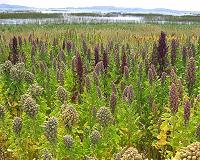
Ancient quinoa found in Ontario, suggesting early links between indigenous groups
by Brooks Hays
Washington (UPI) Jan 16, 2019

The discovery of ancient quinoa seeds outside of Ontario suggests early indigenous groups were exchanging perishable goods as early as 900 B.C.

The charred seeds were originally discovered during a mandatory archaeological review prior to the commencement of a construction project. Scientists were able to identify the seed remains as domesticated goosefoot, C. berlandieri spp. jonesianum, a now-extinct strain of quinoa native to Eastern North America. Until now, archeologists had yet to find domesticated goosefoot north of Kentucky.

"Finding domesticated seeds that are so old in Ontario is special," Gary Crawford, professor of anthropology at the University of Toronto Mississauga, said in a news release. "The next time we find a crop in the province is about 500 A.D., and it's corn. All previous research on this species of quinoa, which is now extinct, has taken place in the central United States: Arkansas, Illinois and Kentucky."

Researchers have previously recovered evidence that early indigenous groups in North America traded minerals and polished stones, but not perishable goods.

"This discovery raises more questions than it answers. We had to consider whether the seeds were only traded here or grown locally," said Ron Williamson, researcher with the archeological consulting firm Archaeological Services Inc. "We also had to consider whether this was the beginning of agriculture in the province."

Archaeologists found no evidence that the grain was grown locally.

"If it were grown in the region, we would have expected to see seeds of the crop in other pits around the site, but they were confined to this specific pit," Williamson said. "We also don't see any sign of agricultural weeds or stone tools that may have been used for cultivation."

So why did the ancient grain end up so far north? Scientists aren't certain, but the evidence -- detailed in the journal American Antiquity -- suggests local native groups traded for the seeds. Quinoa was prized by other indigenous groups for its nutritional value.

"All of these bits of data demonstrate that the Indigenous Canadians were knowledgeable, sophisticated and well-connected across Eastern North America," Crawford said.

Researchers estimate that the seeds were charred on accident during an attempt to parch the seeds.

"You can lightly parch seeds so they don't sprout and store them," Crawford said. "It could have been a mistake to have burned them. There was a slight oxidization of the surrounding sediment, so the soil was heated; we think they were burned in place in the pit."


Related Links
Farming Today - Suppliers and Technology


Thanks for being here;
We need your help. The Space Media Network continues to grow but revenues have never been harder to maintain.

With the rise of Ad Blockers, and Facebook - our traditional revenue sources via quality network advertising continues to decline. And unlike so many other news sites, we don't have a paywall - with those annoying usernames and passwords.

Our news coverage takes time and effort to publish 365 days a year.

If you find our news sites informative and useful then please consider becoming a regular supporter or for now make a one off contribution.
SpaceMediaNetwork Contributor
$5 Billed Once


credit card or paypal
SpaceMediaNetwork Monthly Supporter
$5 Billed Monthly


paypal only


FARM NEWS
Survey: GMO food critics overestimate their knowledge of the subject
Washington (UPI) Jan 15, 2019
Opponents of genetically modified foods overrate their knowledge of the subject, according to a new survey. Researchers surveyed several thousand Americans and Europeans about their opinion of genetically modified foods. They also asked respondents to rate their knowledge of the subject. Participants were quizzed on their knowledge of sciences, genetics and GMO foods. More than 90 percent of the survey's participants admitted some level of opposition to genetically modified foods. Those ... read more

Comment using your Disqus, Facebook, Google or Twitter login.


Share this article via these popular social media networks
del.icio.usdel.icio.us DiggDigg RedditReddit GoogleGoogle

FARM NEWS
Syrian air defences shoot down Israeli missiles: state media

Eyeing China, US to hold missile drill in Japan's Okinawa: report

Lockheed awarded $3.3B for PAC-3 missiles for Saudi Arabia, Kuwait

Missile Defense Agency awards Lockheed Martin contract to design, manufacture and construct defense radar station in Hawaii

FARM NEWS
Raytheon contracted for additional upgrades to AMRAAMs

Raytheon gets $434 million contract to modify AIM-9X Sidewinder missiles

General Dynamics contracted for missile control systems for U.S., U.K.

Turkey says US missile deal does not affect S-400 purchase from Russia

FARM NEWS
New study shows animals may get used to drones

Military help UK police respond to Heathrow drone threat

Insitu gets defense contract for Blackjack unmanned aircraft

General Atomics, Raytheon contracted for Reaper drone support

FARM NEWS
Honeywell and GetSAT win multi-million dollar deal with US Government

Hughes to supply BGAN terminals for Space and Naval Warfare Systems Center

Hughes India and Sterlite Tech enable Satcom connectivity for Indian navy

DARPA awards 6 teams during final Spectrum Collaboration Challenge Qualifier

FARM NEWS
General Dynamics to upgrade 174 more Abrams tanks

High-tech border wall plan on display at CES

KBR Inc. announces inclusion in $12.1B Army IT contract

First mixed male-female boot camp for US Marine recruits

FARM NEWS
Report: Pentagon allowed $28B in available funds to expire

Croatia threatens to axe plans to buy F-16 jets from Israel

Trump claims he 'essentially fired' Mattis

Canada mulls canceling Saudi arms deal over Yemen, Kashoggi murder

FARM NEWS
China says detained Canadian lacks diplomatic immunity

US Navy chief heads to China

Japan FM to visit Moscow amid tensions over island dispute

Canadian ex-envoy held in China gets consular visit

FARM NEWS
Chemical synthesis of nanotubes

Carrying and releasing nanoscale cargo with 'nanowrappers'

Illuminating nanoparticle growth with X-rays

Pitt chemical engineers develop new theory to build improved nanomaterials


The content herein, unless otherwise known to be public domain, are Copyright 1995-2024 - Space Media Network. All websites are published in Australia and are solely subject to Australian law and governed by Fair Use principals for news reporting and research purposes. AFP, UPI and IANS news wire stories are copyright Agence France-Presse, United Press International and Indo-Asia News Service. ESA news reports are copyright European Space Agency. All NASA sourced material is public domain. Additional copyrights may apply in whole or part to other bona fide parties. All articles labeled "by Staff Writers" include reports supplied to Space Media Network by industry news wires, PR agencies, corporate press officers and the like. Such articles are individually curated and edited by Space Media Network staff on the basis of the report's information value to our industry and professional readership. Advertising does not imply endorsement, agreement or approval of any opinions, statements or information provided by Space Media Network on any Web page published or hosted by Space Media Network. General Data Protection Regulation (GDPR) Statement Our advertisers use various cookies and the like to deliver the best ad banner available at one time. All network advertising suppliers have GDPR policies (Legitimate Interest) that conform with EU regulations for data collection. By using our websites you consent to cookie based advertising. If you do not agree with this then you must stop using the websites from May 25, 2018. Privacy Statement. Additional information can be found here at About Us.