
 |
 |
 |
 |
 |
 |
 |
 |
 |
 |

| . |  |
. |

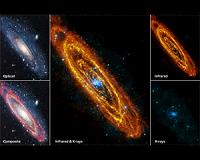
Pasadena CA (JPL) Jan 06, 2011 This mosaic of the Andromeda spiral galaxy highlights explosive stars in its interior, and cooler, dusty stars forming in its many rings. The image is a combination of observations from the Herschel Space Observatory taken in infrared light (seen in orange hues), and the XMM-Newton telescope captured in X-rays (seen in blues). NASA plays a role in both of these European Space Agency-led missions. Herschel provides a detailed look at the cool clouds of star birth that line the galaxy's five concentric rings. Massive young stars are heating blankets of dust that surround them, causing them to glow in the longer-wavelength infrared light, known as far-infrared, that Herschel sees. In contrast, XMM-Newton is capturing what happens at the end of the lives of massive stars. It shows the high-energy X-rays that come from, among other objects, supernova explosions and massive dead stars rotating around companions. These X-ray sources are clustered in the center of the galaxy, where the most massive stars tend to form. Andromeda is our Milky Way galaxy's nearest large neighbor. It is located about 2.5 million light-years away and holds up to an estimated trillion stars. Our Milky Way is thought to contain about 200 billion to 400 billion stars.
Share This Article With Planet Earth
Related Links Jet Propulsion Laboratory Stellar Chemistry, The Universe And All Within It

 Andromeda's Once And Future Stars
Paris, France (ESA) Jan 06, 2011 Two ESA observatories have combined forces to show the Andromeda Galaxy in a new light. Herschel sees rings of star formation in this, the most detailed image of the Andromeda Galaxy ever taken at infrared wavelengths, and XMM-Newton shows dying stars shining X-rays into space. During Christmas 2010, ESA's Herschel and XMM-Newton space observatories targeted the nearest large spiral galaxy ... read more |
|
|
| The content herein, unless otherwise known to be public domain, are Copyright 1995-2010 - SpaceDaily. AFP and UPI Wire Stories are copyright Agence France-Presse and United Press International. ESA Portal Reports are copyright European Space Agency. All NASA sourced material is public domain. Additional copyrights may apply in whole or part to other bona fide parties. Advertising does not imply endorsement,agreement or approval of any opinions, statements or information provided by SpaceDaily on any Web page published or hosted by SpaceDaily. Privacy Statement |


 del.icio.us
 Digg
Digg Reddit
 YahooMyWeb
 Google
 Facebook


