|
 |
 |
 |
 |
 |
 |
 |
 |
 |

| . |  |
. |
Another Piece Of Europe In Your Pocket
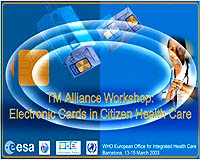
Paris (ESA) Mar 25, 2003 Health-care experts met in Barcelona last weekend to discuss what an EU press release describes as "another piece of Europe in your pocket". The workshop on electronic health cards for Europeans, organised by the TM Alliance, was held at the regional office for Europe of the World Health Organisation (WHO). WHO, together with the European Commission, the International Telecommunications Union (ITU) and ESA, is a partner in the TM Alliance, a project sponsored by the European Commission and led by ESA. The idea behind the workshop was to ensure that the new 'smart' cards make full use of the potential offered by the IT evolution. At first they will be used to replace the E-111 health form that Europeans use when travelling within Europe but, as members of the workshop pointed out, they could be used for much more than that. 'Smart' health cards could hold important information such as a patient's blood group and medication in use, as well as providing access to medical records. Quick and easy retrieval of such information would speed up health care, reduce the risk of erroneous medication and treatment, reduce time, decrease costs and streamline services across Europe. According to Angelica Frithiof, chair person of the European Health Telematics Association (EHTEL) working group on patients and citizens, "the idea of smart cards for health is of great interest for Europeans. Everything that can be used to enhance mobility across borders and freedom of choice will benefit patients and citizens all over Europe". Before such a system can be put into operation however, the health records of all European patients need to be stored in electronic format -- something that is not yet the case -- and state-of-the-art security and data protection standards need to be agreed upon, and put in place, throughout Europe. Invited to the workshop were specialists from across the disciplines involved in electronic health care so as to provide the expertise needed to come up with viable propositions. Initially the idea is for a card that would allow travellers suffering from both serious and less serious illnesses to be fully and quickly reimbursed, in their home country, for any health-care expenses they may incur within Europe. The main difficulty to be overcome is the link between health care provision in the host country and the reimbursement system in a patient's home country. The workshop made good progress on developing a system for reimbursement of acute heath care via use of an electronic card, but a system to allow reimbursement for more routine health treatment needs considerably more work before it can be put into place. Participants put together a proposal on how to structure the implementation of the first health card due to be issued in June 2004. This proposal will be presented later this spring at an EC eHealth conference in Brussels. The workshop proved valuable both for the exchange of information and for the discussions that took place between disciplines. The TM Alliance decided to hold another workshop in the near future, with a slightly broader focus, in order to build upon and continue the work already carried out. Related Links Telemedicine Alliance EU e-health WHO ITU EHTEL SpaceDaily Search SpaceDaily Subscribe To SpaceDaily Express  Mayo Clinic Install World's Strongest Magnet
 Rochester - Mar 03, 2003
The most powerful magnet ever made for research into cellular proteins and DNA -- a one-of-a-kind, ultra high-field 12 Tesla-strength magnet � is expected to arrive Feb. 27 from England for installation at the Mayo Clinic. |
|
|

| The content herein, unless otherwise known to be public domain, are Copyright 1995-2006 - SpaceDaily.AFP and UPI Wire Stories are copyright Agence France-Presse and United Press International. ESA PortalReports are copyright European Space Agency. All NASA sourced material is public domain. Additionalcopyrights may apply in whole or part to other bona fide parties. Advertising does not imply endorsement,agreement or approval of any opinions, statements or information provided by SpaceDaily on any Web page published or hosted by SpaceDaily. Privacy Statement |