|
 |
 |
 |
 |
 |
 |
 |

| . |  |
. |

|
|
. |

 by Staff Writers Berlin, Germany (SPX) Aug 03, 2011
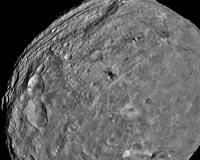
NASA's Dawn spacecraft is another step closer to Vesta; only 5200 kilometres now separate the asteroid and its new 'neighbour', Dawn. The Framing Camera on board the spacecraft is imaging Vesta's surface with steadily increasing accuracy. Researchers at the German Aerospace Center (Deutsches Zentrum fur Luft- und Raumfahrt; DLR) starts generating detailed maps and elevation models using these data. The images show Vesta from ists south pole to areas in the northern hemisphere and allow first geological analysis. It is expected that by 11 August, Dawn will have approached to within approximately 2700 kilometres of Vesta. "Then the in-depth analysis of the asteroid begins; with these images, we will create 3D models of Vesta in order to understand its rough surface", explained Ralf Jaumann, Head of the Planetary Geology Department at the DLR Institute of Planetary Research in Berlin. By August 2012, the distance between the spacecraft and the asteroid will have been reduced to approximately 200 kilometres. At that time, the objective of the DLR researchers is to map the surface of Vesta and generate a three-dimensional terrain model in order to understand its origin and evolution. Through the exploration of the asteroid, scientists will learn more about the birth of the planets. Dawn has spent four years travelling to Vesta and is currently about 184 million kilometres from Earth. Vesta is now providing the first opportunity to study an asteroid at close quarters over an extended period of time. Along with the German Framing Camera, Dawn is also carrying the Visible and Infrared Spectrometer, an instrument developed by the Italian National Institute for Astrophysics (Istituto Nazionale di Astrofisica; INAF) and the Gamma Ray and Neutron Detector (GRaND) instrument, built by the Los Alamos National Laboratory. Discovered on 29 March 1807 by German astronomer Heinrich Olbers, the asteroid underwent a period of melting and cooling following its formation some 4.5 billion years ago. Since then, however, its appearance and composition have hardly changed. Hence, Vesta offers a snapshot of some of the oldest geological processes in the Solar System. At that time, Jupiter's strong gravitational pull prevented other planets from forming in what we know today as the Asteroid Belt, where Vesta is located. With a mean diameter of 520 kilometres, the irregularly shaped Vesta is one of the larger asteroids. In previous images - for example, those acquired by the Hubble Space Telescope - scientists discovered a large, circular depression with a diameter of roughly 460 kilometres with a vast mountain in the centre at the asteroid's South Pole. This deep 'hole' is probably the result of a collision with another asteroid. A few of the fragments resulting from impacts on Vesta have left the asteroid belt and orbit the Sun - some have even made their way to Earth as meteorites
|
. |
|
| The content herein, unless otherwise known to be public domain, are Copyright 1995-2011 - Space Media Network. AFP and UPI Wire Stories are copyright Agence France-Presse and United Press International. ESA Portal Reports are copyright European Space Agency. All NASA sourced material is public domain. Additional copyrights may apply in whole or part to other bona fide parties. Advertising does not imply endorsement,agreement or approval of any opinions, statements or information provided by Space Media Network on any Web page published or hosted by Space Media Network. Privacy Statement |

 del.icio.us
 Digg
Digg Reddit
 Google