|
|
|
|
|
|
|
|
|
|
|


| . |  |
. |
|
|
|
 by Staff Writers San Francisco CA (SPX) Oct 11, 2013
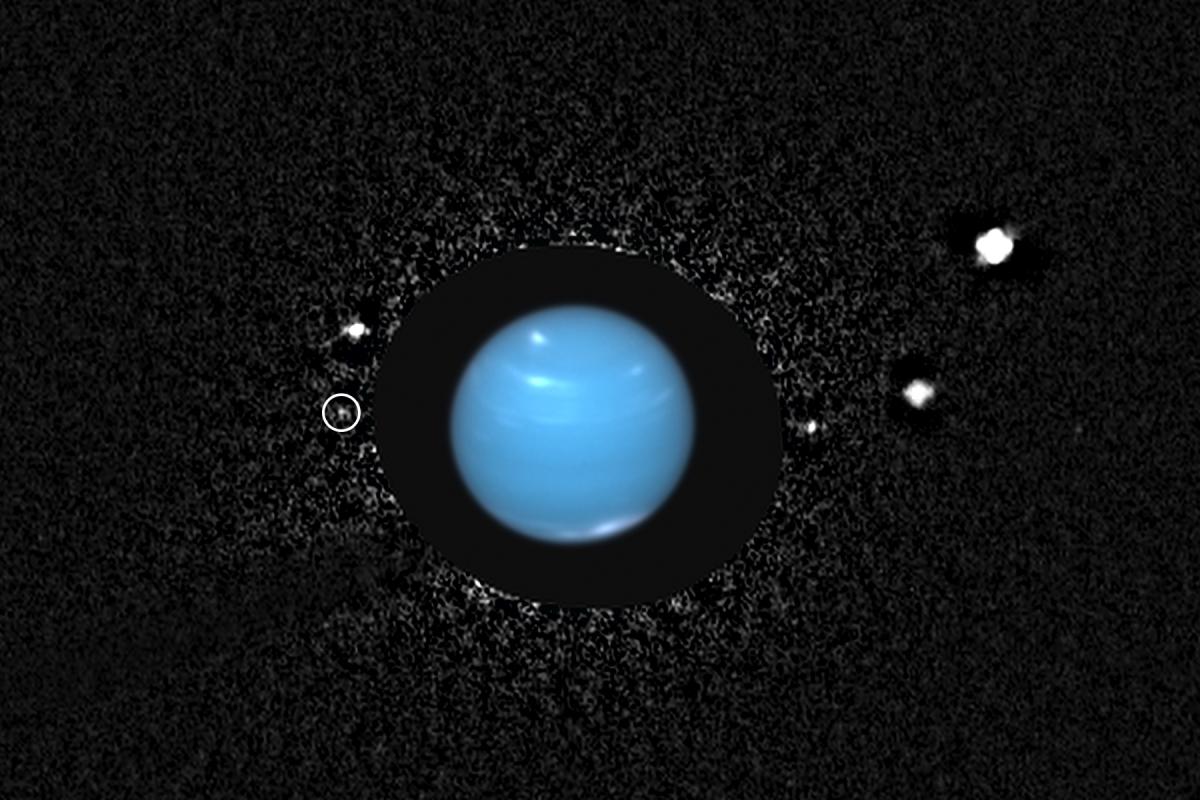
Neptune's tiny, innermost moon, Naiad, has now been seen for the first time since it was discovered by Voyager's cameras in 1989. Dr. Mark Showalter, a senior research scientist at the SETI Institute in Mountain View, California, announced the result in Denver, Colorado, at the annual meeting of the Division for Planetary Sciences of the American Astronomical Society. He and collaborators Dr. Jack Lissauer of the NASA Ames Research Center, Dr. Imke de Pater of UC Berkeley, and Robert French of the SETI Institute, also released a dramatic new image of Neptune's puzzling rings and ring-arcs, which were first imaged by Voyager. "Naiad has been an elusive target ever since Voyager left the Neptune system," said Dr. Showalter. From Earth, Neptune is 2 million times brighter than Naiad, andthetwo are separated by only one arcsecond. "This is equivalent to the width of a human hair from 50 feet away," noted collaborator Lissauer. The team of astronomers needed to develop new techniques to suppress Neptune's glare. Naiad was finally revealed, moving across a sequence of eight images taken during December 2004. Strangely, Naiad appears to have veered significantly off course. The astronomers are puzzled by the fact that Naiad is now far ahead of its predicted orbital position. They wonder whether gravitational interactions with one of Neptune's other moons may have caused it to speed up, although the details remain mysterious. Further observations will be needed in order to understand Naiad's motion. In addition to its moons, Neptune hosts a family faint rings and ring-arcs. The arcs have been changing slowly in the years since their discovery. Whereas Voyager saw a set of four closely-spaced arcs, the leading two arcs have been fading away, and are completely absent from the newest images. The trailing arcs, however, are essentially unchanged. This system of arcs is probably confined by the gravitational effects of the nearby moon Galatea, but the reason for the long-term changes is unknown. Dr. de Pater has also been following the ongoing evolution of the arcs from the 10-meter W. M. Keck telescope in Hawaii. Showalter and his collaborators had previously announced the discovery of a tiny moon of Neptune in July. That moon, which is no more than 20 km (12 miles) across, goes by the provisional designation "S/2004 N 1". The new results reported today are based on further analysis of the same images, which were all obtained by Hubble between 2004 and 2009. Although 100-km Naiad is much larger than the moon announced in July, it orbits much closer to Neptune and so has proven to be much harder to detect. "It is always exciting to find new results in old data," Showalter remarked. "We keep discovering new ways to push the limit of what information can be gleaned from Hubble's vast collection of planetary images." Support for this work was provided by NASA through grant number from the Space Telescope Science Institute, which is operated by the Association of Universities for Research in Astronomy, Inc., under NASA contract NAS5-26555.
Related Links SETI Institute The million outer planets of a star called Sol
|
|
|
| The content herein, unless otherwise known to be public domain, are Copyright 1995-2014 - Space Media Network. AFP, UPI and IANS news wire stories are copyright Agence France-Presse, United Press International and Indo-Asia News Service. ESA Portal Reports are copyright European Space Agency. All NASA sourced material is public domain. Additional copyrights may apply in whole or part to other bona fide parties. Advertising does not imply endorsement,agreement or approval of any opinions, statements or information provided by Space Media Network on any Web page published or hosted by Space Media Network. Privacy Statement |

 del.icio.us
 Digg
Digg Reddit
 Google