|
 |
 |
 |
 |
 |
 |
 |
 |
 |

| . |  |
. |
Are Asteroids Comets And Planets Cut From Same Cloth
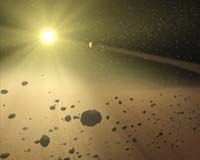
Pasadena CA (SPX) Oct 11, 2006 After analyzing the dust particles of a variety of comets with NASA's Spitzer Space Telescope, the Deep Impact spacecraft and the internationally funded Infrared Space Observatory, Dr. Carey Lisse, of the Johns Hopkins University Applied Physics Laboratory in Laurel, Md., suspects that the answer is yes. "Comets are the stepping stones to planets," said Lisse. "With these missions, astronomers know more about comets today than ever before, and we're still only beginning to scratch the surface." He presents his findings today at the 38th meeting of the Division for Planetary Sciences of the American Astronomical Society in Pasadena, Calif. According to Lisse, the Deep Impact mission, which sent an 820-pound impactor into the path of a hurtling comet about 5 by 8 kilometers (3 by 5 miles) wide, provided a "Rosetta stone" for studying solar system formation in the universe. The collision, on July 4, 2005, unleashed a plethora of pristine particles that had been locked in the core of comet Tempel 1 since the dawn of our solar system. From its lofty perch in space, Spitzer was in the perfect position to scrutinize the cometary material ejected from comet Tempel 1. The sensitive telescope's spectrometer instrument detected dust particles finer than human hair, and discovered the presence of silicates (crushed rock or sand), carbonates (chalk), smectite (clay), metal sulfides (like fool's gold), amorphous carbon (soot) and polycyclic aromatic hydrocarbons (carbon-rich molecules found on barbecue grills and in automobile exhaust on Earth). Scientists have determined that comet Tempel 1 is a loosely assembled icy dirtball with the consistency of talcum powder. "The impactor was able to go 20 to 30 meters into the comet and release material that hadn't been baked or boiled by the comet's previous trips around the sun," said Lisse. Lisse and his team later compared their Tempel 1 data to observations of comet Hale Bopp made by the Infrared Space Observatory in 1997. Although Hale Bopp did not show any of the iron-rich olivine silicates found in Tempel 1, team members did find many chemical similarities, like ice made of water, carbonates, sulfides, polycyclic aromatic hydrocarbons and other types of silicates. They then looked at the Infrared Space Observatory's observations of a distant solar system called HD 100546, which many scientists believe is undergoing planet formation, and again found many of the materials observed in Hale Bopp and Tempel 1. However, unlike the comets, HD 100546 didn't contain some of the most primitive rock-forming elements. "Although there are some particle variations, our team has found that Tempel 1, Hale Bopp and HD100546 share many of the same basic chemical compounds," said Lisse. "We think the differences we see are due to the effect of active planet formation, nebular shocks, and collisions in the HD100546 planet-forming disk." In a new extension of this work, Lisse recently teamed with Dr. Charles Beichman of NASA's Jet Propulsion Laboratory in Pasadena, Calif., to study HD69830, a star surrounded by a disk of dusty material and three Neptune-sized planets. Previously, Beichman and his colleagues suspected the disk could be an asteroid belt. Now, the astronomers have used Lisse's models of planetary body ingredients to confirm that the disk is an asteroid belt, and to show that it may have been created by the destruction of an icy asteroid about 70 kilometers across (43 miles). This is similar to what happened in our own solar system millions of years ago. In addition, the new analysis reveals that the asteroid belt is twice as far out as previously believed, beyond the known planets. "I am thrilled by these findings. This is one of the first steps to realizing that our solar system may be similar to other solar systems in the universe," he said. Related Links Spitzer at Caltech Stellar Chemistry, The Universe And All Within It  A Genetic Study Of The Galaxy
 Paris, France (ESA) Oct 10, 2006
Looking in detail at the composition of stars with ESO's VLT, astronomers are providing a fresh look at the history of our home galaxy, the Milky Way. They reveal that the central part of our Galaxy formed not only very quickly but also independently of the rest. |
|
|

| The content herein, unless otherwise known to be public domain, are Copyright 1995-2006 - SpaceDaily.AFP and UPI Wire Stories are copyright Agence France-Presse and United Press International. ESA PortalReports are copyright European Space Agency. All NASA sourced material is public domain. Additionalcopyrights may apply in whole or part to other bona fide parties. Advertising does not imply endorsement,agreement or approval of any opinions, statements or information provided by SpaceDaily on any Web page published or hosted by SpaceDaily. Privacy Statement |