|
 |
 |
 |
 |
 |
 |
 |
 |
 |

| . |  |
. |
Arecibo Observatory Astronomers Discover First Near-Earth Triple Asteroid
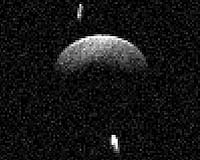
Ithaca NY (SPX) Feb 15, 2008 Once considered just your average single asteroid, 2001 SN263 has now been revealed as the first near-Earth triple asteroid ever found. The asteroid -- with three bodies orbiting each other -- was discovered this week by astronomers at the radar telescope at the National Science Foundation's (NSF) Arecibo Observatory in Puerto Rico. Cornell and Arecibo astronomer Michael C. Nolan said he and his colleagues made the discovery when they obtained radar images Feb. 11. The group subsequently took more images to learn that the three objects -- about 7 million miles from Earth -- are rotating around each other. The main, central body is spherical with a diameter of roughly 1.5 miles (2 kilometers), while the larger of the two moons is about half that size. The smallest object is about 1,000 feet across, or about the size of the Arecibo telescope. Other triple asteroids exist in the asteroid belt (between Mars and Jupiter) and beyond, but this is the first near-Earth system where the actual shapes of objects can be clearly seen. The Arecibo telescope is operated for the NSF by Cornell's National Astronomy and Ionosphere Center. "This discovery has extremely important implications for ideas about the origins of near-Earth asteroids and the processes responsible for their physical properties," said Nolan. "Double, or binary, asteroid systems are known to be fairly common: about one in six near-Earth asteroids is a binary, but this is the first near-Earth triple system to be discovered." The triple asteroid was first discovered visually Sept. 19, 2001, by the Lincoln Near Earth Asteroid Research (LINEAR) project, part of the Massachusetts Institute of Technology's Lincoln Laboratory. The orbits of binary -- and now triple -- asteroid systems unveil the mass and allow astronomers to assess whether they are stable over millennia or have formed very recently. Previous radar investigations of binary near-Earth asteroids have disclosed extraordinary physical and dynamical characteristics. Nolan said this discovery prompts several important questions: Are the objects orbiting in the same plane? How rapidly are the orbits changing with time? Did the moons form when this asteroid formed in the main asteroid belt, or after it arrived in near-Earth space? Because of the small sizes and irregularly shaped components, 2001 SN263 should offer unique insights relative to the much larger triple systems in the main asteroid belt, said Nolan. "Examining the orbits of the moons as we continue to observe 2001 SN263 over the next few weeks may allow us to determine the density of the asteroid and type of material from which it is made," he said. "We will also be studying its shape, surface features and regolith [blanketing material] properties." Radar observations by the Arecibo Observatory can image a much larger fraction of the population of near-Earth asteroids than spacecraft. For example, Arecibo has discovered more than half of the near-Earth binary asteroid systems discovered since 1999. Continued observations will undoubtedly lead to the discovery of new classes of objects, such as this triple system. While the Arecibo telescope is capable of these investigations, the future of the radar program and the entire telescope are in considerable doubt due to NSF budget cuts. Nolan's collaborators on the project are Ellen S. Howell, Arecibo Observatory/Cornell University; Lance A.M. Benner, Steven J. Ostro and Jon D. Giorgini, Jet Propulsion Laboratory/California Institute of Technology; Michael W. Busch, Caltech; Lynn M. Carter and Ross F. Anderson, Smithsonian Institution; Chris Magri, University of Maine at Farmington; Donald B. Campbell and Jean-Luc Margot, Cornell; Ronald J. Vervack Jr., Johns Hopkins University Applied Physics Laboratory; and Michael K. Shepard, Bloomsburg University. Community Email This Article Comment On This Article Related Links Cornell Asteroid and Comet Mission News, Science and Technology
 NASA's Deep Impact Begins Hunt For Alien Worlds
 Pasadena CA (JPL) Feb 08, 2008
NASA's Deep Impact spacecraft is aiming its largest telescope at five stars in a search for alien (exosolar) planets as it enters its extended mission, called Epoxi. |
|
|

| The content herein, unless otherwise known to be public domain, are Copyright 1995-2007 - SpaceDaily.AFP and UPI Wire Stories are copyright Agence France-Presse and United Press International. ESA Portal Reports are copyright European Space Agency. All NASA sourced material is public domain. Additional copyrights may apply in whole or part to other bona fide parties. Advertising does not imply endorsement,agreement or approval of any opinions, statements or information provided by SpaceDaily on any Web page published or hosted by SpaceDaily. Privacy Statement |