|
 |
 |
 |
 |
 |
 |
 |
 |
 |

| . |  |
. |
Asteroid to give Earth a close shave next week
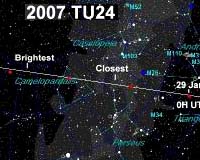
Paris (AFP) Jan 23, 2008 A huge asteroid will zoom past Earth next week at such a close distance that amateur astronomers should be able to spot it, specialists said on Wednesday. Measuring between 150 and 600 metres (yards) across, asteroid 2007 TU24 would inflict devastating regional damage were it to hit Earth, but there is no risk of any collision, they said. It will fly by on Tuesday, being around 534,000 kilometres (334,000 miles) from the Earth at its closest point at 0834 GMT, according to a Near Earth Object (NEO) database compiled by the University of Pisa in Italy. "For a brief time the asteroid will be observable in dark and clear skies with amateur telescopes of three inches (7.5 centimetres) or larger," NASA said on its NEO site (http://neo.jpl.nasa.gov/news/news157.html). 2007 TU24 will make the closest approach of any known potentially hazardous asteroid of this size or larger until 2027, NASA said, adding that objects of this size come close to Earth about every five years or so on average. The rock was discovered only last October under a surveillance programme run by the University of Arizona. According to the Minor Planet Center of the Paris-based International Astronomical Union (IAU), the closest detected approach by an asteroid was on March 31, 2004 by 2004 FU162, which came within 6,500 kms (4,000 miles) of Earth. The day after 2007 TU24's terrestrial flyby, asteroid 2007 WD5 is expected to come within 26,000 kms (16,250 miles) of Mars, a distance that is less than a whisker in space terms. 2007 WD5 ignited a brief surge of excitement among astronomers after it was discovered in November. Initial computations of its orbit gave a roughly 1-in-25 chance that it might whack into Mars on January 30, providing a celestial show that could be monitored by US and European scoutcraft there. Measuring about 50 metres (165 feet) across, it would have delivered an impact equivalent to a three-megatonne nuclear weapon. A rock of this size exploded over Tunguska, Siberia, in 1908, felling around 80 million trees over 2,200 square kms (850 square miles). But further calculation showed that the hoped-for big splat would be a big miss. "It's highly unlikely that it's going to hit," said NEO expert Benny Peiser of Liverpool John Moores University in northwestern England, as the odds of a collision by 2007 WD5 fell to around 0.01 percent, or one in 10,000. Community Email This Article Comment On This Article Related Links Asteroid and Comet Impact Danger To Earth - News and Science
 Small Rocks Make Big Impacts
 Albuquerque NM (SPX) Jan 07, 2008
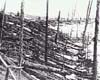
The stunning amount of forest devastation at Tunguska a century ago in Siberia may have been caused by an asteroid only a fraction as large as previously published estimates, Sandia National Laboratories supercomputer simulations suggest. "The asteroid that caused the extensive damage was much smaller than we had thought," says Sandia principal investigator Mark Boslough of the impact that occurred June 30, 1908. |
|
|

| The content herein, unless otherwise known to be public domain, are Copyright 1995-2007 - SpaceDaily.AFP and UPI Wire Stories are copyright Agence France-Presse and United Press International. ESA Portal Reports are copyright European Space Agency. All NASA sourced material is public domain. Additional copyrights may apply in whole or part to other bona fide parties. Advertising does not imply endorsement,agreement or approval of any opinions, statements or information provided by SpaceDaily on any Web page published or hosted by SpaceDaily. Privacy Statement |