. Military Space News .
SPACE MEDICINE
Astronauts' brains 'tricked' for training

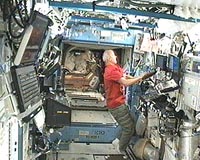
disclaimer: image is for illustration purposes only
by Staff Writers
Houston (UPI) Aug 24, 2010
U.S. scientists say they can trick the brains of astronauts to simulate the dizzying effects experienced when returning to Earth after a long period in space.

A research group at the National Space Biomedical Research Institute has developed a Galvanic vestibular stimulation system that safely induces the sensory and mobility disturbances commonly experienced by astronauts returning to Earth's gravity, an institute release said Tuesday.

These disturbances could affect an astronaut's vision and neurological function, impacting the ability to land a spacecraft. Once on the ground, astronauts often have trouble keeping their balance and walking, researchers said.

The system developed by Steven Moore, an associate professor of neurology at Mount Sinai School of Medicine in New York, uses electrodes placed behind the ear to deliver small amounts of electricity to the vestibular nerve, which then sends the signals to the brain, resulting in sensory and motor disturbances.

This makes it an excellent operational training tool, scientists say.

"You can train for spaceflight tasks under normal conditions on Earth, but that will not give you an indication of what an astronaut will feel like," Moore said. "The GVS system will make mission simulations more realistic. This will be quite useful for astronaut training, especially for astronauts that have not flown before."


Share This Article With Planet Earth
del.icio.usdel.icio.us DiggDigg RedditReddit
YahooMyWebYahooMyWeb GoogleGoogle FacebookFacebook


Related Links
Space Medicine Technology and Systems


Memory Foam Mattress Review
Newsletters :: SpaceDaily :: SpaceWar :: TerraDaily :: Energy Daily
XML Feeds :: Space News :: Earth News :: War News :: Solar Energy News


SPACE MEDICINE
TopCoder Community Refines Medical Kits For Future NASA Space Missions
Glastonbury CT (SPX) Jul 28, 2010
TopCoder has announced the success of a pilot competition that tasked its global community of software programmers with helping to develop the next generation of capabilities NASA will need for its crews to live and work in space. Conducted by Harvard Business School and London Business School/MLab, the NASA-TopCoder Challenge asked TopCoder members to create improved mathematical algorith ... read more


SPACE MEDICINE
Moscow, Central Economic Region Air Defense To Receive S-400, S-500 Systems

End-to-End Ballistic Missile Defense System Simulation Completed

Exoatmospheric Kill Vehicle Plays Key Role In Latest Missile Defense Test

US plans missile interceptor sale to Kuwait

SPACE MEDICINE
Iran test fires surface-to-surface missile

Russia has deployed S-300 missiles in South Ossetia: Tbilisi

India to test advanced Agni II missile

Iran test fires surface-to-surface missile

SPACE MEDICINE
Iran's Ahmadinejad unveils bomber drone

US drone strike kills 12 people in Pakistan: officials

US drone strike kills 13 in Pakistan

India gets reassurance over Predator sale

SPACE MEDICINE
First Battery Engagement Operations Center For Integrated Air And Missile Defense Battle Command System

Boeing to build Air Force satellite

USAF Launches First AEHF Satellite

Persistent Wireless Broadband Communications Network For The Battlefield

SPACE MEDICINE
US Army Acquires First Next Gen Cargo Vehicles From Oshkosh

Army Crafts Tailorable Tactical Wheeled Vehicle Acquisition Strategy

LM Delivers First Two Upgraded LAV Command And Control Platforms

Patria Wins The Swedish Armoured Wheeled Vehicle Contract

SPACE MEDICINE
German military may drop draft

Canadian firm builds for U.S. tank program

German minister plans to cut army, end conscription

Ukraine to upgrade Egyptian T-62 tanks

SPACE MEDICINE
Russia extends military presence in Armenia

China lashes out at Pentagon military report

China military gaining on Taiwan, aiming beyond: US

China lashes out at Pentagon military report

SPACE MEDICINE
New System Developed To Test And Evaluate High-Energy Laser Weapons

Truck-borne laser weapon to be on way soon

Maritime Laser Demonstration System Proves Key Capabilities For Shipboard Operations

Phalanx Sensors Used In Laser Shoot Down Of Airborne Targets


The content herein, unless otherwise known to be public domain, are Copyright 1995-2010 - SpaceDaily. AFP and UPI Wire Stories are copyright Agence France-Presse and United Press International. ESA Portal Reports are copyright European Space Agency. All NASA sourced material is public domain. Additional copyrights may apply in whole or part to other bona fide parties. Advertising does not imply endorsement,agreement or approval of any opinions, statements or information provided by SpaceDaily on any Web page published or hosted by SpaceDaily. Privacy Statement