|
 |
 |
 |
 |
 |
 |
 |
 |
 |

| . |  |
. |
Astronomers Announce Discovery Of Two New Moons Of Pluto
Boulder CO (SPX) Nov 02, 2005 A team of astronomers at Southwest Research Institute (SwRI) and other institutions has discovered that Pluto has two previously unseen moons. Ground-based observers discovered Pluto's only previously known moon, Charon, in 1978. The planet itself was discovered in 1930 and orbits about 4 billion miles from the Sun in the heart of the Kuiper Belt. By virtue of its location in the Kuiper Belt, planet Pluto is also considered a Kuiper Belt object. The newfound satellites make Pluto a "quadruple" system. In observations designed to support NASA's upcoming New Horizons mission to Pluto and the Kuiper Belt, the Hubble Space Telescope (HST), managed by the Space Telescope Science Institute (STScI) in Boulder, first searched for and detected the two new moons on May 15, 2005. On May 18, Hubble looked at Pluto again as a part of its Pluto satellite search program. The two objects seen on May 15 were still there and appeared to be orbiting the planet. These satellites are roughly 5,000 times fainter than Pluto, explaining why they had not been seen previously. The new moons, provisionally designated S/2005 P1 and S/2005 P2, were observed to be in the region between 44,000 kilometers and 53,000 km from Pluto. The objects are roughly two to three times as far from Pluto as its large moon Charon. Determining the sizes of the suspected new moons depends on the amount of light that reflects off their surfaces, which isn't yet known. The candidate moons likely have diameters between about 20 miles (32 km) and 45 miles (70 km). By comparison, Charon's diameter is about 1,200 km. "If, as our new Hubble images indicate, Pluto has not one, but two or three satellites, it will become the first body in the Kuiper Belt known to have more than one satellite," says Dr. Hal Weaver of the Johns Hopkins University Applied Physics Laboratory (APL) in Laurel, Md., co-leader of the discovery team. "Our result also suggests that other bodies in the Kuiper Belt may have more than one satellite. We planetary scientists will have to take these new moons into account when modeling the formation of the Pluto system," says co-leader Dr. Alan Stern, executive director of the SwRI Space Science and Engineering Division. Other members of the discovery team include Drs. Andrew Steffl, William Merline, John Spencer, Leslie Young and Eliot Young, all of SwRI; as well as Dr. Max Mutchler of the STScI and Dr. Mark Buie of the Lowell Observatory in Flagstaff, Ariz. That the Pluto system contains not just Charon, which is half of Pluto's size, but also two small satellites orbiting close to the planet suggests that the origin of the Pluto system was probably not as simple as previously suspected. The new moons could indicate that the giant impact believed to have formed Charon also produced other moons in orbit around Pluto. Alternatively, Pluto's two new, small candidate satellites may have been captured from orbits in the Kuiper Belt or could have resulted from large impacts that ejected material from Pluto before the Charon-forming event. Are there still other satellites of Pluto to be discovered? The team looked long and hard for other potential moons around Pluto. "These Hubble images represent the most sensitive search yet for objects around Pluto," says team member Steffl, "and it is unlikely that there are any other moons larger than about 10 miles (16 km) across in the Pluto system." This HST program was carried out in support of NASA's New Horizons mission to Pluto and the Kuiper Belt, the first mission in NASA's New Frontiers program. Pending final approval, the spacecraft will launch from Kennedy Space Center in January 2006. Stern leads the New Horizons science and mission teams; APL manages the mission and will operate the spacecraft for the NASA Science Mission Directorate. Related Links SpaceDaily Search SpaceDaily Subscribe To SpaceDaily Express  Hubble Spots Possible New Moons Around Pluto
 Laurel MD (SPX) Nov 01, 2005
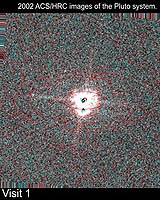
The Hubble Space Telescope images above, taken by the Advanced Camera for Surveys, reveal Pluto, its large moon Charon, and the planet's two new candidate satellites. |
|
|

| The content herein, unless otherwise known to be public domain, are Copyright 1995-2006 - SpaceDaily.AFP and UPI Wire Stories are copyright Agence France-Presse and United Press International. ESA PortalReports are copyright European Space Agency. All NASA sourced material is public domain. Additionalcopyrights may apply in whole or part to other bona fide parties. Advertising does not imply endorsement,agreement or approval of any opinions, statements or information provided by SpaceDaily on any Web page published or hosted by SpaceDaily. Privacy Statement |